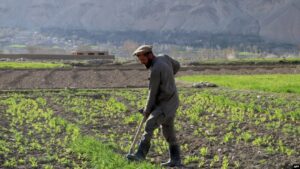
A number of farmers in Khost Province say that in recent years, they have obtained the seeds and saplings they need from other provinces. However, some of these seeds and saplings have not produced the desired results in their fields because of differences in weather and environmental conditions.
Abdul Raouf, a farmer from Gurbaz district of Khost, told Salam Watandar that the Department of Agriculture, Irrigation and Livestock should research seeds and saplings that are adaptable to the soil, climate, and environmental conditions of Khost so that farmers can get higher yields.
He says he has also tested several new seeds and agricultural varieties, including green tea, oranges, tomatoes, and several other plants, but has not yet achieved the desired results.
“Our request is that they bring in plants that have not been tested in Khost before, or even plants that have not been tested anywhere in Afghanistan. The weather conditions in many provinces of Afghanistan are similar, and many plants may also produce good results here. People should be given the opportunity to test these agricultural materials and then make them available to farmers,” he adds.
Jannat Gul, another farmer from Khost, says most farmers in the area still use traditional seeds and saplings. He says these products do not produce enough crops compared with the cost of production.
He adds that because of economic problems, farmers cannot afford to buy and transport new seeds and saplings from other areas. According to him, improved seeds produce higher yields and are of better quality than traditional seeds.
He says that several years ago, he bought improved wheat seeds with his own money and planted them on five jeribs of land. The harvest was almost twice as much as in previous years.
“If good-quality seeds and saplings are provided to us—seeds and saplings that are adaptable to the climate and conditions of Khost and have been grown here—they will be very useful for us. They can produce much higher yields than other crops, wheat or other ordinary seeds,” he adds.
Kamal, another farmer, says that sometimes the crops which farmers obtain seeds for from other areas without testing them dry up and are lost. According to him, this happens because some seeds are not adaptable to the soil, water, and climate of Khost.
“People plant wheat or another tree or plant, but it dries up because it needs medicine and other care. The climate of Khost is different from that of many other provinces. In some areas, the weather is colder, while it is warmer here, and this difference can have a negative effect on plants,” he adds.
Agricultural experts also consider establishing research farms important for standardizing agriculture, increasing yields, and supporting farmers.
Saifullah Mangal, head of the Horticulture Department at the Faculty of Agriculture of Sheikh Zayed University in Khost, says that different types of saplings and seeds are grown and tested at research farms so that the best agricultural materials can be provided to farmers.
He adds that if farmers plant saplings or seeds in their fields that have not been properly researched and tested before, weather conditions, soil conditions, or seasonal diseases may have a negative effect on them, which may result in financial losses for farmers.
“In general, if research farms or companies that produce seeds and saplings exist, all of these can help improve the situation of farmers. These centers can play an important role in improving the lives of people, especially farmers, and in producing higher-quality crops and greater yields,” he says.
Meanwhile, officials of the Khost Department of Agriculture, Irrigation and Livestock say they have established three research farms for the first time, aiming to standardize agriculture, support farmers, and increase yields.
According to them, different types of fruit saplings, wheat, legumes, and vegetables are being tested at these farms. Varieties that show positive results will be made available to farmers for cultivation and promotion after the research is completed.
Sher Mohammad Zabih, head of the Khost Department of Agriculture, Irrigation and Livestock, says every seed and sapling tested at the research farms is evaluated from different aspects, including its characteristics, resistance to diseases caused by climate change and seasonal diseases, and its adaptability to the weather conditions of the region.
“Every seed and sapling that is provided to farmers should be researched and tested. Its diseases should be assessed, and it should be determined whether it is adapted to the climate and weather conditions of the region. All these things are examined, and after that, the seeds or saplings are provided to farmers for use,” he says.
Climate change has made agriculture more dependent than before on choosing the right seeds, saplings, and farming methods that are adaptable to local conditions. The experience of farmers in Khost shows that using untested seeds and saplings that are not adapted to local weather conditions can increase the risk of lower yields and economic losses.
Establishing research farms can be a step toward helping agriculture adapt to climate change. However, continued research, testing varieties that are resistant to drought, heat, and diseases, and ensuring that farmers have easy and affordable access to adaptable seeds and saplings are important for turning these efforts into a sustainable solution.
Reporter: Khalid Zaheen