
Salam Watandar’s interviews with 14 women whose children have a hole in the heart (Atrial Septal Defect) show that limited access to healthcare centers during pregnancy and childbirth, along with a lack of awareness about the disease, has delayed the diagnosis and treatment of their children.
Of the 14 women interviewed across nine provinces, seven said they had no access to healthcare centers during pregnancy and childbirth, while five reported limited access. Two women said they had not visited healthcare centers because they were unaware of the importance of seeking medical care. Four women said they had taken medication without medical advice during pregnancy.
Bibi Amri, a resident of Panjshir whose daughter has a hole in the heart, says her daughter’s disease was diagnosed late because she had no access to healthcare centers.
“My daughter has a hole in her heart. I had no access to healthcare centers during pregnancy. All my children were born at home. My daughter had been ill for several years. We took her to the French Medical Institute for Mothers and Children (FMIC), where doctors told us she had a hole in her heart,” she adds.
Zeb-un-Nissa, who lost two of her children due to a hole in the heart and whose three-year-old child also has the disease, says:
“Two of my daughters died because of a hole in the heart. My three-year-old daughter has a 10-millimeter hole in her heart. She seemed to be doing well, and I thought she had recovered. But one day, she fainted. We took her to the doctor, who told us that the hole in her heart had grown to 23 millimeters.”
Ten of the women interviewed for this report said their infants showed no signs of a hole in the heart during the first few days after birth.
Marziya, a resident of Maidan Wardak, says she found out that her baby had a hole in the heart when the baby was three months old.
“My baby developed pneumonia, so we took the baby to a health center. The doctors told us the baby had a hole in the heart. Before that, I didn’t know. The only thing I had noticed was that my baby’s eyes didn’t close completely during sleep,” she says.
Fahima, a resident of Parwan, says she found out that her child had a hole in the heart two years ago.
“One day, I placed my hand on my child’s chest and noticed that the heartbeat was fast. My child is 11 years old, and we found out two years ago that the child had a hole in the heart. I then registered my child with the Red Crescent for treatment,” she adds.
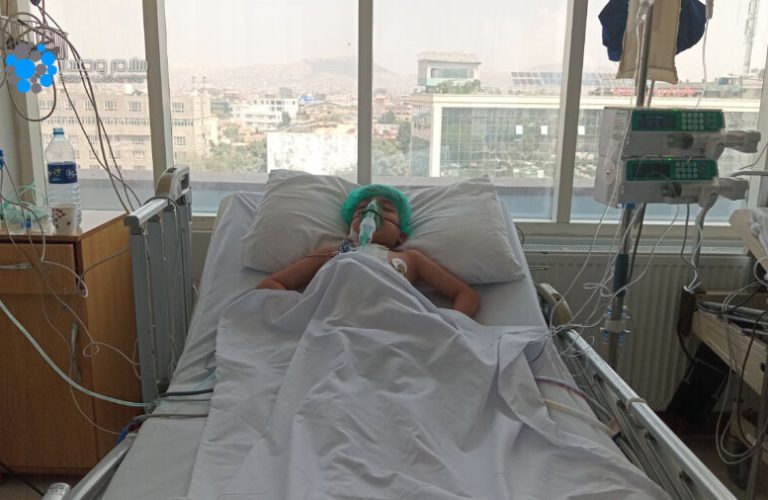
A hole in the heart is a disease present at birth (congenital) in which the wall separating the chambers of the heart does not form completely, leaving an opening. Symptoms vary from child to child, and some infants show no clear signs of a hole in the heart during the first few days of life.
A number of doctors say that maternal infections and uncontrolled illnesses during pregnancy, taking medication without medical advice, diabetes, being overweight, and genetic factors may contribute to a hole in the heart in children. Mohammad Saber Safi, a cardiologist in Kabul, says:
“Some uncontrolled maternal illnesses, infections, taking medication without medical advice, and high blood pressure can contribute to congenital problems in infants. However, in some cases, no risk factors are identified in the mother, yet the baby is still born with a hole in the heart.”
Kamin Safi, another specialist in pediatric internal medicine, says: “Environmental factors may also play a role. Exposure to gunpowder in the living environment and a poor diet may contribute to congenital defects in infants.”
The Afghan Red Crescent Society (ARCS) says the number of children with a hole in the heart has increased significantly in recent years. Abdul Qadeem Abrar, a spokesperson for the ARCS, says the number of children with a hole in the heart increased by nearly 3,000 in 1404 compared with 1403.
“In the 1403 solar year, 3,500 children with a hole in the heart were registered with our organization. In 1404, nearly 7,000 children were registered. Some families may not be able to afford treatment and register their children with the Red Crescent to receive treatment, so the actual number could be higher,” he says.
According to figures provided by the Afghan Red Crescent Society, 35,000 children with a hole in the heart are registered with the organization, and about 2,000 children with the disease receive treatment each year.
Meanwhile, the Ministry of Public Health of the Islamic Emirate says the ministry is continuing its efforts to expand treatment services for children with a hole in the heart. Sharafat Zaman Amarkhil, a spokesperson for the ministry, says:
“The Ministry of Public Health is working to provide standard medical services to children with a hole in the heart. For the first time, a pediatric heart surgery unit has been opened at Indira Gandhi Children’s Hospital (Sehat-e Tefl Hospital).”
Lack of access to healthcare centers is considered a major challenge in diagnosing and treating children with a hole in the heart. Earlier this year, the World Health Organization (WHO) announced that, following a reduction in international aid, at least 422 primary healthcare centers and mobile health teams had ceased operations in 2025, affecting access to healthcare services for about 3.3 million people.
Reporter: Nilofar Mohammadi