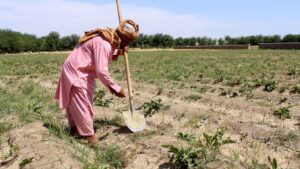
In the mountainous areas of Daikundi, Afghanistan, almond blossoms are being damaged by sudden spring frosts, while consecutive droughts are reducing harvests. For families who depend on almonds for their livelihoods, this is more than the loss of a crop. It means smaller meals and growing financial pressure, forcing some families to sell their remaining livestock, borrow money to buy food from local shops, and cut back on meals.
As international organizations such as the Food and Agriculture Organization (FAO) and the World Food Programme (WFP) state that rural communities in Afghanistan will face an acute food crisis, the stories of Daikundi’s orchard owners offer a reminder ahead of the global climate conference: for families whose year-long work can be destroyed by frost within hours, climate adaptation is not simply a term used at international meetings. It is a daily struggle to protect their crops and put food on the table for their children’s survival.
In Afghanistan’s central highlands, almond trees have for decades been more than an agricultural crop. They have been a major source of income and an important source of food for thousands of families in Daikundi. But farmers now face a combination of drought, water shortages, spring frosts, pests and plant diseases. These problems have reduced orchard yields and increased economic pressure on families that depend on almond crops.
In Ramkak village in central Daikundi, Khaliq Nazar says his orchard used to produce 30 to 40 seers of almonds a year, but several of his trees have now dried up. The remaining crop has also been damaged by spring frost.
“After the consecutive droughts, the almonds were badly affected. We cut down some of the almond trees and used them as firewood, while some are partly dry and partly alive. This year the trees blossomed, but when the cold came, the blossoms and fruit on the branches were damaged. We used to cover all our living expenses from these crops. Now that there has been no harvest, we have sold our livestock, including cows, to cover our expenses, and nothing is left for us. Poverty has weakened people’s economic situation, and I know many families that have cut one of their three daily meals. We have faced problems buying clothes and medicine and getting medical treatment, and we buy everything from the Nili market on credit. Now that the almonds have been hit by frost this year, we do not know how we will repay our debts,” he adds.
Khaliq’s experience shows that the damage to an orchard goes beyond a lower almond harvest. When harvests decline, families sell their assets to compensate for lost income, borrow money and eventually reduce the amount of food they eat.
Ghulam, another orchard owner from Ramkak, also speaks of declining harvests and plant pests. He says,
“This year, our orchards have produced only half the almond crop, and we may get about 20 seers, while in previous years we harvested 30 to 40 seers. When the trees were flowering, they were attacked by pests, which damaged the blossoms. We could not spray the trees at the right time. We are living on very little food, and we farmers are just surviving. We cannot afford to buy meat. We buy a small amount of chicken once every 10 to 15 days. Even the 10 to 20 seers of almonds we produce are not enough to pay for a year’s supply of cooking oil. But we have to continue. This is the nature of orchard farming, and if we give it up, all the trees will dry up.”
Anwar, a 54-year-old from Zowjok village in Shahristan district, is facing a similar situation. He says the yield from his orchard has fallen from about 40 seers to less than 10. He adds,
“The almonds have been affected by disease. There is a lot of dust on the trees. At the beginning of spring, there was a frost that damaged almost half of the trees. Now our entire village is buying on credit from the market because of the almond trees. When the trees do not produce, there is poverty and hunger. Our table has changed. We either eat bread and tea or skip one meal to get by. We may or may not be able to afford meat once a month. In the past, people went to Iran and Pakistan or worked in coal mines in Dara-e-Suf, Samangan. All those opportunities have disappeared. We feel hopeless. What will we do about our debts, and where will we get food every day? This winter, I hope the children do not die of hunger.”
Nayeb Ali, a 35-year-old from Chahar Aspan village in Shahristan district, says the yield from his orchard has also fallen, from about 70 seers to 30 or 40.
“There is a lack of water and a spread of disease. At the beginning of the year, insects attack the trees, and the almond shells dry out and cannot be processed easily. Trees that were 15 to 20 years old have died because of drought. Almonds are the main source of income for people in Daikundi. If there are no almonds, families’ tables will suffer, and people will not be able to cover their winter expenses. These trees are the hope of orchard owners. Despite all these frosts, we do everything we can to keep the trees from drying out and continue to care for them,” he says.
However, experts say some of the damage is linked to the sensitivity of almond trees during the flowering period. Yasin Kawsar, a university lecturer and agricultural and horticultural expert, says changes in temperature patterns can alter the flowering time of trees. When the weather becomes warm and is followed by a sudden drop in temperature, the cold can harm almond blossoms. He explains,
“Almond trees are among the plants that begin flowering very early in spring, much earlier than other trees. At least 15 years ago, the seasons were more predictable and clearly separated. Winter was cold, and the weather gradually became warmer as spring approached. But in recent years, temperatures have risen unusually quickly in late winter or early spring. The trees sense the warmer weather and begin to blossom. Then sudden changes occur: the weather becomes very cold and may even bring snow. Almond blossoms are very sensitive to low temperatures and can be completely damaged in a single night when temperatures fall below zero. In addition, cloudy weather and rain during the pollination period can prevent proper pollination and greatly reduce fruiting.”
On the other hand, Aqaye Agah, an environmental and climate change expert, says traditional methods used in many orchards, limited knowledge of orchard management, and a lack of preparation for new weather conditions are intensifying the damage.
“Climate change has caused serious losses because we are not prepared and our orchards are not properly managed. Based on the information I have, perhaps only 20 percent of our people are professional orchard growers. The rest own land and continue to farm using traditional methods. Factors such as having enough pollinating trees, choosing the right location and direction for an orchard based on sunlight and shade, and selecting areas where trees flower after transplanting can affect yields by 80 to 90 percent. Untimely rain that coincides with the flowering of almond trees has made the situation difficult to control and shows that we need to change traditional farming methods,” he adds.
The problems facing Daikundi’s orchard owners are part of Afghanistan’s wider climate and livelihood crisis. The International Organization for Migration (IOM), in its «nationwide Afghanistan Climate Vulnerability Assessment», says the country is facing worsening drought, floods and extreme weather events. These hazards have affected people’s livelihoods, property and movement. The assessment covers communities across all 34 provinces and examines their exposure level, their vulnerability and their ability to adapt.
The Food and Agriculture Organization of the United Nations (FAO) has also said that drought and dry conditions in 2025 affected rain-fed wheat production in parts of Afghanistan. Daikundi was among the provinces where agricultural production was affected by dry conditions. FAO has linked rising food insecurity to a combination of economic factors, fewer livelihood opportunities and the effects of dry conditions.
According to the latest Integrated Food Security Phase Classification (IPC) analysis for Afghanistan, about 13.8 million people were facing Phase 3 or higher levels of food insecurity in September and October 2025. The number was forecast to rise to about 17.4 million between November 2025 and March 2026. The organization identified continued drought, economic problems and declining humanitarian assistance as factors worsening the situation.
Meanwhile, the World Food Programme (WFP) says Afghanistan continues to face one of the world’s most serious hunger crises in 2026, with about 17.4 million people facing severe food insecurity. The organization identifies recurring droughts and unstable weather conditions, along with the economic crisis and other factors, as major threats to livelihoods and food security.
Therefore, when an orchard owner in Daikundi says his family has gone from eating three meals a day to one or two, his story should be seen as part of the bigger picture: a climate shock can become a humanitarian crisis when a family no longer has the economic capacity to cope with its losses.
These measures could help reduce climate-related damage in the short term. They include using late-flowering almond varieties after testing and confirming that they are adaptable to Daikundi’s climate, improving water management, expanding grafted orchards, training orchard owners, controlling pests and diseases, and establishing rapid information systems to provide timely on cold weather and other weather conditions.
Yet the suffering of Daikundi’s orchard owners raises a basic question for the world: when climate change takes away a rural family’s food, who pays the cost?
For farmers in Ramkak and Shahristan, “climate adaptation” discussed at international conferences means having a little more water, planting late-flowering almond varieties, having access to pesticides to control pests, and receiving a simple warning on the radio before frost destroys a year’s work.
As the global climate conference, COP31, approaches in Antalya, the United Nations is once again calling for food security and funding for climate adaptation. But these commitments will only have real value if they help bridge the gap between international conference halls and the empty pots and plates of families living in the mountains of Daikundi.
Meanwhile, the cracked hands of orchard owners continue to wait for support from agricultural institutions, while efforts to obtain information about the plans and responses of local officials and the Ministry of Agriculture, Irrigation and Livestock had been unsuccessful by the time this report was published.
If the world is to speak of saving the Earth, that effort must begin, above all, by bringing abundance back to the empty tables of orchard owners in Daikundi.
Reporter: Nasir Keshawarz
A report from the “Maseer Sabz” program
References:
- UNFCCC (United Nations Framework Convention on Climate Change) – Reports and technical papers on Climate Action, Agriculture, and Food Security (Sharm el-Sheikh Joint Work / COP Global Climate Agenda).
- IPC (Integrated Food Security Phase Classification) – Afghanistan: Acute Food Insecurity Analysis and Climate Shock Vulnerability Updates.
- FAO (Food and Agriculture Organization of the United Nations) – Afghanistan Agriculture Drought and Climate Adaptation Assessments & Early Warning Monitoring.
- FEWS NET (Famine Early Warning Systems Network) – Afghanistan Food Security Outlook: Impacts of irregular precipitation, early spring temperature spikes, and household food deficits.
- WFP (World Food Programme) – Afghanistan Country Briefs: Household coping strategies, market debt trends, and rural livelihoods assessment.