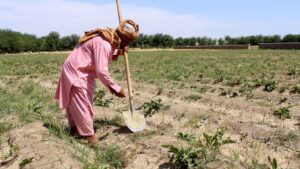
Water shortages caused by drought and climate change have affected agriculture and livestock farming in several districts of Ghazni in recent years. A number of farmers and orchard owners in Ghazni city and the districts of Khwaja Omari, Malistan, Deh Yak, Qarabagh and Jaghatu say groundwater levels have fallen significantly in recent years, although the extent of the decline varies from area to area.
Shah Wali, a farmer in the Shinda area of Malistan district, says groundwater levels in some parts of the district have dropped by 20 to 30 meters.
“Unfortunately, the water level in the wells has dropped by 20 to 30 meters. Last year, we had to deepen the well we used by about eight meters. Agricultural yields have fallen by 50 percent. This has also negatively affected orchards and livestock farming, and some of our farmland has been left uncultivated,” he says.
A number of farmers say they have been forced to deepen their wells to regain access to water. This has increased production costs, which many rural families cannot afford.
Hekmatullah, a farmer in Qarabagh district, says the decline in water levels has limited the ability of district residents to continue farming and raising livestock.
“Because we need more water, we have to dig our wells deeper, which costs us more, and most farmers cannot afford it. The water shortage has caused us to leave some of the land we used to fully cultivate uncultivated,” he adds.
Hamidullah, another farmer in Khwaja Omari district, also says: “Over the past two or three years, groundwater levels in Khwaja Omari have fallen. People have tried to deepen their wells, but it has not helped. People face this problem mostly in summer. In some areas, farmland remains dry because of the water shortage.”
The farmers’ main demands include building water-storage and water-management infrastructure, promoting crops that require less water, and providing access to drought-resistant seeds.
Najib-ur-Rahman, a farmer from the Sarab area of Jaghatu district, says: “Our request to the government is to pay more attention to this issue by building dams and check dams, establishing modern drip-irrigation systems, and distributing improved seeds and agricultural medicines to farmers.”
Agricultural experts in Ghazni consider climate change and the excessive use of water resources to be the main factors behind the decline in groundwater levels. They warn that if the trend continues, it could seriously affect agriculture, livestock farming and the livelihoods of rural families in the coming years. Saleh Mohammad Ghaznawi, an agricultural expert, says,
“Excessive use of water through water pumps and rising temperatures cause water to evaporate, which plays a major role in climate change. Snow melts early; it either flows like a flood or evaporates. If the situation continues this way, deep wells, kariz systems and springs will dry up, and most people will not have the ability to pump water from such depths.”
Meanwhile, officials from the Ghazni Sub-Basin Directorate of Standing Water have confirmed a significant decline in groundwater levels in several districts of the province. They say that in some areas, water levels have fallen from around 10 to 12 meters to 30 to 32 meters. Mohammad Nazir Sahhar, a technical adviser at the Directorate, says,
“We have data showing that groundwater levels in the provincial capital and some districts of Ghazni are falling every day. In areas where the water level used to be 10 to 12 meters, it has now fallen to 30 to 32 meters. In areas where the water level was two or three meters, it has fallen to 15 or 16 meters. The water level continues to decline day by day. If water continues to be used this way, our farmers will suffer serious losses in the near future.”
He adds that the directorate has restricted unauthorized well drilling under specific regulations to prevent excessive extraction of groundwater. He says check dams have also been built in several districts to help recharge groundwater, while surveys have been conducted for the construction of several large dams.
“We have banned unauthorized drilling, and we have regulations specifying where wells can and cannot be drilled. We have also implemented projects to recharge groundwater. Check dams have been built in different districts, and more are under construction. We have also surveyed several large dams and shared it with the central authorities,” he adds.
However, officials from the Ghazni Department of Agriculture, Irrigation and Livestock say water shortages and drought have affected agricultural production. Mohammad Zakaria Hotak, Head of the Press at the Ghazni Department of Agriculture, says,
“Unfortunately, we have received reports that areas relying on kariz water and other water sources have been affected. However, fortunately, 35 check dams have been built in seven districts. Irrigation canals have also been built in some districts, and people have turned to drip-irrigation systems. The problem is more serious in rain-fed areas, where some fruits, grains and vegetables that were previously cultivated have been affected.”
Ghazni is one of Afghanistan’s agricultural provinces, and a large portion of the population in the provincial capital and its districts relies on agriculture and livestock farming for their livelihoods. In these circumstances, the continued decline in groundwater resources is not only an environmental problem. It can directly affect agricultural production, household incomes and food security and, if the trend continues, may affect the ability of people to remain in rural areas.
Reporter: Turyalai Tabesh