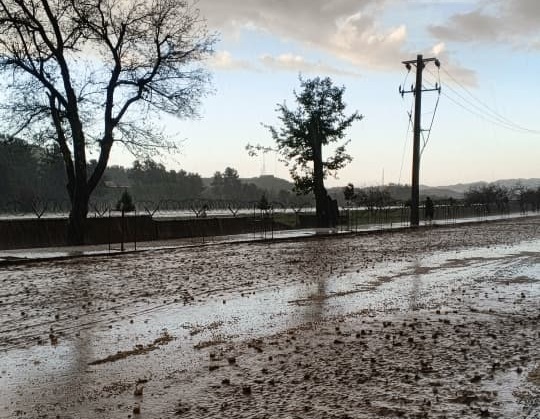
Recent floods and heavy rainfall in Badghis have caused extensive damage to farmland, orchards, and people’s property. A number of farmers say these events have not only destroyed the results of a year’s hard work but have also left the livelihoods and primary sources of income of many families in crisis.
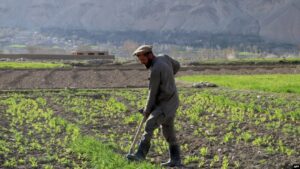
Abdullah, a 30-year-old farmer from Ab Kamari district in Badghis, says the recent floods severely damaged his pistachio and fruit orchards, as well as his farmland.
He explains that he had cultivated around four jeribs of land with wheat and barley and owned nearly two jeribs of pistachio and fruit orchards. However, three jeribs of his wheat and barley fields and almost his entire pistachio orchard were damaged by heavy rain, hail, and flooding.
According to him, in a normal year, each jerib of land yields around 40 to 50 seers of wheat, while a significant portion of his family’s income comes from the sale of pistachios and apples.
“This year’s floods have had a negative impact on our agricultural land. The pistachio and fruit orchards suffered the most damage. We had cultivated four jeribs of wheat, but the rain and hail destroyed almost everything. These losses have severely affected our lives, and we are now facing many difficulties,” he says.
According to Abdullah, based on the expected wheat harvest and the income from his pistachio and fruit orchards, the total damage to his property reaches around 70,000 to 90,000 Afghanis.
He also says that the damaged land can no longer be cultivated this year, and they will have to wait until next year. He adds that the assistance he received from some organizations was limited and insufficient, and that people are calling on the government and aid organizations to pay greater attention to them.
“The assistance we received was very limited and not satisfactory. We want governmental institutions and organizations to pay greater attention to us and provide more aid,” he adds.
Abdul, a 32-year-old farmer from Muqur district, also reports widespread destruction of agricultural land. He says that most rainfed farmland in the district is used for growing wheat and barley, while chickpeas and cumin also yield good harvests in years with sufficient rainfall. However, the recent floods have destroyed nearly all crops. According to him, six hectares of his land, planted with wheat and barley, have been damaged.
“Six hectares of our land in Muqur district have been destroyed, and all of our crops have been lost. Our land is cultivated only once a year, and we are now waiting for assistance from aid organizations, but so far we have not received any help,” he says.
According to him, in high-yield years he would earn around 150,000 to 200,000 Afghanis from his farmland. This year, however, he is likely to recover only the cost of the seeds he planted, with losses at around 90,000 to 110,000 Afghanis.
Mohammad Mirwais, a 29-year-old farmer from Qadis district, also says that the recent floods destroyed more than three jeribs of his farmland. He had planted wheat on one part of the land and barley on the other. According to him, he would usually earn between 20,000 and 30,000 Afghanis annually from these fields, but this year he is unlikely to harvest anything.
“Most of our income comes from farming, and the floods have affected our livelihoods very badly. Many of us are unable to replant our fields and have had to seek alternative options, such as day labor,” he says.
He adds that he has not yet received any assistance and believes that the increase in heavy rainfall and flooding is linked to climate change.
“In my opinion, these heavy rains have become more frequent because of climate change. In the past, rainfall was not this intense or irregular, but now floods occur more often and have a very negative impact on people’s lives.”
Meanwhile, Moazzam Haqmal, Dean of the Faculty of Agriculture at Badghis University, says that intense and unseasonal rainfall is directly linked to climate change. He explains that rising temperatures, declining vegetation cover, and disruptions in the natural seasonal cycle have caused rainfall to become increasingly sudden and intense, creating conditions that lead to destructive flooding.
“In arid and semi-arid regions such as Badghis, climate change has made rainfall more irregular and intense. This reduces the soil’s capacity to absorb water and leads to destructive floods,” he says.
According to him, farmers should adopt climate-resilient methods, including the use of drought-resistant improved seeds, water storage systems, drip irrigation, the preservation of vegetation cover, and the cultivation of crops that can withstand water scarcity.
Sayed Faiq Mehraban, Director of Publications at the Badghis Disaster Management and Preparedness Authority, also says that the recent floods have caused human losses and extensive damage.
“As a result of these events, 14 people have lost their lives and two others have been injured. More than 1,000 houses and shops have been fully or partially destroyed, while over 13,000 jeribs of land have been damaged due to heavy rainfall and hail. Cash assistance has been distributed to the families of the martyrs and the injured, and food and non-food aid has also been provided to hundreds of other families. The process of support and assistance for affected families is ongoing,” he says.
Meanwhile, Abdul Halim Halimzad, Head of Press at the Badghis Department of Agriculture and Livestock, says that wheat and chickpea fields have suffered the greatest damage. He also says that the increase in sudden and intense rainfall is the result of climate change and the decline in vegetation cover.
Confirming the figures provided by the Department of Disaster Management, Halimzad says that the Department of Agriculture has also provided estimated statistics from villages showing that around 22,000 jeribs of agricultural land have been destroyed.
“As a result of the recent floods, extensive damage has occurred. According to estimated statistics received from the districts, approximately 22,000 jeribs of farmland owned by farmers have been damaged. Options to address this include planting trees along flood-prone areas, preventing deforestation, and promoting the cultivation of climate-resilient plants.”
It is worth noting that between March and May, heavy rainfall and hail affected the districts of Muqur, Ab Kamari, Qadis, Sang-e-Atash, Tagab Alam, Bala Murghab, and Qala-e-Naw. As a result, 14 people lost their lives, two others were injured, and significant damage was caused to farmland, shops, and residential homes.
Reporter: Obaida Nikofar