In recent years, climate change and prolonged droughts have had a significant impact on the lives of people in Andkhoy district of Faryab province. Reduced rainfall and declining groundwater levels have caused many wells to dry up, while agricultural lands are no longer producing the yields they once did.
Experts and local officials say that repeated droughts have had a direct impact on declining groundwater levels. They believe that using salty water to irrigate farmland has a negative impact on soil quality and its productivity.
However, people in Andkhoy district complain that water shortages have reduced their harvests.
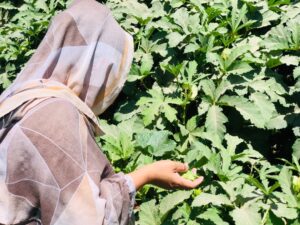
Mohibullah Sadat, who has worked as a farmer for more than 40 years, says that in the past, he was able to meet much of his family’s needs through the harvest from his farmland. However, agriculture now faces serious problems due to water shortages and increasing salinity.
“On one hand, the weather is extremely hot, and on the other hand, the water is salty. It contains sediment and stones. After a week of irrigation, the soil becomes like cement. That is why crops cannot survive. Because Andkhoy is very hot, the land loses its quality, which completely destroys the crops. Due to water shortages, we were forced to quit farming because we have not been able to harvest anything for several years,” he says.
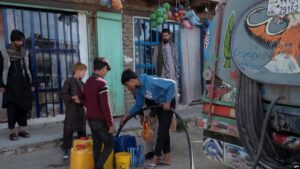
A number of residents of Andkhoy also say that the lack of drinking water has become one of the main problems in their daily lives. Many families are forced to travel long distances to fetch water. Zalmai Azizi, a community elder, says,
“In my view, the main factors behind this situation are reduced rainfall, drought, and, most importantly, the excessive extraction of groundwater through water pumps.”
Experts say there is a direct relationship between consecutive droughts, reduced rainfall, and declining groundwater levels. They warn that using salty water for irrigation damages soil quality and reduces soil fertility.
Abduljalil Noori, an environmental expert, says that if this trend continues, agricultural lands could become less productive or even uncultivable.
“Irrigating farmland with salty water has a major impact on crop quality and reduces agricultural production. The salts in the water accumulate in the soil and prevent plants from absorbing essential nutrients. If this situation continues, the land could become less productive or even uncultivable. Cultivating salt-resistant crops, creating green belts, managing wells, and storing rain and snow water by constructing small channels during winter could be good solutions,” he says.
Asadullah, manager of the Agriculture Extension in Andkhoy district, says that declining rainfall and consecutive droughts have caused a significant drop in groundwater levels.
“Climate change has caused water sources to dry up. There is now almost no surface water left in Andkhoy, and only groundwater remains. However, groundwater levels continue to decline every year. In the past, water could be found at a depth of 15 to 20 meters, but today it can only be found at around 40 meters,” he says.
Meanwhile, Abdul Wali Rashiq, executive director of Andkhoy district, says that many old wells have dried up and that some remaining water sources are salty and unsafe for drinking.
“Many old wells have dried up or their water levels have decreased. In addition, much of the available water is salty and cannot be used for drinking. As a result, people have been forced to use water purification systems, which has created additional costs for families. People have to travel one and a half to two kilometers to fetch drinking water,” he says.
Experts emphasize that better management of groundwater resources, rainwater storage, preventing unnecessary well drilling, and using modern irrigation methods are among the most important measures needed to reduce this crisis.
However, some residents of Andkhoy hope that the completion of the Qosh Tepa Canal project and the benefits from its operation will help ease water shortages, improve irrigation for farmland, and increase access to water for local communities. Many see the project as a new hope for reviving agriculture and improving livelihoods in Northern Afghanistan.
Reporter: Yolduz Masror