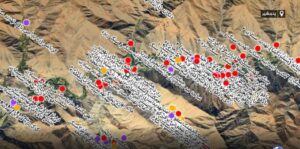
A widespread infestation of the Wheat Sunn Pest (kafshak) has caused serious concern among farmers in wheat fields across Faryab Province. Field reports indicate that this year’s outbreak has increased significantly compared to previous years, severely affecting the districts of Pashtun Kot, Almar, Shirin Tagab, Chehel Gazai, Khwaja Namusi, and Qaisar.
Farmers in Faryab say the insect appears during the most important stage of crop growth (the heading stage) and feeds on soft wheat grains, causing a reduction in yield weight.
Abdul Ghaffar, a farmer in Pashtun Kot district, says, “This year, the Sunn Pest was very widespread. It especially settled on wheat heads and damaged the grains. We sprayed pesticides, but the results were not fully effective. Part of our land produced a lower yield, and we suffered significant losses.”
Mohammad Nabi, another farmer from Shirin Tagab district, points to lack of facilities, “We used some pesticides and sprayed the fields several times, but the Sunn Pest was too much and could not be fully lost. We referred the matter to the Department of Agriculture, and they said technical teams would conduct an assessment, but we urgently need assistance.”

Abdul Hamid, a farmer in Almar district, also highlighted farmers’ weak financial capacity as a major obstacle in combating the pest, calling on the government to distribute free or low-cost pesticides.
“This insect mainly damages wheat heads and grains. We did our best, but it was not enough. We ask the government to provide effective pesticides and technical support so that our harvest is not destroyed,” he adds.
In response to growing criticism, the Faryab Department of Agriculture has announced that technical teams, in coordination with a central delegation from the Ministry of Agriculture, will be dispatched to the affected areas. A source from the department, who requested anonymity, told Salam Watandar that this year, in addition to Wheat Sunn Pest, pests such as locusts, rust and smuts have also been observed in several areas.
“Compared to the previous year, the situation regarding pests and diseases in wheat fields has worsened. Locusts, Sunn Pest, rust, and smut have been observed in parts of the province. The Department of Agriculture, through its Plant Protection and Quarantine Directorate, continues to support farmers by holding scientific and professional seminars, distributing improved seeds, and providing technical services,” he adds.
Meanwhile, Rahmatullah Seddiqi, an agricultural expert, warns, “The Sunn Pest is one of the most destructive wheat pests and directly damages wheat heads and grains. If timely and coordinated control measures are not taken, it can significantly reduce yields. Cooperation among the Ministry of Agriculture, partner agencies, and farmers is essential at this stage.”
Given that wheat is the main source of livelihood for many people in Faryab, the continuation of this situation could worsen poverty and food insecurity in the province.