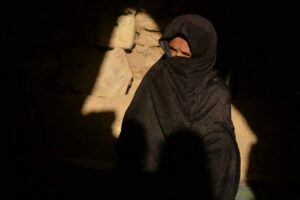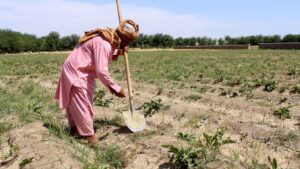
A warm evening wind blows across the dry plains of Ab Kamari district in Badghis. The strong summer sun shines on land that was once covered with golden wheat fields. But now, many of those green fields have turned dry and cracked. In one corner of the plain, 29-year-old Parwana, a farmer, stands wearing a black headscarf and looks at the land that has been part of her life and memories for years.
Her hands show years of farm work—the hands that have been familiar with the soil, seeds and wheat since childhood. Parwana worked on the farm with her father and brothers since childhood. After getting married, she continued to work alongside her husband.
“I have a small farm garden at home. I sell its crops and use the income for my family’s expenses. In the past, we used to harvest about one or two kharwars from each jerib of land. But now, rain-fed farming produces almost nothing. In the past, snow would remain until the first month of the solar year (March-April), but now there is very little rainfall,” she says.
In Badghis, the livelihoods of thousands of rural families depend on seasonal rainfall. Any change in the timing or amount of rainfall directly affects their lives and their sofras (tables). In recent years, winters with little snow and long periods of drought have disrupted the usual seasons and left large areas of land dry.
Parwana experiences the consequences of this situation every day. The days she once spent caring for her children and keeping her home peaceful are now increasingly spent looking for water. Declining rainfall and drying springs have placed an even heavier burden on rural women.
“Since there is less water and the weather has become hotter, I spend a lot of time storing water and thinking about how to use it carefully so that we do not run out. Sometimes we have to travel long distances to find water or spend a lot of money to buy it. This situation takes a lot of time and energy from women like us,” she adds.
In many villages, women are among the first ones to feel the consequences of water shortages and lower crop yields. They have to prepare food with fewer facilities, take care of their children and do their household chores. When the fields produce fewer crops, family sofras become smaller, and concerns become bigger.
She says that rising food prices have also put more pressure on their lives. She is concerned about families that cannot afford many of their basic needs.
“During droughts, crops in the fields decrease and families face a lot of pressure. Food prices increase, and some families cannot afford what they need. Children become more at risk of malnutrition, and this is very worrying,” she adds.
According to her, women and girls are more harmed by the consequences of climate change because they are responsible for many household tasks. Fetching water, cooking, caring for children and managing the family during difficult economic conditions have placed a heavy burden on women. She explains,
“Women and girls are more harmed than others. When water becomes scarce or economic problems increase, household responsibilities also increase. We have to do more work with fewer facilities. In addition to physical pressure, mental stress also increases because we are concerned about the future of our families and children.”
She stays silent for a moment and looks into the distance, where dry land extends up to the hills. Her biggest concern is the health of her children, a concern shared by many rural mothers in Badghis.
“My biggest fear is that my children’s health will be at risk. I am afraid that one day we may not have enough water and food or that our economic problems will become worse. We try to store water and use it properly, but we still face water shortages,” she says.
Despite all these difficulties, she has not lost hope. She believes that educating people about water management, supporting farmers and providing more job opportunities could help reduce some of these problems.
“If people learn how to store water and use it properly, the situation will improve. Also, if farmers and women receive more support and more job opportunities are provided, families will be better able to cope with drought and climate change,” she adds.
The sun slowly disappears behind the dry hills of Ab Kamari. A warm breeze carrying the smell of dry soil passes through a field that was once full of wheat. Parwana sits in a corner of the field. She pours herself a glass of tea and holds a piece of dry bread that she brought from home. Her face shows the years she has spent working on the farm, while her eyes, which once lit up at the sight of green fields, now stare into the distance.
As evening falls, she gathers her belongings and prepares to return home. But she does not take only her belongings with her. She also carries her worries home—the worry that drought and water shortages will make her family’s sofra smaller and make the burden of life even heavier on her shoulders.
Reporter: Obaida Nikofar