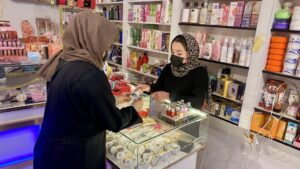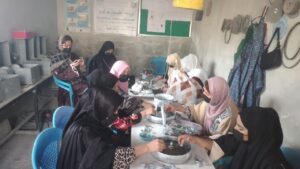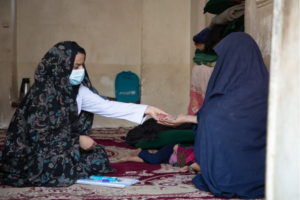
Support from aid organizations has given some women who returned to Afghanistan an opportunity to use their skills again to start small businesses after experiencing unemployment and economic problems.
These women, who returned to Afghanistan from Iran and Pakistan over the past one to five years, brought skills in tailoring, handicrafts, and food production, particularly baking different types of sweets—skills that have been effective in creating job opportunities for some women.
For this report, 12 women in eight provinces were interviewed. They said that after returning to Afghanistan, they were able to start their economic activities after receiving different forms of support. Of the 12 women, three received cash assistance, five received cash assistance along with training and equipment, and four received equipment and training.
From returning and unemployment to starting businesses
The women say they were able to start their businesses with support from aid organizations. Based on the findings of this report, four of them received support from the International Organization for Migration (IOM), three from the United Nations Development Programme (UNDP), two from charitable organizations, and three others from organizations supporting women and other institutions.
Saleha Zamankhail from Kabul, who returned from Iran nearly three years ago, started a small business in the food production field after completing a three-month training course and receiving equipment and financial assistance from the International Organization for Migration (IOM).
“An organization called IOM, which helped migrants, provided us with training. We learned the work there during those three months. Then they gave us equipment. Now we have started our business using the equipment they gave us and the financial assistance they provided,” she says.
Zainab, a 29-year-old from Jawzjan, returned to Afghanistan from Pakistan four years ago and established a small carpet-weaving workshop with support from a charitable organization.
“After we came to Afghanistan, I faced serious problems, including economic problems and unemployment. The charity established a small carpet-weaving workshop for us, which helped me stand on my own feet,” she adds.
Women’s businesses; an opportunity to employ others
The economic activities of these women are not limited to covering their own and their families’ living expenses. After starting or expanding their businesses, they have also created job opportunities for other women and people.
Marziya Arefi, a 34-year-old from Daikundi who returned to Afghanistan from Iran two years ago, says that after receiving 54,000 Afghanis in cash assistance from UNDP, she started businesses in dried fruit production and tailoring and has created job and income opportunities for several women.
“I have two shops, one for products and the other for fabric and tailoring. In the products section, there are six of us working together as partners. We also buy products from 50 women farmers, and we have contracts with them,” she says.
Sara, a 27-year-old from Faryab, says that after receiving training and equipment for making sweets, she started her own workshop. Currently, 15 girls and women work alongside her to produce cakes and cookies.
“We produce cakes and cookies. I work together with everyone who works with me, and they receive a fixed salary. I am really happy that today I have been able to provide job opportunities for women whose access to work is limited,” she says.
Lack of markets and high costs of raw materials; challenges for women entrepreneurs
Despite the support provided to help these returnee women start and expand their businesses, they still face many challenges. The lack of suitable markets, high prices of raw materials, shortage of capital, a reduction in the number of customers, and the cost of transporting products are among their main challenges.
Marwa Niazi from Nuristan, who works in handicrafts and tailoring, complains about the lack of suitable markets and the high cost of raw materials.
“The main problems are the lack of a suitable market for selling our products, the high cost of raw materials, a shortage of capital, and the difficulty of transporting products to other markets. If there is a good market, we can increase our production,” she adds.
Marziya Noorzai from Farah, who works in food packaging and processing, also faces a shortage of packaging equipment and low sales.
“One of our main problems in packaging is the lack of necessary equipment and the difficulty of buying it. Also, similar products imported from abroad are sold at lower prices, which makes it difficult for us to sell our products,” she adds.
The International Organization for Migration (IOM) told Salam Watandar in an email that it has supported 2,079 businesses related to women across Afghanistan, 220 of which belong to returnee women.
The support includes equipment, business maintenance, cash assistance, participation in exhibitions, and internships.
“Of the 220 businesses related to returnee women, 105 received support in the form of equipment and assets, 44 received support to maintain their businesses, one received cash assistance, 31 received support to participate in exhibitions, and 110 received support through internships,” says the IOM.
Financial support is not enough; markets and training are also needed
Economic experts say that financial support, technical and vocational training, and creating markets for women’s products can help women develop their businesses.
Omidullah Qasemzai, an economic expert, says that such support can not only help families economically but also create job and entrepreneurship opportunities for women.
“If organizations cooperate with these women, this support can include financial assistance and technical and vocational training, creating opportunities to develop women’s businesses and trade, and creating domestic and foreign markets for their products,” he adds.
Women’s employment; a way to reduce re-migration
Meanwhile, migration experts say economic insecurity and a lack of job opportunities can be the main factors behind women’s decision to migrate again. They say that, in order to reduce re-migration, women’s businesses should be supported and economic opportunities should be created for them. Abdul Raziq Adeel, a migration expert, says,
“Targeted economic support can prevent more than 70 or 80 percent of re-migration, provided that government institutions remove administrative and mobility barriers that women face in small businesses, and international organizations shift from temporary humanitarian assistance toward sustainable reintegration projects, microloans, and the establishment of production workshops.”
Fariba Noori, acting head of the Afghanistan Women’s Chamber of Commerce and Industries, says the organization has established about three centers in different fields to provide training and strengthen women. Alongside professional training, it has also provided internship opportunities for a number of women.
“At one center in Kabul, in the Khushal Khan area, several women have received training. We have established other centers in Paktia and Ghazni, but they have not yet been completed,” she adds.
Officials at the Ministry of Labor and Social Affairs say the ministry has considered programs to support returning migrants, particularly through employment and technical and vocational training. By supporting the private sector, the ministry will provide employment and income opportunities for returnees.
Mohammad Seddiq Tawhidi, spokesperson for the Ministry of Labor and Social Affairs, says: “Through technical and vocational training in fields such as tailoring, carpentry, carpet weaving, and handicrafts, we are trying to support returnee women.”
Meanwhile, the United Nations Development Programme (UNDP), in cooperation with its women’s section, announced in a report in September 2026 that it has launched a program to support women entrepreneurs and develop their businesses.
According to the report, the program, with an investment of $1.7 million, will support 1,500 women entrepreneurs over the next year in financial literacy, business planning, and access to markets.
Reporter: Zarafshan Sharifi