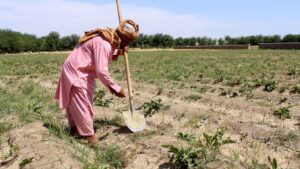
In Baghlan, the «Poza-e Eshan Agricultural Research Farm» has in recent years been working to identify and develop cotton varieties that are more resistant to water shortages, extreme heat and diseases by establishing a cotton collection. At the center, characteristics such as fiber length, boll weight, plant height, growing period and the level of crop production are examined so that seeds better suited to future climate conditions can be identified and made available to farmers.
Cotton, known as “white gold” because of its high economic value, is one of Baghlan’s important agricultural crops. It is also a source of raw materials for textile and vegetable oil factories in the province.
Noor Rahman Ahmadzai, an employee of the General Directorate of the «Poza-e Eshan Agricultural Research Farm», says that as climate change intensifies and water resources decline, the farm’s research focuses on introducing varieties that can adapt to changing conditions.
“Resistance to water shortages, early maturity, high crop yields, good fiber quality, resistance to pests and diseases, and efficient use of water are among the most important characteristics considered in our research programs,” he adds.
According to Ahmadzai, one of the farm’s promising achievements was the testing of a new cotton variety in 2025. The variety produced about 120 seers, equivalent to 840 kilograms, on a one-jerib experimental plot, while farmers using local cotton seeds under similar conditions usually produce less than 80 seers, or 560 kilograms, per jerib.
“From one jerib, it can produce about 120 seers, equivalent to 840 kilograms, while farmers under similar conditions using local cotton seeds usually obtain less than 80 seers, or 560 kilograms, per jerib,” he says.
He adds that after the two-year research cycle is completed and the seeds are confirmed, pure seeds will be produced and made available to hundreds, and even thousands, of cotton farmers in different provinces.
Meanwhile, Abdullah Niazai, General Director of Agricultural Extension, says the «Poza-e Eshan Agricultural Research Farm» plays an important role in connecting scientific research with farmers’ practical needs.
“The research conducted at the «Poza-e Eshan Agricultural Research Farm» in Baghlan has played an important role in helping farmers adapt to climate change,” he says.
He also adds that with increasing drought, extreme heat and the spread of pests, agricultural research should focus more on developing varieties that require less water during their growing period and are more resistant to climate-related stresses.
Meanwhile, Wali Amarkhail, spokesperson for the Baghlan Department of Agriculture, Irrigation and Livestock, says the department works closely with the «Poza-e Eshan Farm» in implementing research programs.
“This cooperation includes providing technical facilities, coordinating with relevant institutions, expanding research programs, establishing demonstration plots based on research findings in different parts of the province, sharing research findings with farmers, and continuously monitoring the research activities,” he says.
He also says the findings of the research are shared with farmers through field days, training programs, demonstration plots, local visits, extension meetings and media programs.
Amarkhail adds that, in addition to cotton, research is also continuing on other important agricultural crops, such as wheat, rice, corn, barley, mung beans, beans, chickpeas, lentils, soybeans, sunflower, saffron, peanuts, melons and tomatoes, to introduce varieties that are better adapted to Afghanistan’s climate conditions.
This report shows that as climate change puts increasing pressure on agriculture in Afghanistan each year, scientific research can help bridge the gap between current farming practices and future needs. Experts believe that developing climate-resilient seeds, improving water use and sharing research findings with farmers are among the most effective ways to protect food security and promote sustainable agricultural production in Afghanistan.
Reporter: Marina Naseri