In recent years, agricultural land in Kunduz has come under increasing pressure from multiple environmental challenges. Water resources have declined, surrounding forests have been destroyed, pasturelands have been overused, and climate change has made the province’s soil more vulnerable than ever before.
These successive factors have reduced the fertility of many agricultural areas and significantly reduced crop harvests.
Meanwhile, officials at the Kunduz Department of Agriculture, while confirming soil erosion in agricultural land, say that the problem is largely the result of the non-standard and excessive use of agricultural land by farmers.
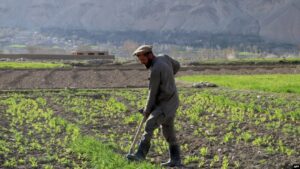
Mohammad Omar, a farmer in Kunduz, told Salam Watandar that consecutive years of drought have reduced the soil’s moisture, and lands that were once highly productive no longer have the same capacity.
“When there is no rain or snowfall, the land no longer produces good yields. The soil becomes very hard, and if we want to cultivate such land, it becomes extremely difficult. Another sign of soil erosion is that the land becomes saline,” he says.
Gul Mohammad, another farmer, says the loss of natural vegetation and trees around villages has made the soil less stable, allowing the top layer to be washed away easily with every rainfall. He adds that severe soil erosion in recent years has created serious problems for farmers.
“When there is a shortage of water, of course our farming does not improve; it only gets worse. Water scarcity damages the crops. When the soil erodes, agricultural yields decline, and when domestic production falls, it hits our economy hard,” he adds.
Abdul Khaliq, another farmer, says soil erosion has caused him direct financial losses in recent years, and crop yields have declined significantly compared to five years ago. According to him, despite using large amounts of chemical fertilizer, his land no longer has the capacity to produce acceptable yields.
“If we do not apply large amounts of chemical fertilizer to our land, it produces almost nothing. In previous years, we harvested about 100 seers of wheat annually from one jerib of land without using chemical fertilizer. Now, despite applying fertilizer and taking much greater care of the land, the yield has fallen to just 60 to 70 seers,” he says.
On the other hand, Faizuddin Nabizada, a soil science expert in Kunduz, says climate change has accelerated the process of soil erosion in recent years, making the topsoil of agricultural land increasingly vulnerable. He emphasizes that urgent and serious measures are needed to address the challenge of soil erosion in this province’s agricultural lands.
“Effective measures must be taken to reduce soil erosion in Kunduz Province. For example, the natural pistachio forests and riverbank forests that have been destroyed over the past 40 years should be restored. Surface and groundwater resources should be managed more efficiently. People should also be encouraged to plant trees, protect natural resources, and prevent the overgrazing of livestock in Kunduz’s pasturelands,” he adds.
Meanwhile, Nawidullah Huzayfa, head of forests and pasturelands at the Kunduz Department of Agriculture, told Salam Watandar that soil erosion is increasing in Kunduz, with border areas and sloping lands particularly vulnerable.
“According to our assessments, the level of soil erosion in Kunduz is rising. The main reason is the improper and inappropriate use of agricultural land. Particularly, the areas most affected by soil erosion include the plains of Chahar Dara District, southern Imam Sahib, and western Dasht-e-Archi,” he adds.
It is worth mentioning that Kunduz is one of the major agricultural provinces in Afghanistan. However, in recent years it has experienced declining rainfall, water shortages, and the loss of vegetation cover. Combined with overgrazing and poor land management practices, these factors have accelerated the trend of soil erosion and reduced the fertility of many agricultural areas.