
Problem statement
In the contemporary era, Artificial Intelligence (AI) has become one of the most influential technologies of our time. With remarkable speed, it has moved from research laboratories into everyday life, transforming the ways people work, learn, communicate, and make decisions.
Afghanistan, despite structural challenges and limitations in access to digital infrastructure, has not remained unaffected by this global wave. Afghan youth, who constitute a significant proportion of the country’s population, have increasingly turned to AI tools with growing enthusiasm. Platforms such as ChatGPT, Gemini, and other intelligent chatbots have become key sources of information, academic and career guidance, and even psychological support for many of them.
Therefore, the central issue of this study is the level of familiarity among Afghan youth with artificial intelligence and the ways in which this technology is utilized in their daily lives.
Background and significance of the study
Following the emergence of artificial intelligence globally, and based on a review of existing literature in Afghanistan, various efforts have been undertaken in this field in line with the importance of the issue and societal needs. However, this body of literature remains limited and fragmented, and has paid comparatively little attention to analyzing the impact of artificial intelligence on the lives of youth in Afghanistan. A selection of these studies, along with their limitations, is outlined below:
a) The survey titled “Youth familiarity with artificial intelligence and its use in daily life” was conducted by the Salam Afghanistan Media organization – Salam Watandar Radio on 10 December 2024, with the participation of 395 young respondents across 34 provinces of Afghanistan. This study focused primarily on the level of familiarity of artificial intelligence among youth.
b) The report titled “Advancements in artificial intelligence in 2024” is a visual report published by Afghanistan International in 1403 (2024). This report highlights the significant growth of artificial intelligence as a key tool in the field of technology.
c) The article titled “Consulting Artificial Intelligence: Threat or Opportunity for Families” was published by the Hasht e Subh Daily Newspaper. In this report, interviews were conducted with several families residing in Kabul. The findings indicate that families use artificial intelligence for resolving family issues, including marital relationships, child upbringing, and managing family tensions.
Although these studies have addressed different dimensions of artificial intelligence usage—and their efforts are commendable—they are mostly limited in scale and do not provide a sufficiently precise and clear picture of the role of AI in decision-making, social relationships, and the everyday lifestyles of youth.
Therefore, considering these limitations, conducting the present survey is essential. It aims to examine the comprehensive use of artificial intelligence in the daily lives of Afghan youth, including areas of application, extent of usage, and its role in decision-making and social relationships. This study can provide accurate and scientific insights and help fill the existing gap in previous research.
Research objectives
- To examine the level of Afghan youth’s familiarity with artificial intelligence
- The motivations and contexts of youth usage of artificial intelligence
- The effectiveness of artificial intelligence in the lives of youth
- The facilitative role of artificial intelligence for youth
Research questions
- To what extent are youth in Afghanistan familiar with artificial intelligence?
- What are the goals and motivations of youth in using artificial intelligence?
- What is the level of effectiveness of artificial intelligence in the lives of youth?
Methodology
The methodology of this research is quantitative and based on the analysis of collected statistical data. The research instrument is a structured questionnaire, which was distributed and collected both in the field and through social media platforms.
Population of the study
The statistical population of this study includes youth aged 15 to 35, geographically covering 32 provinces of Afghanistan. The sample consists of 1,154 respondents.
Limitations of the study
- Lack of access to stable internet among youth
- Low participation of rural populations
- Low representation of some provinces
- Lack of a culture of field-based research
- Limited cooperation from youth
Executive summary
The survey on Artificial Intelligence and Afghan youth was conducted with 1,154 respondents across 32 provinces of Afghanistan. The findings indicate that artificial intelligence has become more deeply embedded in the daily lives of Afghan youth than expected.
92% of respondents reported familiarity with artificial intelligence, and more than two-thirds (66.6%) are regular users. Furthermore, 84.1% of youth have used artificial intelligence at least once for advice, indicating that it has become a reference for guidance and decision-making.
At the same time, 82% of users reported a decline in consulting friends and relatives, while 58.1% expressed concern about the “mechanization” of decision-making. The most significant perceived risk among youth is not technical failure, but rather “overdependence and the reduction of human emotions” (35%)—reflecting a notable level of critical awareness that should be considered serious.
Overall report
1.Demographics of respondents
Provinces
The survey was conducted with 1,154 respondents across 32 provinces of Afghanistan.

Age groups
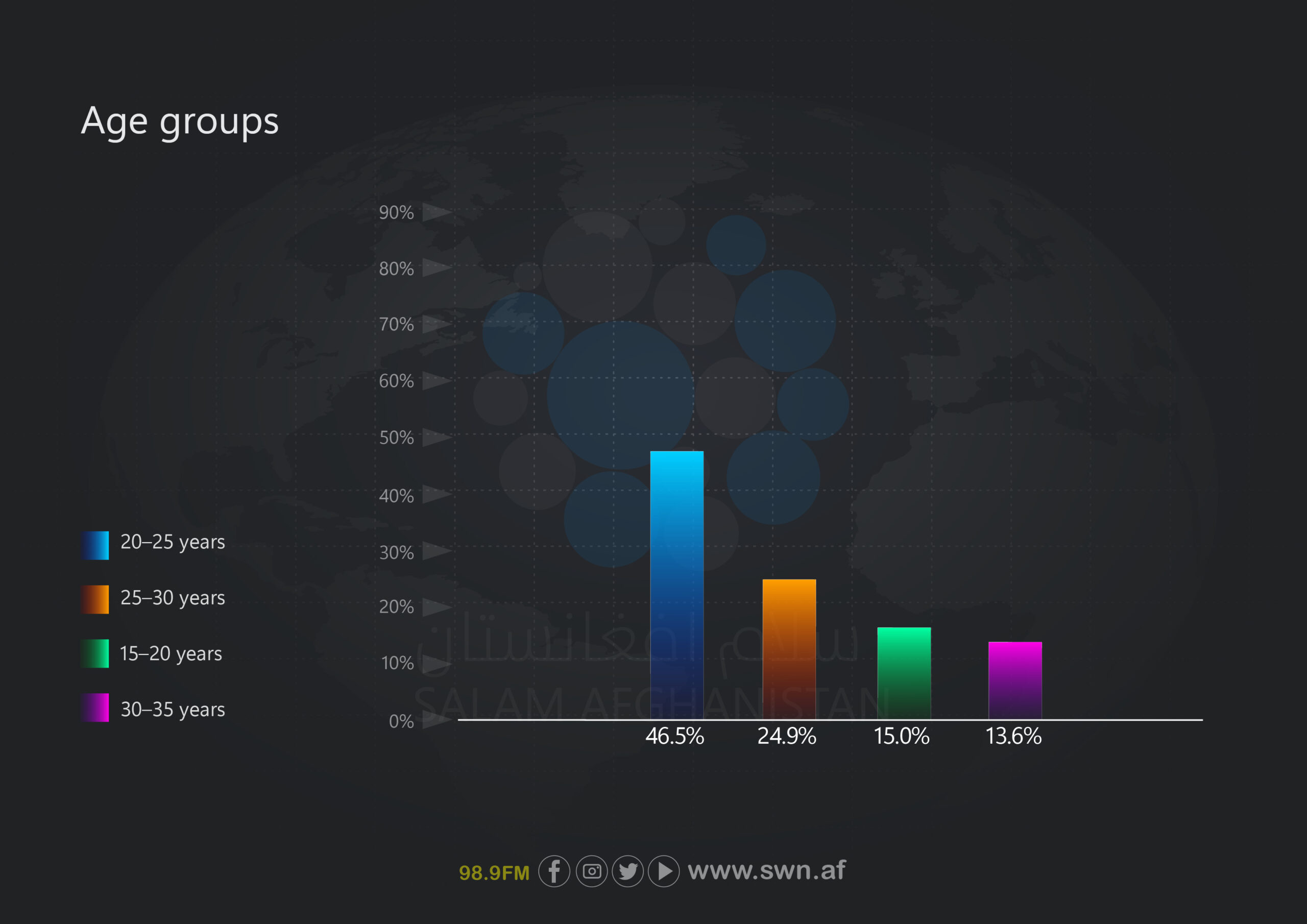
The largest age group among respondents (46.5%) consists of youth aged 20 to 25 years, meaning that nearly half of the participants are in their university years and at the peak of their educational experience. The 25 to 30 age group ranks second with 24.9%. In total, 86.4% of respondents are under the age of 30.
Gender
The gender distribution of respondents is relatively balanced, with males accounting for 50.6% and females comprising 49.4% of the respondents.

Type of settlements
The demographic findings indicate that 83.2% of respondents are urban residents, while 16.8% live in rural areas.

Level of education
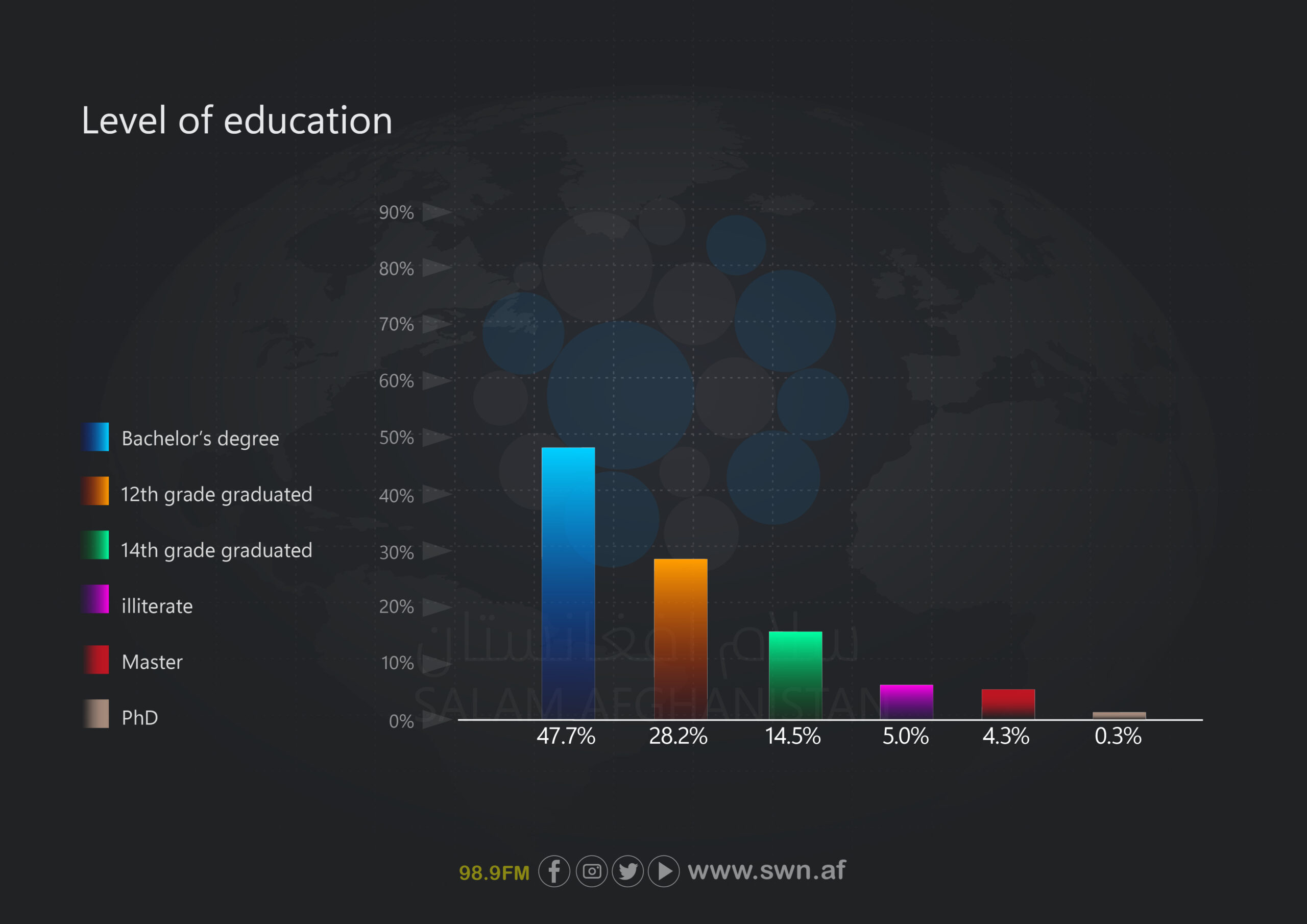
The findings indicate that 66.8% of respondents in this survey have a high level of education. The majority of participants are literate and possess higher education qualifications.
2.The level of youth familiarity with artificial intelligence
The data show that 92% of respondents are familiar with artificial intelligence. Among them, 40.6% report a moderate level of familiarity, while 23.3% have slightly familiarity. A further 24.9% report a high level of familiarity, and 3.2% consider themselves experts. Only 8% of respondents reported having no familiarity with artificial intelligence at all. Contrary to common perceptions of limited access in Afghanistan, these findings indicate a significant penetration of artificial intelligence among youth.

Level of usage
The findings show that more than two-thirds of young respondents (66.6%) are regular and consistent users of artificial intelligence. Among them, 35% use AI on a daily basis, while 31.6% use it several times per week.

Artificial intelligence tools
Chatbots such as ChatGPT and Gemini are the most widely used artificial intelligence tools among youth, with a percentage of 71.3%. Educational applications rank second with a percentage of 9.5%.

3.Consultative use of artificial intelligence
84.1% of youth—approximately five out of every six—have used artificial intelligence at least once to seek advice. This indicates that AI has become a consultative reference.

Areas of consultation
Academic consultation is the largest area of use, with 42.5%. Career consultation ranks second with 23.2%, while personal life matters rank third with 15.3%.

Evaluation of advice quality
34% of respondents consider the advice provided by artificial intelligence to be mostly accurate, while 32.6% rate it as moderate, and 7.3% describe it as completely accurate. Overall, more than 73% of respondents who have used AI for advice consider its quality to be at least moderate or better.

Based on the findings, 42.7% of respondents report high satisfaction (4–5), 32.2% indicate moderate satisfaction (3), while 16.7% report low satisfaction (1–2).

4.Consequences of artificial intelligence use
29.9% of respondents reported a slight decrease in consulting others, while another 29.9% experienced a moderate reduction. 11.2% reported a significant decrease, and 3.1% indicated an almost complete replacement. In contrast, only 17.6% reported no change in their consultation behavior.
Overall, 74% of respondents visit friends and relatives less often after using artificial intelligence.

Impact on social relationships
Nearly half of the respondents report experiencing some form of negative impact on the quality of their social relationships. In contrast, 37.4% perceive no impact at all. However, 31.8% state that AI use has created a slight distance, while 18% believe it has contributed to a reduction in communication with friends and relatives.

Concerns about dehumanization
25.7% of respondents reported low concern about the reduction of human emotions, while 25.1% expressed a moderate level of concern. 14.0% reported high concern, and 4.6% indicated very high concern. In contrast, only 22.3% completely rejected this concern.
Overall, 69.4% of respondents expressed at least some level of concern about the potential dehumanizing effects of artificial intelligence.

Concerns about the mechanization of decision-making
42.9% of respondents reported a low level of concern, while 15.2% expressed a high level of concern. Overall, 58.1% of youth indicated some degree of concern. In contrast, only 24.8% stated that they are not concerned.

Greatest benefit
Rapid access to vast information (37.3%) is identified as the most significant benefit of artificial intelligence from the perspective of youth. Time-saving (19.5%) and support for learning and skill development (19.4%) are nearly equal and jointly rank second. These three leading benefits are all associated with individual empowerment.

Greatest Risk
Excessive dependence on machines and the reduction of human emotions (35%) is identified as the most significant perceived risk. Reduced consultation with friends and family (20.9%) and the inaccuracy or incompleteness of some advice (18.3%) rank next. Notably, youth prioritize human and social concerns over technical concerns.

Conclusion
This study presents a complex and multidimensional picture of the relationship between Afghan youth and artificial intelligence. Contrary to simplistic perceptions that view this technology as either entirely beneficial or entirely harmful, the findings reveal the simultaneous presence of significant opportunities and challenges.
On one hand, artificial intelligence plays an undeniable role as a digital teacher, career advisor, and source of information for youth who face limited access to such services. On the other hand, increasing dependency, the weakening of human relationships, and concerns about the mechanization of decision-making represent serious warning signs that require attention.
The findings further indicate that Afghan youth are not passive users. Rather, they actively engage with artificial intelligence while maintaining a critical perspective. This critical capacity forms an important foundation upon which policymakers, educational institutions, and media organizations should build.
Recommendations
- Develop digital infrastructure in rural areas to reduce the digital gap.
- Design ethical frameworks for the use of artificial intelligence in accordance with the cultural and Islamic values of society.
- Invest in Artificial Intelligence literacy (AI literacy) education in schools and universities.
- Integrate AI literacy into the curricula of schools and universities.
- Promote critical use of artificial intelligence.
- Continue field-based research to document ongoing changes in the use of artificial intelligence.
- Organize public discussions and radio programs to strengthen social dialogue on artificial intelligence.
Reporter: Hosai Afghan