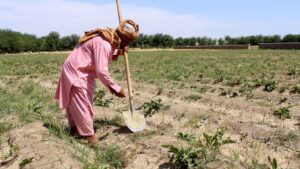
Laghman is a province where most of its population earns their living through agriculture and natural resources. With its green mountains, natural forests, and flowing rivers, this province is considered one of Afghanistan’s most important agricultural and natural areas. Two major rivers in the province, Alishang and Alingar, are essential sources of life for the people.
These rivers irrigate vast agricultural lands and provide water for thousands of families for farming, livestock, and drinking. Local farmers say that without the water from these rivers, a significant portion of their crops would be lost. Farmers living near the Alishang River report that, although their lands are irrigated by the river, its water decreases or completely dries up during winter, which negatively affects their harvests.
Ansarullah, a farmer who irrigates his land from the Alishang River, says, “In the summer, the river has plenty of water, but in winter, it decreases or disappears entirely, the reason is deforestation. The snow that falls in winter melts too quickly, and as a result, agricultural lands do not produce crops.”
Meanwhile, farmers who use the Alingar River say that, due to the greater availability of water, they can harvest their lands three to four times a year. They also call on the government to build canals and dams.
Mohammaduddin, a resident of the ‘Mir Hasan’ area in Laghman, says, “We irrigate our lands from the Alingar River, but when floods occur, the canals and dams are destroyed because they are primitive and substandard. We ask the government and institutions to construct standard and solid canals so we can continue to harvest several times a year.”
Environmental experts say that in recent years, climate change, reduced rainfall, deforestation, and improper water use have put the future of these rivers at risk.
Turyalai Paigham, a professor at the Faculty of Agriculture at Laghman University, explains, “The irrigation canals have become worn out, and a large portion of the water is lost before reaching our agricultural lands, and sudden floods also sometimes destroy our farmlands.”
He also adds, “In the areas where the rivers originate, rainwater and snow are absorbed by plant roots and flow steadily. But if the forests are destroyed, rainwater carries away the soil, and it becomes impossible to use the water effectively.”
Officials from the Laghman Agriculture Directorate say that improving water management, rebuilding irrigation systems, and restoring forests can prevent these problems. Mohammad Shaker, Director of Natural Resources at the directorate, emphasizes, “Cooperation between the people and the government to protect natural resources is crucial.”
“These two rivers, Alingar and Alishang, give Laghman its special beauty and importance and irrigate approximately 25,000 hectares of land, in some areas, a single plot of land can yield crops up to four times a year.” he adds.
The Alishang and Alingar rivers play a vital role in the economic and environmental stability of Laghman province. If these water resources are not properly managed and protected, agriculture, the environment, and the livelihoods of the people will face serious challenges in the future.