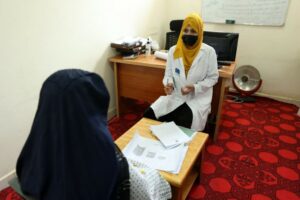
Legal experts and religious scholars emphasize that, under the law, Hanafi jurisprudence, and Islamic Sharia, women are entitled to the rights to education, employment, and the choice of a spouse. According to them, depriving women of these rights on the basis of customs and traditions has no social justification and contradicts Islamic principles. However, several women interviewed for this report stated that prevailing customs in society have prevented them from exercising their fundamental rights, including education, employment, and the choice of a spouse.
Zarina Wafayi, a 30-year-old woman from Daikundi, reported that her marriage was arranged under family and customary pressures, and she was not allowed to meet her future husband before the engagement. She considers herself a victim of these customs.
“My mother always told me to marry the man she chose. She said I had to accept, otherwise people would gossip about us. When the suitor came, my parents met him themselves. My father said, ‘What does the girl need to do? We have seen him and his family. It would be shameful—what will people say?’ They never realized he was addicted to drugs. I am not satisfied, and my father sacrificed me for the sake of customs and people’s opinions because I could not meet the boy before the engagement.” she says.
Khadija Ahmadi, a 26-year-old woman from Parwan, shares a similar experience. She says she was not ready for marriage, yet her father forced her into an engagement to avoid what people would say. She also complains about the strict limitations imposed on her during the engagement period. She says,
“My father said he did not want people to gossip and ask why his grown daughter was still unmarried,” she says. “So they engaged me to someone I had never seen before. It has been six months since our engagement, and we are already religiously married, but I am still not allowed to meet him alone. Whenever my fiancé visits, my father and brothers constantly watch him. They treat him like a stranger. We are not allowed to go out together, and I still haven’t become comfortable with him because of these restrictions.”
Zarina and Khadija are not the only victims of such customs. These stories reflect the experiences of many girls in Afghanistan who are pressured by their families to accept imposed decisions and are deprived of basic rights, including education, employment, and the choice of a spouse.
Shamila Hossaini, a resident of Kabul, says her family restricted her access to education and employment due to prevailing customs, while the men in her family considered any work for her shameful.
“Local beliefs and customs often limit women. When I wanted to continue my studies, my family told me it was better to remain at home. Later, when I tried to work or earn an income, my family said that the job was unsuitable for women and would make the men of the family appear dishonorable. During my studies, I was also prohibited from attending evening classes or participating in extracurricular university activities.”
Despite this, some religious scholars say that according to Hanafi jurisprudence and Islamic Sharia, women’s rights to education and to choose a spouse are firmly established and cannot be overridden by social customs.
Qutbuddin Mujtahid, a religious scholar, says it is allowed for a boy and girl to meet in the presence of a third person, which is the main condition for marriage, and that Islam also allows women to study. He explains,
“It is permitted to see a girl for the purpose of marriage so that the man can make a decision about marriage. However, being alone in a place without a third person is not allowed. In Islamic Sharia, custom is valid only if it does not conflict with Sharia. It is a rule of jurisprudence that custom is valid as long as it does not contradict Sharia. In Islam, it is necessary for both men and women to study, and Hanafi jurists have specified that a woman should learn the rules of her own religion.”
Khwaja Mohammad Omar Ghorbandi, a legal expert, points to the Law on the Elimination of Violence against Women, adopted in 2009, which prohibits forced marriage, deprivation of education, and similar practices, and simultaneously considers them as crimes.
“The Law on the Elimination of Violence against Women, adopted in 2009, even considers certain customs, such as forced marriage and the prohibition of education, to be crimes. In Hanafi jurisprudence, it is also stated that if a custom causes oppression, injustice, or violates the rights of a person, the Prophet (PBUH) said that obedience to created being—whether one person or a hundred—is not obligatory in matters that involve disobedience to the Creator.”
Parwiz Khalili, another legal expert, says that when customs deprive women of their rights to education, employment, or marital choice, women have the legal right to seek justice through the courts.
“The rights to education, marriage, and employment are granted by God for women, and these rights are recognized in both Sharia and Islamic jurisprudence. Therefore, opposing these rights is, in essence, opposing God’s command. A woman or girl who is a victim of such discrimination or coercion can pursue her rights through the courts according to Islam and claim her Sharia-based rights.”
Tahmina Mangal, women’s rights activist, says that neither religion nor law is responsible for restrictions imposed on women; rather, misinterpretations within families and society are the root cause of rights violations.
“In community, traditional beliefs deprive women of education, employment, and the right to marriage. Yet both Islam and many laws recognize these rights for women. The problem lies not in religion or law, but in social pressures and incorrect interpretations that prevent women from exercising their true rights.”
A custom is a set of behaviors, speeches, and continuous habits that are accepted in a society and considered binding by its members. Custom is one of the sources of unwritten rights, alongside formal laws, on the condition that it does not conflict with peremptory law, Sharia principles, or the general order.
Reporter: Sharifa Qasemi