Women can play an important role not only within the family but also in reducing violence, preventing violent behavior from being passed on to the next generation, and resolving disagreements peacefully in society.
Findings from Salam Watandar’s survey of 190 women across 20 provinces of Afghanistan show that 67.4% try to teach their children to resolve disagreements through dialogue. Meanwhile, 54.2% said they would support women who make complaints about domestic violence by listening to them without blaming them. Another 66.8% believe that teaching children to respect others and avoid violent behavior is an effective way to prevent violence. At the societal level, 68.9% of the women surveyed consider encouraging people to resolve disagreements through dialogue one of the most important roles women can play.
Mothers’ role in raising children without violence
Of the 190 women who participated in the survey, 67.4% said that when their children have disagreements, they try to understand the reasons and help them resolve their problems through dialogue. Similarly, 66.8% believe that teaching children to respect others and resolve disagreements through dialogue is an important way to prevent violent behavior from being passed on to the next generation.
Meanwhile, 51.6% said they feel happy when their children avoid violence and conflict.
Zarmina, a 29-year-old from Ghor, is a mother of two children and has been married for six years. She describes how she tries to prevent tensions between her children:
“When my children fight with each other, I separate them to make sure neither of them gets hurt. Then, I give each of them a chance to explain what happened. If my son and daughter fight over a toy, instead of blaming either of them, I tell them that both have the right to play. I try to teach my children from an early age to solve problems through conversation, patience, and respect rather than crying, shouting, or hitting each other.”
Women’s reactions to domestic violence
The survey findings show that 43.7% of the women, or 83 respondents, consider talking privately with their husbands an appropriate way to respond to insults and humiliation. Another 35.8%, or 68 women, emphasized seeking help from trusted people.
In addition, 54.2% said that if a woman makes complaints about violence by her husband, they would listen to her without blaming her and support her in finding a safe solution.
Altina Rahel, a resident of Kabul, says she has mediated family disputes in several cases, guiding women and men and encouraging them to resolve their problems through dialogue.
“I have guided women to be patient. I have also explained to them that violence is not a solution to disagreements. We have spoken to men as well, telling them that God has provided a solution to every problem and that disagreements cannot be resolved through physical violence, beating, or abusive language. I explained that violence has serious consequences and can destroy the family,” she adds.
Women’s role in resolving disagreements peacefully in society
The survey findings show that women can help reduce tensions and resolve disagreements peacefully, both within their families and in society.
40.5% of respondents said they would try to stop violence if they could do so without putting themselves or the affected person at risk.
Similarly, 68.9% emphasized the importance of impartial mediation and encouraging people involved in disputes to resolve their differences peacefully. On the other hand, 74.2%, or 141 women, said they try to prevent rumors and people speaking badly about other women from spreading.
Sayera, a 26-year-old from Badakhshan, shares her experience of helping resolve a disagreement between two women:
“In one case, I mediated a dispute between two women who had become upset with each other because of a misunderstanding and incorrect remarks. First, I listened to each of them separately. Then, I encouraged them to talk to each other calmly and respectfully. As a result, the misunderstanding was cleared up, their resentment decreased, and their relationship improved.”
Traditional beliefs and lack of support; barriers to women’s role in preventing violence
The survey findings show that women face several barriers when trying to intervene in family and social disputes.
27.9% of respondents identified the belief that women should not interfere in family disputes as one of the main barriers. Another 26.8% pointed to a lack of support for women, while 18.4% cited fear of reactions from their husbands, families, and others. Additionally, 17.9% identified a lack of awareness about how to respond to violence and where to seek help as among the main barriers to women’s role in preventing violence.
Maryam Haidarian, a 28-year-old from Herat, describes how a lack of family support can prevent women from playing a role in resolving family and social disputes:
“In one case, one of my relatives was facing verbal abuse and pressure because of family problems. I wanted to help and intervene, but I knew my family would oppose me and accuse me of interfering in other people’s private matters. So, I decided not to get involved. My main concern was that my family’s reaction might create even more tension within the family. For this reason, I only supported her indirectly and did not take any serious steps to intervene.”
Hila, another woman from Kapisa province, also says: “The first barrier is the family. Families prevent women from getting involved because they believe it could put them at risk or damage their reputation. The second barrier is the women themselves. Because of fear or a lack of self-confidence, some women do not take action.”
Raising awareness and providing support; ways to strengthen women’s roles in society
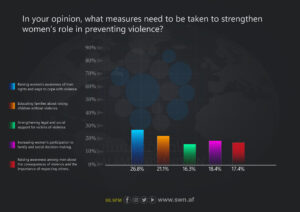
The women surveyed said that raising women’s awareness is one of the most important measures to strengthen their role in preventing violence. 26.8%, or 51 women, emphasized the importance of this measure.
On the other hand, 21.1% identified educating families about raising children without violence as an important step, while 18.4% said that increasing women’s participation in family and social decision-making was necessary.
Mursal Ahmadi, a 24-year-old from Herat province, says: “In my opinion, education and awareness-raising, legal support, psychological counseling, and establishing support centers for women are very important. These forms of support can help women find the courage to stand up for their rights and defend them more confidently.”
Experts’ and officials’ views on strengthening women’s roles in society
Muzhda Azizi, a women’s rights activist, identifies fear of family reactions and economic dependence as some of the factors that limit women’s role in preventing violence. She also emphasizes the importance of raising awareness.
“This can be achieved by raising public awareness about women’s rights, improving women’s access to education, and strengthening their economic independence. Support centers should also be established to provide counseling and help women improve their lives,” she says.
Shoaib Ahmadi, a sociologist, also considers education, awareness-raising, and greater economic opportunities important ways to improve women’s participation in society.
“Expanding educational opportunities for women and girls and raising their awareness of their rights are important steps. Thirdly, women should be given economic opportunities so they can become financially independent. Increasing women’s participation in decision-making can also be a solution,” he adds.
Psychologists believe that all forms of violence can have serious consequences for mental health. Sami Raihan, a psychologist, emphasizes the importance of teaching dialogue skills as a way to prevent violence.
“Emotional control, active listening, peaceful conflict resolution, problem-solving skills, empathy, expressing feelings in a healthy way, and setting healthy boundaries are among the skills that help people prevent family violence. Teaching people effective communication skills helps them set their own boundaries and respect those of others,” he adds.
Similarly, Abdulahad Ateed, a religious scholar, emphasizes the importance of respect, dignity, and kind treatment within the family. He explains:
“God Almighty says regarding the treatment of women: ‘Treat women kindly and do not intend to harm them.’ The Prophet (PBUH) also says in a Hadith: ‘The best among you is the one who treats his family best.’ Treat women with kindness and gentleness. “God Almighty also says that He has honored the children of Adam and granted them dignity, whether they are Muslims or non-Muslims, men or women.”
Meanwhile, officials from the Ministry for the Promotion of Virtue and Prevention of Vice say they always hold reform meetings to raise public awareness. They also say that women can visit the ministry to resolve their family problems. Mohammad Aslam Badariwal, spokesperson for the Ministry, says:
“Women who face mistreatment or other problems within their families that violate their rights under Sharia can call 191 or contact the ministry’s local muhtasibs (officials). The ministry considers it its responsibility to listen to their voices and address their complaints.”
Women’s role in creating a peaceful environment within families and society, however, is not limited to mediating disputes. It also includes raising the next generation, encouraging dialogue, strengthening mutual respect, and supporting people affected by violence. Providing women with access to education, family support, and opportunities to participate in society can help expand their role in preventing violence.
Reporter: Hosai Afghan