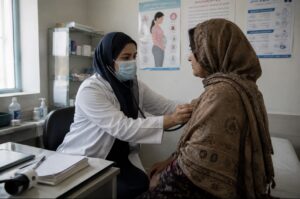
Doctors warn that violence against women during pregnancy has irreversible consequences. However, some women, in interviews with Salam Watandar, describe experiencing severe violence during this period—violence that has even resulted in miscarriages.
These women say they were often subjected to violence primarily because they were carrying female fetuses.
Zarlasht spent her pregnancy months in hope. Doctors had informed her that she would have a baby girl—a news that displeased her husband and his family. A few days later, an argument occurred between her and her husband, which ended in tragedy. Amid anger and violence, her husband delivered a strong blow to her abdomen. Moments later, severe bleeding began, and Zarlasht lost the child she had been carrying in her womb with hope for months. She now lives with deep sorrow, and the fear of repeating that tragic fate casts a heavy shadow over her life.
She explains, “I was in my sixth month of pregnancy. I went for a check-up. The doctors said it was a girl. I was very happy, but when I told my family, they were not happy at all, and I felt they were upset. One day, I had an argument with my husband. He hit my abdomen with a stick. I started bleeding. When they took me to the hospital, they said the baby had died in the womb. I cried a lot, but there was nothing I could do. I sit alone and talk to myself. I have developed many psychological problems. I am very afraid that if I become pregnant again and it is a girl, I do not know what they might do to me.”
Nazifa, a 29-year-old woman, and Zarmina, 34-year-old woman also share similar accounts. They too speak of violence that resulted in the loss of their fetuses.
Nazifa says, “During pregnancy, they used to say they would beat me—especially my mother-in-law. She prayed for me, ‘May God bring you no health.’ I had no choice but to sit and cry. They told me that I was too old to have children. They said it is a girl; we do not want it, we want a boy.”
Zarmina also says, “I was beaten by my husband; my hand was broken several times. Once, I miscarried. I kept telling him, ‘Do not hit me, I am already hurt.’ He never listened until someone came and rescued me from him. Because of this violence, my children are also not in good psychological condition.”
Meanwhile, doctors warn about the physical and psychological consequences of violence during pregnancy on the health of both women and children. Saeeda Saeedi, a specialist in obstetrics and gynecology, says,
“Violence during pregnancy is one of the risk factors for maternal and fetal complications and is not limited to physical harm. Psychological stress can also have serious consequences and increase the risk of preterm birth. In addition, a blow to the abdomen may lead to placental abruption, bleeding, uterine rupture, and even intrauterine fetal death.”
Mohammadullah Baloch, a psychologist, says that violence during pregnancy causes severe psychological stress for the mother, which can lead to unintended miscarriage. He adds,
“Domestic violence has three major effects on pregnant women: first, increased psychological stress, which can lead to miscarriage or harm to the fetus’s health. Second, maternal depression, which causes serious harm to the child. Third, mood disorders in the mother, which reduce brain hormones essential for fetal brain development and disrupt fetal growth.”
Religious scholars also consider violence against women, especially pregnant women, to be religiously forbidden.
Qutbuddin Mujtahid, a religious scholar, says that no one has the right to commit violence against a pregnant woman. According to him, if such violence occurs and results in the loss of the fetus, in Hanafi jurisprudence, the ruling of ‘Ghurra’ becomes obligatory for the perpetrator.
“In Hanafi jurisprudence, if a husband or another person hit a pregnant woman and the blow harms the fetus, leading to miscarriage and the expulsion of a stillborn fetus, then ‘Ghurra’ becomes obligatory. This refers to the payment of a slave, or in contemporary terms, its monetary equivalent. However, if the fetus is born alive and then dies, full diyah (blood money) becomes obligatory,” he adds.
Ghurra is a financial compensation paid in cases where a fetus is miscarried as a result of harm or assault on the mother.
Saif-ul-Islam Khyber, spokesperson for the Ministry of Promotion of Virtue and Prevention of Vice, told Salam Watandar,
“In Afghanistan, violence exists in one out of every two households. In this regard, we have recorded around 200,000 cases over the past four years in which women’s family-related issues have been resolved. There is hardly a day when the ministry does not report a figure of more than 35 percent of domestic violence cases across the provinces. About 10 cases of domestic violence and family disputes are handled and resolved on a daily basis.”
However, many victims of domestic violence against pregnant women still do not turn to government authorities and continue to endure ongoing violence within their families without legal protection, while such violence poses a serious threat to the health of both the mother and the fetus.
Reporter: Husna Sadat