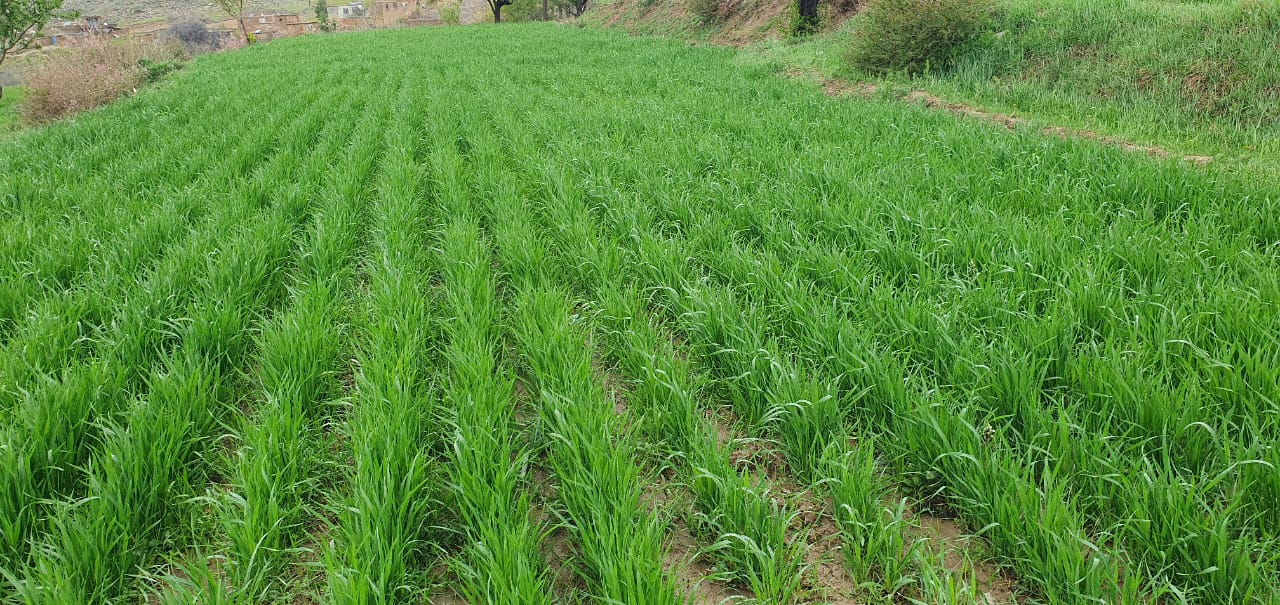
In several districts of Panjshir Province, about 15 jeribs of land have been set aside as demonstration plots for row planting of wheat. This initiative has been launched by the Department of Agriculture, Irrigation, and Livestock to promote improved farming methods and increase crop yields.
Row planting is a method in which seeds are planted in organized rows, in specific lines. According to experts, this method helps use resources more efficiently and supports better plant growth.
Ahmad Seyar, a farmer from Anaba District in Panjshir who participated in this program, says, “One advantage is that it uses less water, produces higher yields, and is more resistant than traditional methods. It is also much easier to control pests and diseases. Farmers can earn better profits by using this method.”
Keramuddin, another farmer in Panjshir who has adopted row planting on about one jerib of his land, says the method has not only improved wheat growth but has also reduced water use. He explains that, compared to traditional farming, both the yield per jerib and the quality of the crop have increased.
“We used wheat row planting on nearly one jerib of land. It has been very effective for harvesting, weed control, and reducing the use of water and chemical fertilizers. We ask the Department of Agriculture to expand this method so farmers can move away from traditional practices,” he adds.
Despite these benefits, some farmers mention the initial costs. They say that obtaining necessary equipment, such as planting rulers and other basic tools, as well as receiving training, can be challenging at the beginning.
Agricultural experts consider row planting a scientific and effective method that can play an important role in improving the farming situation in the country. Ahmad Zubair Qazizada, a horticulture specialist, says,
“Generally, in row planting, competition between plants is reduced because sunlight is distributed equally among the plants. It also saves seeds and fertilizers, improves irrigation efficiency, and makes weed control easier.”
According to him, this method not only increases production quantity but also improves the quality of wheat, which can play an important role in strengthening food security.
Fazlullah Dewband, Head of the Department of Agriculture, Irrigation, and Livestock in Panjshir, says,
“This program aims to promote modern farming methods, increase productivity, improve the use of water and fertilizers, and develop farmers’ capacity in the field of agriculture. In the applied plots, better plant growth, reduced seed loss, and a relative increase in yield have been observed. The Department of Agriculture, Irrigation, and Livestock in Panjshir plans to expand this method to other districts of the province if continued support and the necessary resources are available, as it plays an important role in reducing the impact of climate change.”
Overall, traditional wheat farming often faces problems such as high water usage, uneven seed distribution, irregular plant growth, difficulty in weed control, and lower yields. However, there is growing hope that with the wider use of row planting, farmers can improve production, use resources more efficiently, and better adapt to climate change.