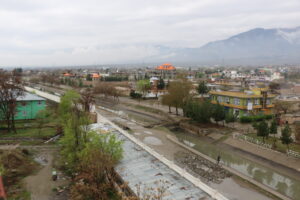
GHAZNI CITY (SW) – The central Ghazni province is witnessing an evident surge in children working roadside to earn a livelihood for their struggling families.
Polishing shoes, pushing carts and selling goods at the roadside as well as other hard work are some of the the common activities that children can be seen performing in Ghazni city. 11-year-old Zahid is a child who goes from shop to shop and car to car in Ghazni city to beg for money while burning the traditional herbs for them aga evil spirits. He told Salam Watandar that he is the sole breadwinner of his family of eight.
Zahid adds: “I work by myself, I work for 100-150 afghanis a day. I want to study, but if I don’t work, our family will starve.” He was wearing a thin and disheveled vest and the blackness of the smoke was visible on his childish face. He says that if the government helps his family, he will go to school himself to build his future. “We know nothing about the aid. The government has not helped us, it has never helped us. The government should help us so that I can go to school, my future should be secured.”
Ismail Khan is another child who earns 5 to 10 afghanis from people in this area by doing the same job. He says that he is responsible for providing for his family and he earns 50 to 100 afghanis a day, with which he takes home a few loaves of bread at night. “My father doesn’t work, I work myself. It’s too expensive, I have to work. Today I worked for 50 afghanis, other days I used to work for 100 afghanis.”
In another corner of the city, I meet Salim Shah, another 13-year-old child, and I asked him about his daily income and government and the sid organisations’ support. He says: “Today, I worked for 100 afghani, my father works on his push cart for livelihood. At one time, we received 4,000 afghanis, and at one time, we received a bag of flour and a barrel of oil as aid.”
The increase in poverty and unemployment in Afghanistan has caused an increase in child labor, and this issue has caused the complaints of residents of Ghazni and the concern of sociologists. They say that a number of these children have made working on the roads their profession despite their family’s good economy.
Mohammad Salem, a shopkeeper in Ghazni, says: “A number of them are in need, but most of them have their business. We ourselves understand that they come with enthusiasm. We see them running up to the cars and pushing to get dome money from the driver.”
Mohammad Jalil Karimi, one of the sociologists, also says: “The future of these children can be an inappropriate future because they stay away from social and academic education, and it is possible that when they grow up, they reproduce and continue the same cycle of producing children as adults.”
Meanwhile, Ali Mohammad Mahmoud, acting head of Ghazni’s Department of Labor and Social Affairs, told Salam Watandar that about 10,000 unaccompanied children live in this province and some of them are engaged in hard work.
He adds: “The number of homeless children reaches 9,000 to 10,000. With the cooperation of aid institutions, warm winter clothes have been distributed to about 2,570 of these children, and shops have been provided to 120 children over 12 years of age as small scale business support. “Some 16- and 17-year-old children have been referred to other professions.”
The Acting Director of Labor and Social Affairs of Ghazni also says that based on the order of the leader of the Islamic Emirate, the process of surveying orphaned children for financial support has started in the country and this process has also started in this province for some time now.
He emphasizes: “A plan has been approved by the leadership, based on which children who are left out of education and engaged in hard work will be helped. To implement this plan, a commission has been established by the ministries, which will be implemented in Ghazni soon. The Department of Labor and Social Affairs of Ghazni has started its investigations in the districts, and the investigations will be completed by the time the commissionbegins its work.”
Poverty, and the lack of a specific solution for the management of orphaned children have caused the number of working children in Afghanistan, especially in Ghazni, to increase day by day.
ENDS