The expansion of solar-powered pump use in Nangarhar has reduced farmers’ irrigation costs and helped increase crop yields. However, declining rainfall and excessive use of groundwater have raised concerns about falling water levels and the possibility of a water crisis in the coming years.
Farmers are pleased that irrigation costs have decreased and that supplying water to their fields has become easier. However, experts warn that if water resources are not properly managed, Nangarhar Province could face a serious water crisis in the future.
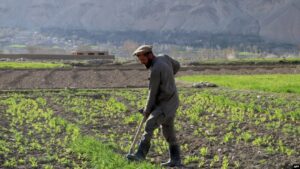
Arefullah, a farmer in Nangarhar, says he has been using a solar-powered irrigation system for three years, which has increased the production of his fields. However, he is also concerned about the decline in groundwater levels.
“Solar-powered irrigation systems have increased our crop production, but groundwater levels have decreased. In some areas, the water level has decreased by five to six meters. It would be better to use water from rivers through irrigation ditches to reduce pressure on groundwater,” he says.
Sawab Jan, who has been working in agriculture for about seven years, says solar-powered irrigation has made it easier to water his fields and reduced his costs.
“Solar-powered irrigation pumps have provided us with good facilities because they have reduced our farming costs. However, the falling water level has made us concerned. If water extraction continues at this rate, we may face water shortages in the future, and our agriculture could be harmed,” he says.
Abdul Wakil, another farmer, also says that because of declining water levels, he has deepened his water well from 55 meters to 75 meters over the past two years.
“The use of solar-powered irrigation pumps has increased crop production. Because the water level has fallen, I have had to deepen my well,” he adds.
Meanwhile, water experts say the main problem is not the use of solar-powered pumps but the irregular and excessive extraction of groundwater.
Rahmat Sadat, a professor at Nangarhar University’s Faculty of Agriculture, says Jalalabad city and the districts of Rodat, Surkh Rod, Chaparhar and Kot are among the areas facing serious groundwater decline. He considers proper water management, water storage and the development of water-saving irrigation systems necessary.
“The main solution is to manage water use and prevent waste. Water should be used properly, and when it is not needed, additional water should not be extracted. In addition, rainwater collection systems should be developed in valleys, and floodwater should be stored through dams and check dams so that groundwater can be recharged and water infiltration can increase,” he adds.
Mohammad Naeem Shinwari, an official of the Nangarhar River Basin, also says that the use of solar-powered pumps has increased by about 20 percent over the past five years due to declining rainfall.
“The districts of Chaparhar, Rodat and Ghani Khel are facing greater water shortages compared to other districts. Declining rainfall has had a significant impact on groundwater levels. To prevent excessive groundwater extraction, regulations are being implemented. Unauthorized wells and water networks are not allowed. Currently, 79 monitoring wells are being monitored to measure groundwater levels. If water resources are not protected, Nangarhar will face a serious water crisis within the next five to 10 years,” he says.
Although solar-powered pumps have reduced irrigation costs for farmers in Nangarhar and made it easier to water their fields, declining groundwater levels in Jalalabad, Rodat, Surkh Rod, Chaparhar, Kot and Ghani Khel have raised concerns. Experts emphasize that better water management, preventing excessive groundwater extraction, using river water, storing water and expanding water-saving irrigation systems should be prioritized to protect water resources.
Reporter: Alia Rahmati