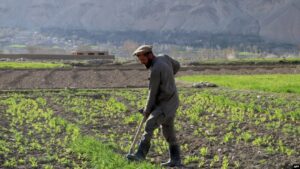
Consecutive droughts in Al-Jihad District of Sar-e Pol Province have created serious challenges for livestock owners. Shortages of fodder, dried grazing lands, and water shortages have caused many families to lose part of their livestock or sell their animals to sustain their livelihoods. However, the recent rainfall over the past month has renewed hope among livestock owners across the district.
Mohammad Zaman, a livestock owner in Al-Jihad District, says in an interview with Salam Watandar,
“We are rural people. When there is sufficient rainfall and a good year, it would be very good for us. And when snowfall and rainfall are less, we face serious difficulties. We cannot provide enough straw, grass, and feed, and many of our livestock die. If there is enough grass, our livestock can feed themselves, and there will be no problem. God willing, this year will be a good one. The water pits and pools have filled up, and people are very happy.”
Mohammad Saber, another livestock owner, says that drought over the past several years has had a negative impact on both agriculture and livestock.
“There was very little straw, and we faced many shortages of animal feed. Now, by the grace of God, both straw and cultivation have become abundant. If this year’s cultivation gives good results, there is straw this year, and we are storing rainwater. If we fail to store it, our livestock could die again in the future,” he says.
According to him, although the current situation is promising, there are concerns among people about the return of drought.
Gul Ahmad, another livestock owner in Al-Jihad District, also says,
“Of course, drought harms people’s livestock. People here are mostly farmers. If farming fails, livestock also suffers greatly. At the moment, we are relatively satisfied, but only God knows what will happen in the future. For now, the straw is good and the livestock are in relatively good condition. In previous years, a sheep sold for around 4,000 to 5,000 Afghanis, but now the price can reach 10,000 to 12,000 Afghanis or even more.”
Qamaruddin Poya, a climate change expert, says that reduced rainfall and rising temperatures in recent years have significantly diminished both the quality and quantity of fodder available in Sar-e Pol’s grazing lands.
According to him, while recent rainfall has improved conditions to some extent, it is not sufficient to compensate for the losses caused by droughts, and practical measures and improved natural resource management are required.
“This situation has caused livestock to become weak and the production of milk and meat to reduce. At the same time, fodder prices have risen, placing additional pressure on livestock owners. Livestock owners should store fodder during appropriate seasons, maintain herd sizes according to their capacity, and use grazing lands in turn. Proper water management and, where possible, cultivating fodder crops on private land can also help address these challenges,” he adds.
Ahmad Fawad, another climate change expert, says that in recent years climate change has had widespread impacts on the livestock sector in Sar-e Pol.
“Recently, climate change has had profound and multifaceted impacts on livestock in Sar-e Pol. The most important effects have been rising temperatures and declining regular rainfall, which have caused grazing lands to dry up and reduced the quality and quantity of natural fodder. On the other hand, changes in regular rainfall patterns (sometimes low and sometimes stormy and severe) have disrupted livestock management and reduced the production of livestock products such as milk, meat, and wool,” he says.
He warned that continued climate change could also threaten animal health, as shortages of fodder and clean water increase the risk of livestock disease spread.
Meanwhile, Nasrullah Hossaini, Head of Press at the Sar-e Pol Department of Agriculture, says that continued droughts in recent years have caused serious damage to both agriculture and livestock production in this province.
“When rainfall increases day by day, people become more hopeful about their livelihoods, farming activities, and livestock production. We have witnessed that drought has harmed people greatly, particularly those in Al-Jihad District, over the past several years. Fortunately, recent rainfall has led to the growth of grazing lands across different areas, and livestock owners are very pleased,” he says.
According to him, the Department of Agriculture, in cooperation with national and international organizations, has put in place awareness-raising programs and measures to reduce the impacts of climate change so that livestock owners can cope better with this situation.
Despite these concerns, livestock owners in Al-Jihad District remain hopeful that the continuation of rainfall and support from relevant institutions will improve the livestock situation in the area and help compensate for some of the losses from previous years.