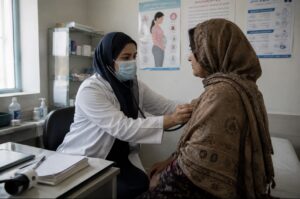
Psychologists say that forced marriage can affect women’s lives, leading to feelings of worthlessness, low self-esteem, anxiety, a severe decline in self-confidence, and even self-harming behavior.
Meanwhile, women interviewed for this report say they were forced into marriage without their consent based on decisions made by their families. According to them, these marriages have resulted in psychological trauma, dissatisfaction, and emotional difficulties.
Mursal Mohammadi, a 25-year-old woman who has been married for 11 years, says her life changed without her consent because of a family feud that forced her into marriage.
According to her, the decision took away her peace of mind and happiness. She recalls that entering her husband’s home was not the beginning of a joyful life, but the start of days filled with estrangement and suffering. She says she had no interest in her husband, and even being close to him was difficult and upsetting for her.
“My older brother became involved in a feud with another family, and my father had no choice but to send him abroad and marry me into that family. The hardest part of my life was going to my husband’s home. I was deeply unhappy and did not want him to come near me. For an entire month, we did not have a marital relationship because I was not interested in him. Whenever he entered the room, I would hurt myself and harm my own body,” she says.
Zarghona, another 22-year-old victim of forced marriage from Daikundi, shares a similar story. She says she has no interest in her husband and continues to live in sadness and distress. She explains,
“This marriage has had a very negative impact on my mental health. I had no interest in my husband then, and I still do not. My life continues without my consent and under force. I constantly feel sadness, distress, and discouragement. I feel like a prisoner who is merely alive but does not have a real life. Emotionally and psychologically, I have been completely affected. I am always distressed and vulnerable. Even during pregnancy, I was not in a good mental state.”
Zainab, a 27-year-old from Samangan, is another woman who was forced into marriage against her consent. She says that this situation has also affected her children’s emotional well-being and has left her feeling lonely.
“Because of my family’s decision and the circumstances at the time, I was forced to marry without my opinion or consent being taken into account. This situation has also affected my children’s emotional well-being, and at times they have sensed the tensions and unhappiness around them. For most of my life, I have felt lonely,” she says.
Meanwhile, psychologists warn that forced marriage can contribute to depression and a range of other mental health conditions, including psychological and psychosomatic disorders.
Abduljalil Amarkhil, a psychologist, says forced marriage reduces women’s self-esteem and can lead to psychological problems, while also contributing to an increase in factors such as domestic violence, infidelity, and divorce. He says,
“Forced marriage affects women’s self-esteem and sense of self-worth, and leads them to feel inferior. It can contribute to psychological and psychosomatic disorders, suicidal thoughts, self-harming behavior, and other mental health problems. Many women consider themselves victims and perceive marriage not as an emotional relationship but as a form of victimization.”
Zahra Qayoumi, another psychologist, says women in forced marriages are harmed both individually and socially, and are often unable to focus on their social relationships.
“A woman who is forced into marriage cannot fight for her rights, speak better in society, or build social relationships. She becomes distant from society and may develop depression. She may also become violent toward others because she has experienced violence herself,” she says.
Qutbuddin Mujtahid, a religious scholar, says that under Hanafi jurisprudence, marriage without the consent of both the woman and the man is not valid, and mutual consent is a fundamental condition of marriage. He also describes forced marriage as contrary to Islamic principles.
“The foundation of marriage is the consent of both parties. According to Hanafi jurisprudence, if an adult woman is married without her consent, she has the right to reject or seek the dissolution of the marriage (faskh-e nikah). Forced marriage is contrary to Islamic principles, and consent is a fundamental condition of marriage,” he adds.
Ahmad Rashed Seddiqi, a sociologist, emphasizes that marriage should be based on the mutual consent and choice of both parties—the woman and the man—because the family is the foundation of a healthy society.
“When we speak of forced marriage, we mean imposing a life partner on a girl without her consent, which unfortunately exposes her to serious problems. This can also lead to the unhealthy upbringing of children. Therefore, we should allow our sons and daughters to choose their own partners. Such marriages are more likely to be successful and can help build the foundation of a good society,” he says.
Meanwhile, Saif-ul-Islam Khyber, spokesperson for the Ministry for the Promotion of Virtue and Prevention of Vice, says that nearly 10,000 forced marriages have been prevented over the past five years. He also points to the ministry’s ongoing awareness-raising programs on forced marriage. He adds,
“Over the past nearly five years, the Ministry for the Promotion of Virtue and Prevention of Vice has prevented nearly 10,000 forced marriages. These figures do not include the 1404 solar year or the current year. If we provide precise statistics, the number would exceed 11,000. The ministry’s muhtasibs (employees) continue to raise awareness through religious scholars, educational centers, religious schools (Madrasas), and schools.”
Consent is not only a fundamental condition for marriage under Islamic principles, but also an essential factor in building a healthy family. Therefore, ignoring or disregarding it can lead to psychological problems and, in some cases, the breakdown of a marriage.
Reporter: Husna sadat