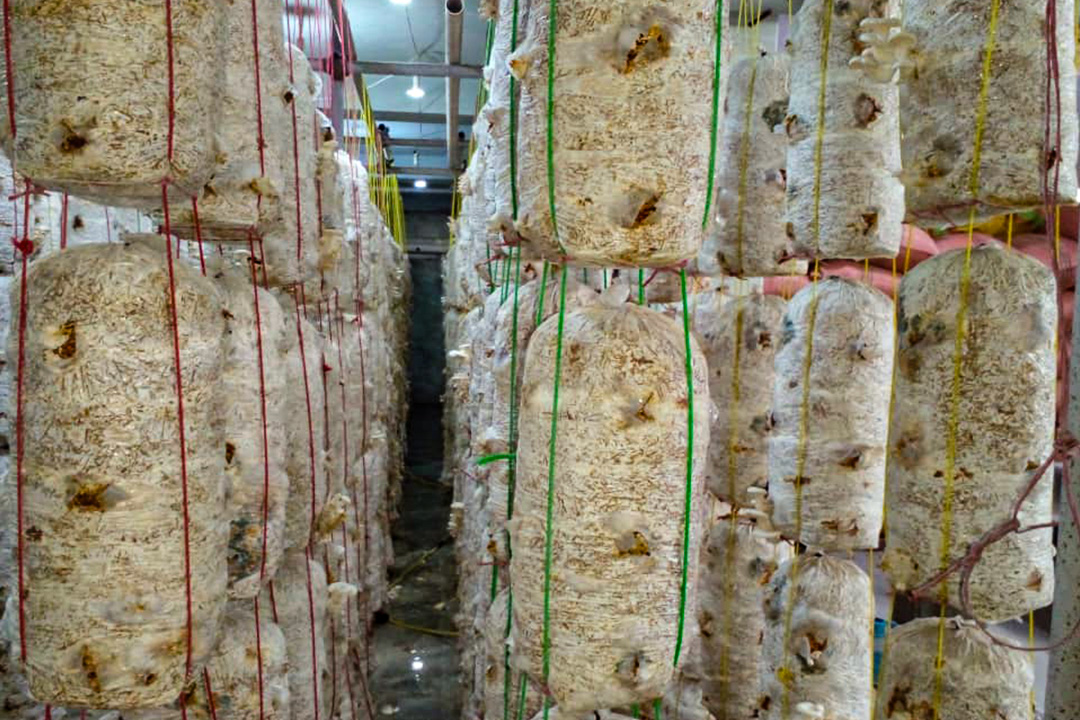
An initiative by a woman in Kabul to establish a mushroom farm has not only led to her own financial independence but has also created employment and income opportunities for dozens of other women. Fazela Sorosh began mushroom farming in Kabul two years ago with a small investment, driven purely by personal interest. She says this initiative has now become a stable source of income for herself and many other women.
Speaking about her motivation and how she started, she told Salam Watandar, “Over the past two years, because of my interest in mushrooms, I started cultivating them. Since I had no prior experience and did not know how the work was done, I spent one or two months researching and then, with an investment of two thousand Afghanis, I set up a small farm.”
Her success in the first experience motivated her to expand her work. She decided to establish a larger farm and began searching for mushroom spawn (seeds). According to her, cooperation with another woman made this process easier.
“When I got a good harvest, my interest grew even more. I built a larger second farm and partnered with a woman who had a large basement in her home. After creating this shared farm and seeing positive results, I moved toward research and production of mushroom spawn, and fortunately achieved good results.”
According to Sorosh, in addition to achieving her own financial independence, the farm has indirectly provided training and employment opportunities for women in five other provinces. She says,
“While working on the second farm, I trained nearly 500 women. I exported mushroom spawn to different provinces and encouraged women to establish farms in their homes. Fortunately, today mushroom spawn is sent to provinces such as Herat, Ghor, Laghman, Paktia, Balkh, and Logar, where mushroom farms have been established.”
However, she emphasizes that the path to success has not been without challenges. The main problem has been the lack of suitable land for expanding mushroom cultivation.
“The biggest problem for me was the lack of space. We expected the Ministry of Agriculture to provide us with land.”
Manizha Safi, another active woman in this field who has established a mushroom farm in Kabul, describes her challenges as follows,
“Our only problem has been the lack of market for selling products. Regular sales require a standard laboratory, distribution equipment, and packaging facilities. So far, we have received no support or cooperation from any governmental or non-governmental organization.”
Horiya Ahmadi from Jawzjan, one of the women working in this sector, says,
“Last winter, we established a mushroom farm and achieved positive results. I am happy that I succeeded. At first, the work was experimental, but with Ms. Sorosh’s online guidance, I achieved good results.”
Hamida Sediqi from Baghlan, another woman engaged in this work, says,
“I started with a small investment of about two thousand Afghanis, and now we are working on seven farms. We are happy that we not only provide good, protein-rich food for ourselves, but also for several other women who both consume and sell it.”
Meanwhile, women’s rights activist Huwaida Hadis believes that expanding such initiatives can help reduce women’s unemployment. She calls on the government to support these activities.
“Women’s participation in mushroom cultivation helps strengthen their economic empowerment and improves their position in agriculture. We should use their products within the country. Institutions and the Ministry of Agriculture should support women’s presence in farms and provide suitable land for cultivation.”
Shaker Yaqubi, an economic expert, considers women’s role in agriculture fundamental and says that supporting women’s work in this sector can reduce poverty and improve family economic conditions. he adds,
“The role of women in Afghanistan’s agriculture—from cultivation and harvesting to primary processing and food preservation—is undeniable. In many rural areas, women are the main pillar of agricultural production, and their active participation increases family income and reduces poverty. However, they face serious challenges such as access to land, capital, markets, technical training, and modern technology. If women farmers gain access to small loans and organized markets, they can play a more effective role in the country’s economic growth.”
The success story of Fazela Sorosh and other women engaged in mushroom farming shows that with small investments and personal initiative, opportunities for employment and women’s empowerment can be created. However, the lack of institutional support, the shortage of suitable land, and market challenges remain serious obstacles for these hardworking women.
Reporter: Liza Omari