Lack of awareness, limited treatment facilities, and poor prenatal care have led many pregnant women in Takhar to face fetal hydrocephalus. Doctors in the province say that when mothers do not receive proper checkups or information during pregnancy, babies are more likely to be born with this condition.
They explain that hydrocephalus can not be treated in Takhar because the necessary facilities are not available there. As a result, they have to send their patients to Kabul for treatment. This forces families to travel long distances for care, creating serious challenges for both mothers and newborns. They also urged the authorities to take concrete steps to improve healthcare services and increase awareness among mothers.
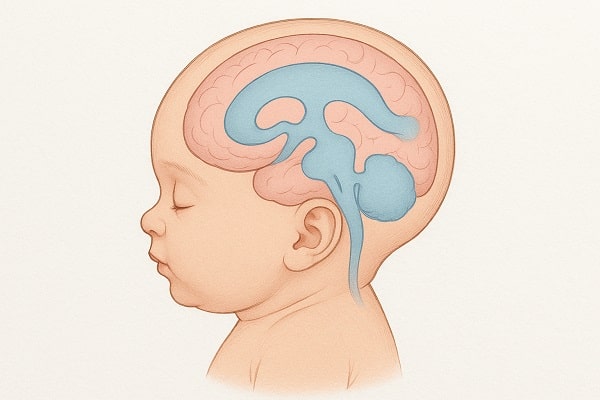
Fazl Karim Sahebzada, a pediatric specialist in Takhar, describes the illness clearly, “Hydrocephalus can be congenital or acquired.”
He says. “It happens when cerebrospinal fluid (CSF) collects too much in the brain’s ventricles. The child’s head becomes enlarged. Later, these children may face developmental delays, intellectual disability, infections, and feeding problems. They must stay under medical supervision until surgery. Sadly, fewer than 5% of families really understand this disease.”
Mahfooz Noori, another pediatric specialist, explains it simply: “When too much fluid gathers in a child’s head, it grows abnormally large.” He stresses the importance of early diagnosis. “If mothers are informed on time, they can make better decisions and prevent serious consequences.”
He also explains the treatment options: “If the brain fluid is less, we give acetazolamide tablets. If it’s severe, surgery is necessary. Most children need surgery because their heads become too large. A small number of them do not survive.”
He adds that the situation is worse in rural areas. “There’s no ultrasound in many villages and districts. Some babies die at birth. Later, families realize the baby’s head was larger than the body. Doctors who perform ultrasounds must inform mothers clearly. They should say, ‘Your baby’s head is enlarged. You may need surgery.’ That way, the family can make the right decision.”
Several women in Takhar say that learning their unborn babies have hydrocephalus has filled them with fear and anxiety, and that the lack of proper facilities and awareness has made it even harder for them to make decisions.
Zarmina, from ‘Qalbaras’ village, shares her experience: “In my twentieth week of pregnancy, during an ultrasound, the doctor said, ‘There is fluid in your baby’s head. It may be hydrocephalus.’ I did more tests, but there weren’t enough facilities in Takhar. I had to travel to another province. The doctor told me, ‘You must stay under observation. Your baby may need surgery, and you might also need an operation.’ I’m scared, but I’m continuing my pregnancy and leaving the rest to fate.”
Manizha Hamidi, from ‘Sofiayi’ village, discovered in her sixth month that her baby had hydrocephalus. “The doctors said, ‘You must have surgery,’” she recalls. “I was afraid of both childbirth and the operation. After the delivery, they put my baby in a machine and said, ‘There is too much fluid. We must operate immediately.’ Now he is under medical care, but we don’t know if he will survive. I had never even heard of this disease before. No one in my family had it. This was my first experience.”
Bibi Gul, from ‘Khaskapa’ village, speaks with deep sorrow. “When my baby was born, we took him to the hospital. The doctors said, ‘His condition is critical. He needs surgery. He may survive, or he may not.’ During the operation, my baby died. We lived in a remote village and didn’t understand this illness. The doctor was not very experienced. If I had known more, maybe I could have saved my child.”
At the same time, the lack of medical facilities—including CT scan and MRI machines—has left doctors in Takhar unable to treat children with hydrocephalus at the provincial hospital, forcing them to transfer patients to Kabul for care.
Dr. Mahfooz Noori says, “We do not have a neurosurgery department. When we see a child with an enlarged head, we tell the family that the condition cannot be treated here and refer them to Kabul, where MRI and CT scan facilities are available and specialized care can be provided.”
Reports show that many women in Afghanistan, especially in remote areas, still struggle to access basic healthcare. There are not enough diagnostic tools, not enough female specialists, and very few awareness programs. Because of this, serious conditions like hydrocephalus are often diagnosed late, and treatment comes too late for some families.
Reporter: Farida Hafizi