Executive summary
This survey, conducted with the participation of 1,020 farmers from 30 provinces of Afghanistan, provides a clear and alarming picture of the widespread impacts of drought on livelihoods, food security, and social stability in rural communities across the country. The findings show that drought is not only a climatic challenge, but a multi-layered crisis with economic, social, and environmental consequences that threaten the sustainability of Afghanistan’s agricultural sector.
Key findings
- More than 80% of farmers reported being directly affected by drought.
- 90% expressed serious concern about the severity of its impacts.
- 91% of farmlands experienced reduced yields or complete crop failure.
- Over 70% of households faced a significant decline in income.
- 70% of water sources have decreased or dried up entirely.
Objectives of the survey
Main objective:
To comprehensively assess the impacts of drought on Afghan farmers and identify effective coping and response strategies.
Sub objectives:
- To measure the level of farmers’ vulnerability to drought;
- To identify the most affected provinces and critical areas;
- To assess the economic and social consequences of drought;
- To examine farmers’ adaptation and coping measures;
- To provide policy recommendations.
Research methodology
Study population: All active farmers across 30 provinces of Afghanistan.
Sampling method: Multi-stage cluster–stratified sampling.
Sampling stages:
- Stage One: Selection of provinces based on agricultural significance;
- Stage Two: Selection of sample districts within each province;
- Stage Three: Random selection of farmers within each cluster.
Sample size
- Final sample: 1,020 farmers
Data collection tool
A structured questionnaire consisting of:
- Demographic characteristics (5 questions)
- Impacts of drought (8 questions)
- Economic consequences (6 questions)
- Adaptive measures (7 questions)
- Access to support and assistance (4 questions)
Study period: April to August 2025
Publication date: (July–August 2025)
Definition of drought:
A significant reduction in rainfall, drying of surface water sources, and decline in groundwater levels, leading to a substantial decrease in agricultural production.
Study limitations
- Limited access to some remote areas due to complex geography and time constraints.
- Lack of comprehensive historical data.
- Resource constraints preventing full coverage of all districts.
- Absence of precise climatic data for all regions.
Comprehensive abstract of the drought survey in Afghanistan
Executive summary
This survey, conducted with the participation of 1,020 farmers across 30 provinces of Afghanistan, provides a clear and alarming picture of the widespread impacts of drought on livelihoods, food security, and social stability in rural communities. The findings indicate that drought is not merely a climatic challenge, but a multi-layered crisis with economic, social, and environmental consequences that threaten the sustainability of the country’s agricultural sector.
Key findings
Over 80% of farmers reported being directly affected by drought, and 90% expressed serious concern about its severity. Wheat, the country’s main crop, suffered the most, with 91% of farmlands experiencing reduced yields or complete crop failure.
The economic effects are severe; over half of households faced a significant drop in income, and nearly one-fourth experienced a complete loss of income. The drought has worsened water availability, with 70% of water sources depleted or dried up, particularly affecting irrigated lands.
Provinces like Badghis, Logar, and Kunduz are in an extreme crisis; Faryab and Maidan Wardak are severely affected, while Badakhshan is among the less affected provinces. Geographically, central provinces face high migration and land dryness, Northern provinces experience reduced production, and eastern provinces show limited coping responses.
Only some farmers have taken adaptive actions, such as digging wells or changing crop types. Kabul leads in positive responses, while Takhar has the highest rate of inaction. Half of the farmers received no assistance, and nearly the other half lacked necessary training.
The survey emphasizes the need for immediate and comprehensive measures across infrastructure, support services, education, and adaptation. Without effective planning, drought could escalate into an uncontrollable crisis for Afghanistan’s agriculture and food security.
Overall picture of drought in Afghanistan
Report summary
In recent years, drought has emerged as one of Afghanistan’s most serious climate crises, leaving deep impacts on farmers’ lives. This survey, conducted with 1,020 farmers across 30 provinces, provides a detailed and concerning picture of the economic, social, and environmental dimensions of this phenomenon.
The vast majority of respondents were men, but the participation of 19% women shows that, even in smaller numbers, women play an active role in agriculture. The largest age group—youths aged 20 to 25—indicates that farming is common among young Afghans, making their survival and future directly tied to climate developments.
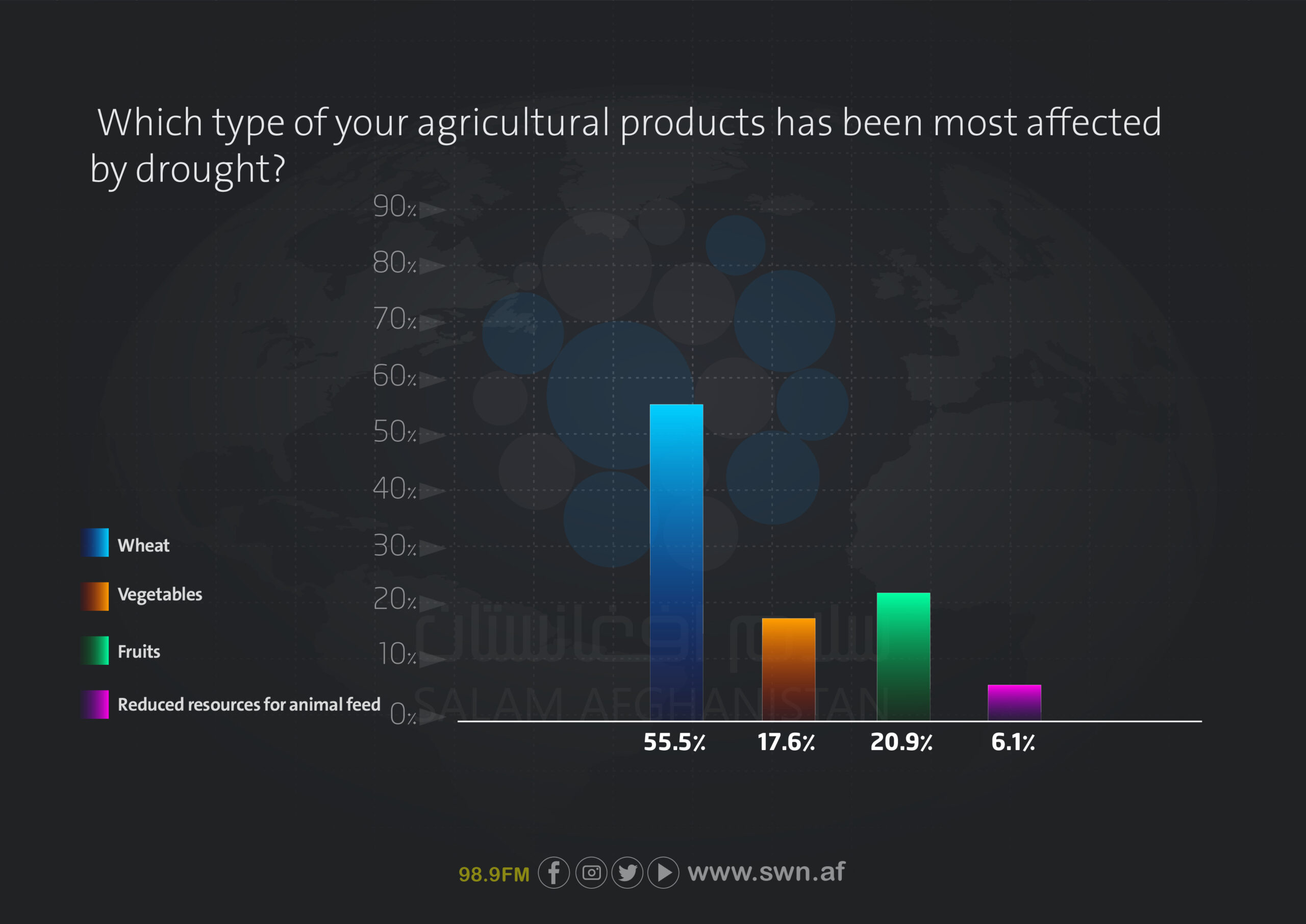
Over 80% of farmers reported direct negative impacts of drought on their land and crops. Nearly 90% said their crops were heavily damaged or reduced, with wheat—the main staple for Afghan families—suffering the most at 55.5% loss, posing serious food security challenges.
The economic consequences are also striking. More than 70% of households experienced a sharp decline or complete loss of income, highlighting growing structural poverty and the fragility of farmers’ livelihoods. Combined with livestock losses or forced migration, this paints a clear picture of the gradual erosion of rural economic and human capacity.
Regarding agricultural infrastructure, most farmers depend on surface water sources; however, about 70% reported that their water sources had decreased or dried up completely. High dependency on unstable water sources threatens the future of agriculture even further.
Only some farmers have managed practical responses, such as digging wells, changing crops, or switching occupations. One-third of farmers took no action, reflecting poverty, despair, or lack of institutional support.
This sense of abandonment is reinforced by findings showing that less than 7% of respondents received effective assistance, while half received no help at all, and the rest heard only empty promises. This reveals a major gap between urgent local needs and the response from the government and international agencies.
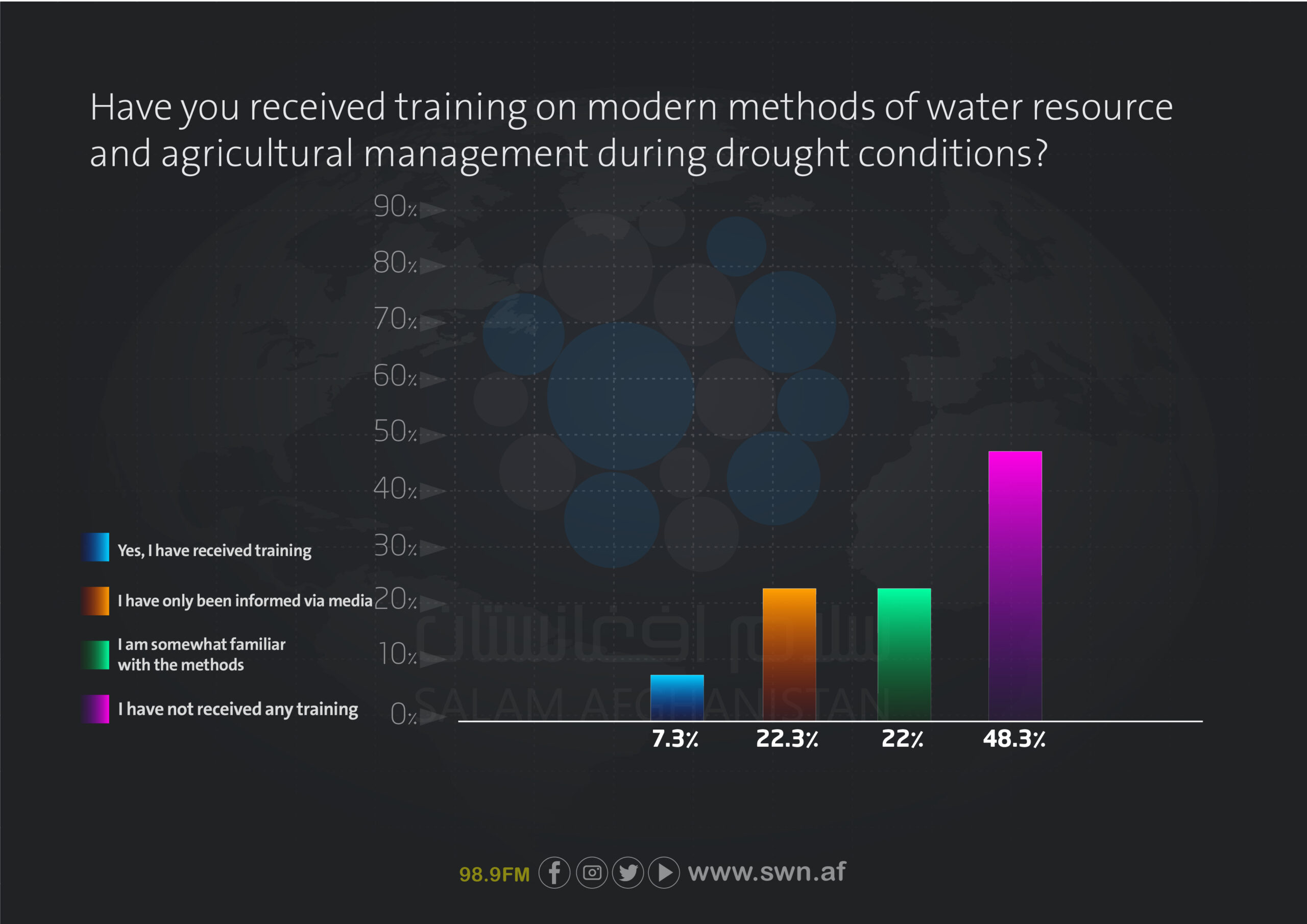
Low awareness of drought management among farmers is another barrier to reducing damage. Nearly half have received no training, highlighting the need for broad educational and support programs.
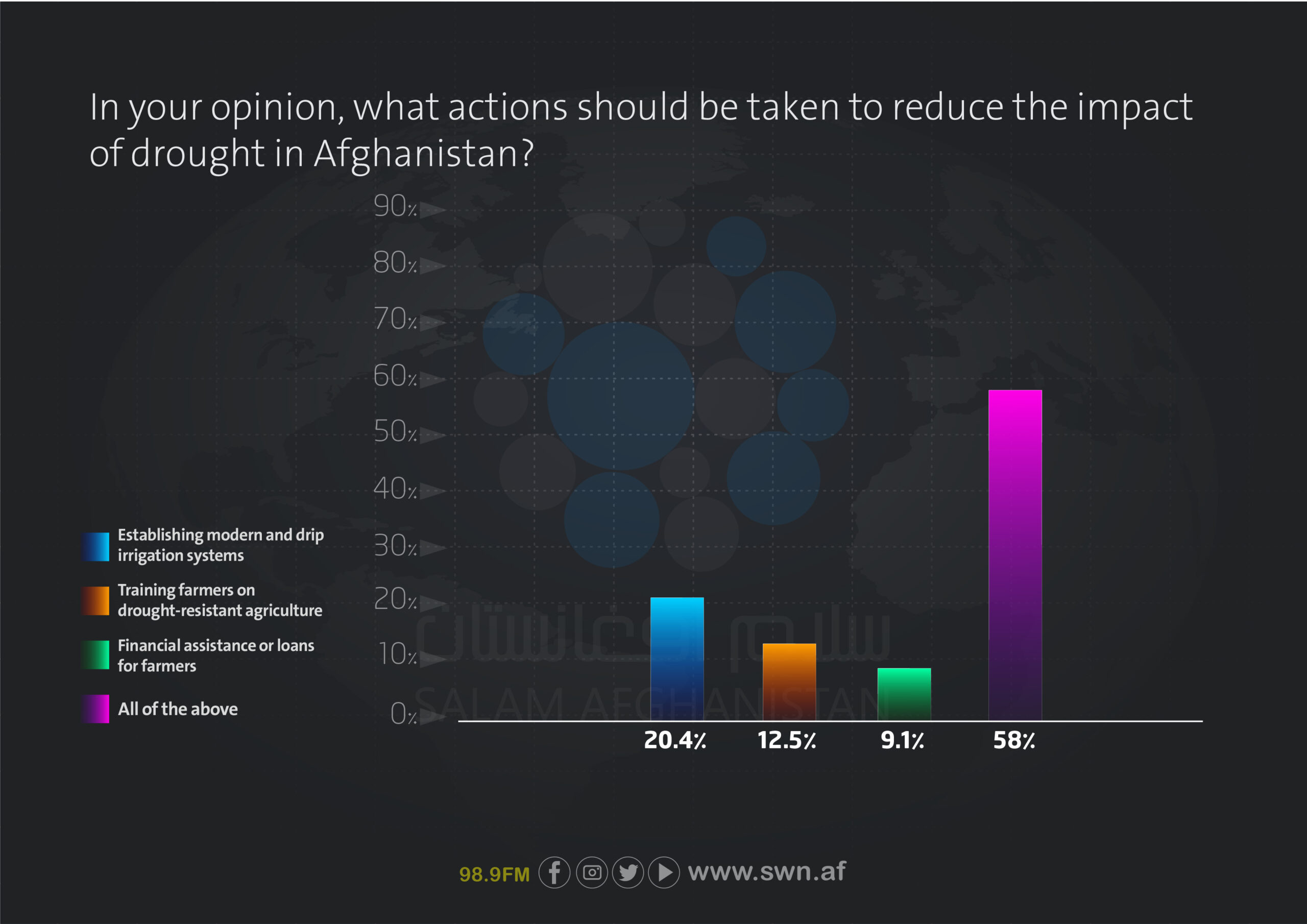
Finally, respondents emphasized combining solutions such as modernizing irrigation systems, training, and financial support, underlining their understanding of the multi-layered nature of the crisis. The survey shows that addressing drought requires a comprehensive, multi-dimensional approach involving direct participation from local communities. Without it, poverty, social instability, and internal migration are likely to escalate.
Overall report
Demographic characteristics of respondents
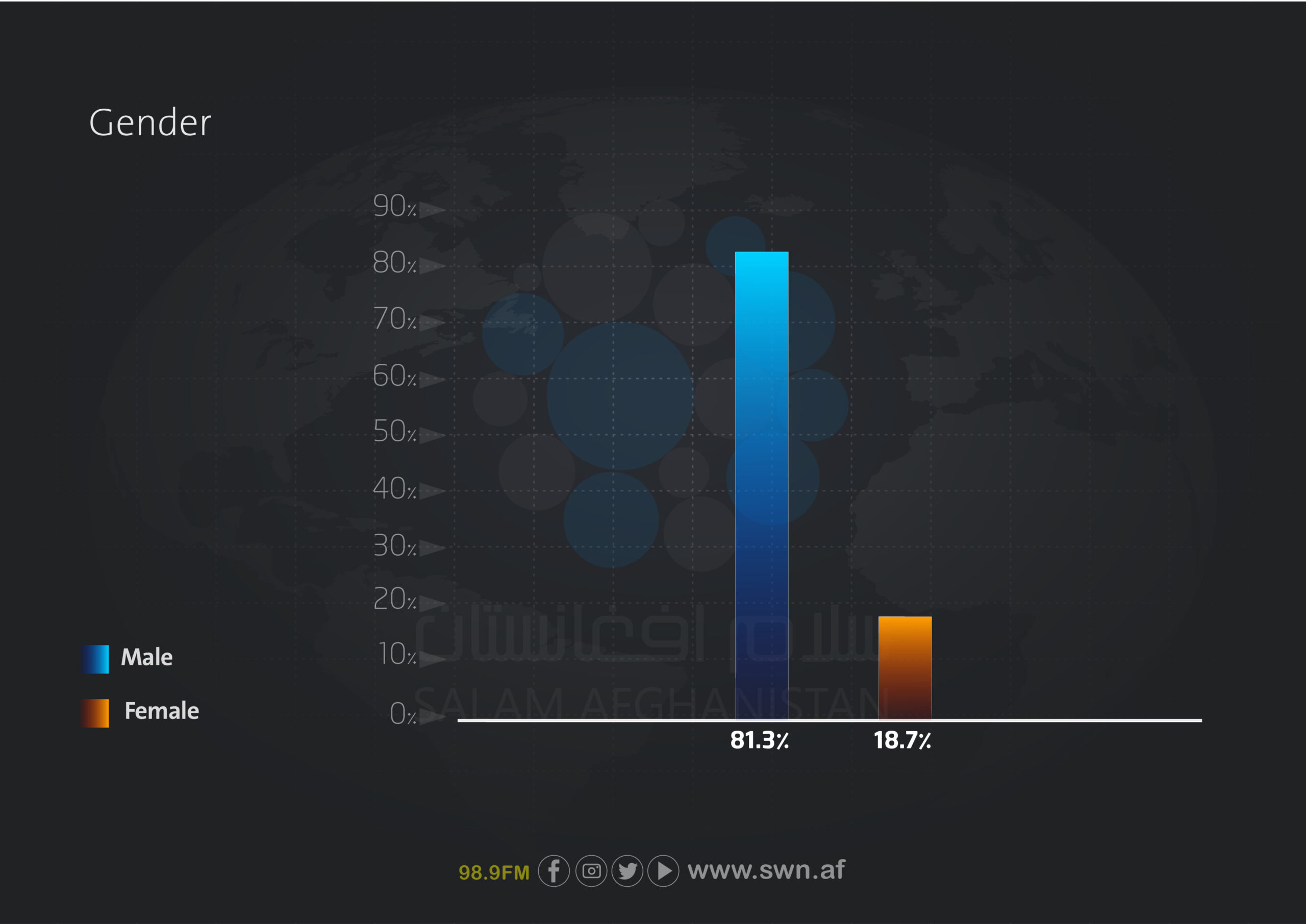
This survey was conducted among 1,020 farmers across 30 provinces. Of the 1,020 respondents, 829 (81%) were men and 191 (19%) were women, indicating that the majority of participating farmers were male.
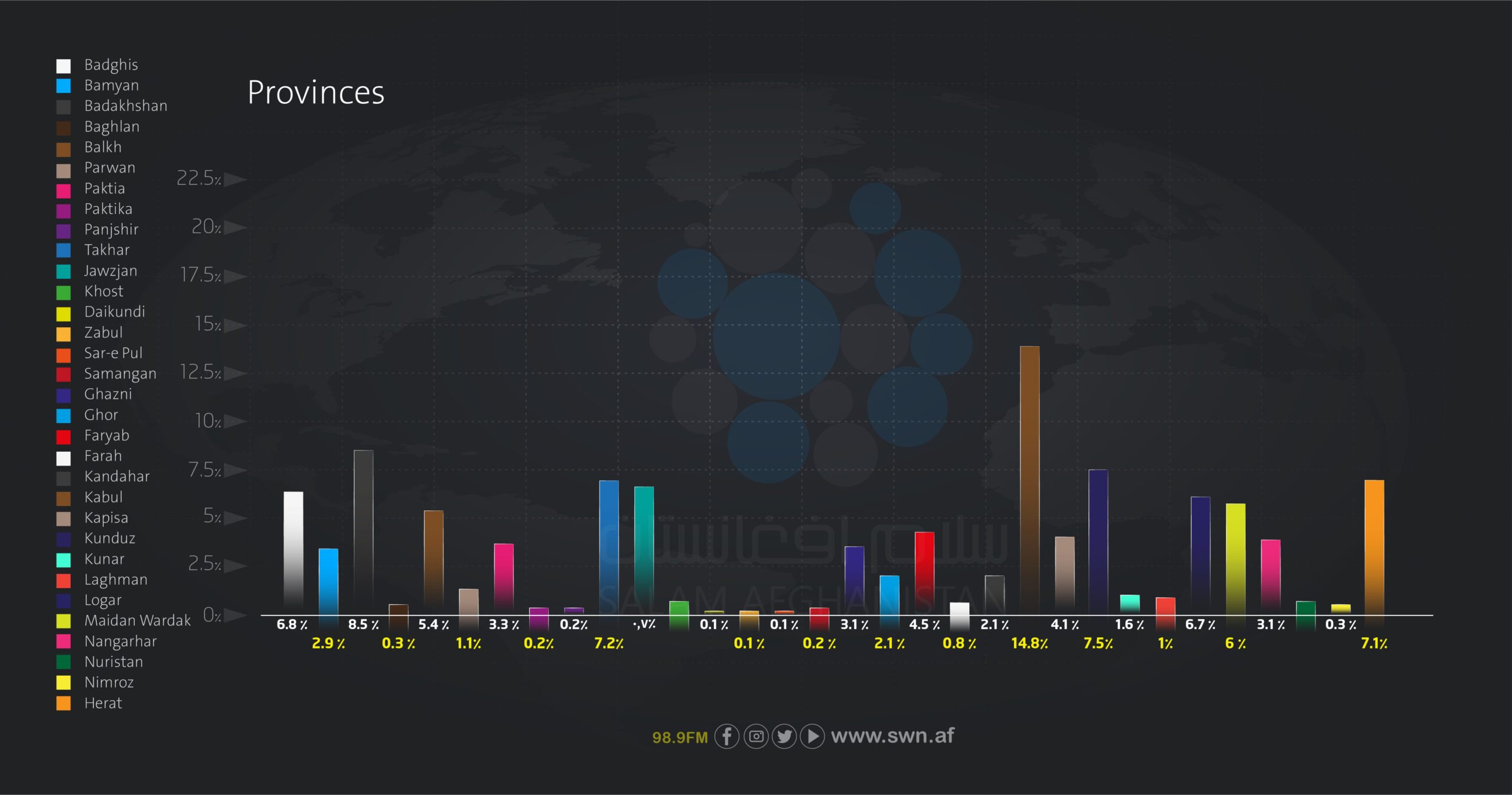
Farmers from all 30 provinces participated in the survey. The highest numbers came from Kabul (151), Badakhshan (87), Kunduz (76), Takhar (73), and Badghis (69). The lowest participation was from Sar-e Pul, Zabul, Daikundi, Baghlan, and Nimroz, each contributing fewer than three respondents.
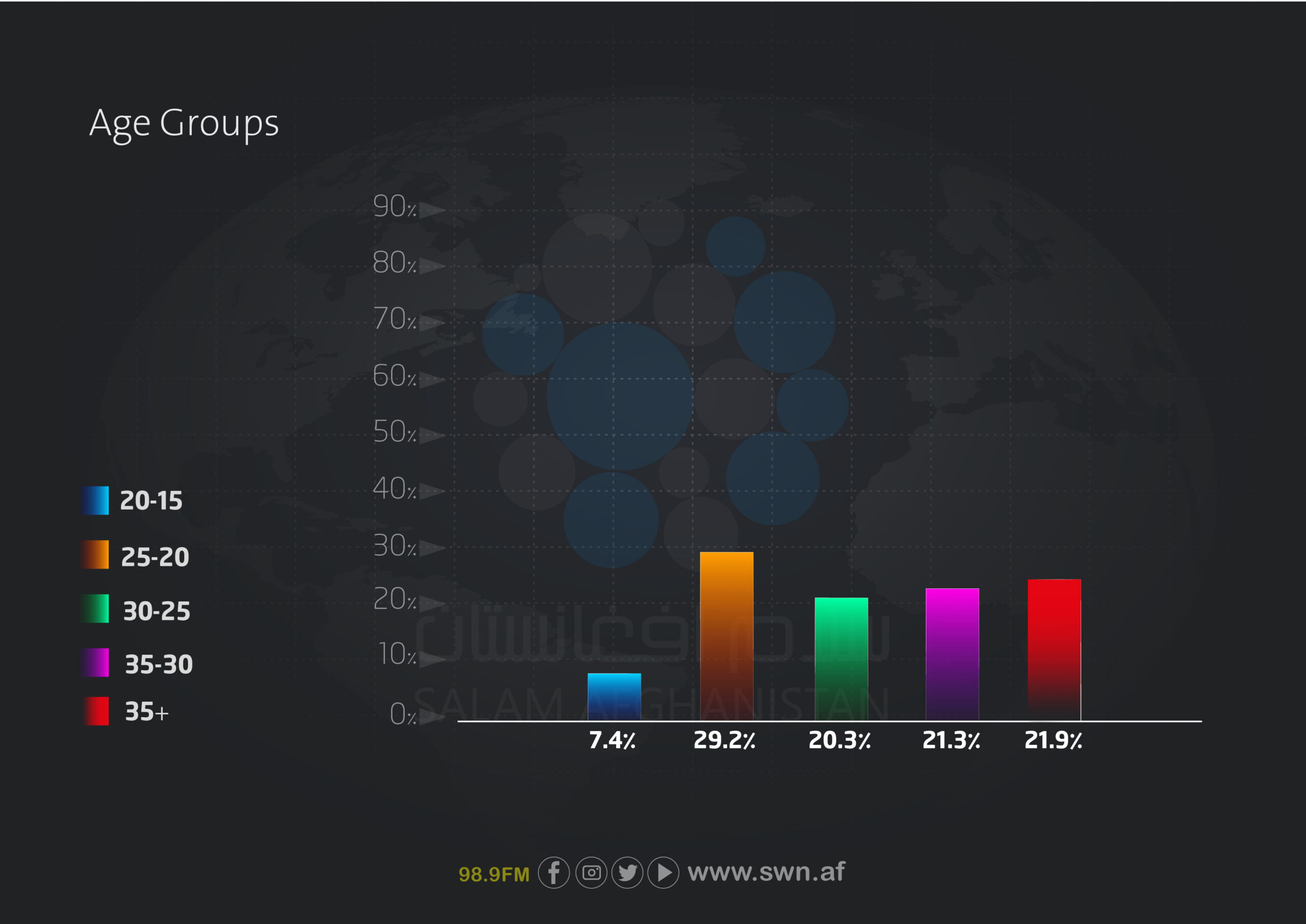
The largest group of respondents was aged 20–25 years (298 individuals, 29%). This was followed by ages 30–35 (217, 21%), 25–30 (207, 20%), and over 35 years (223, 22%). This indicates that farming is common among young people in Afghanistan.
Impact of drought on agriculture
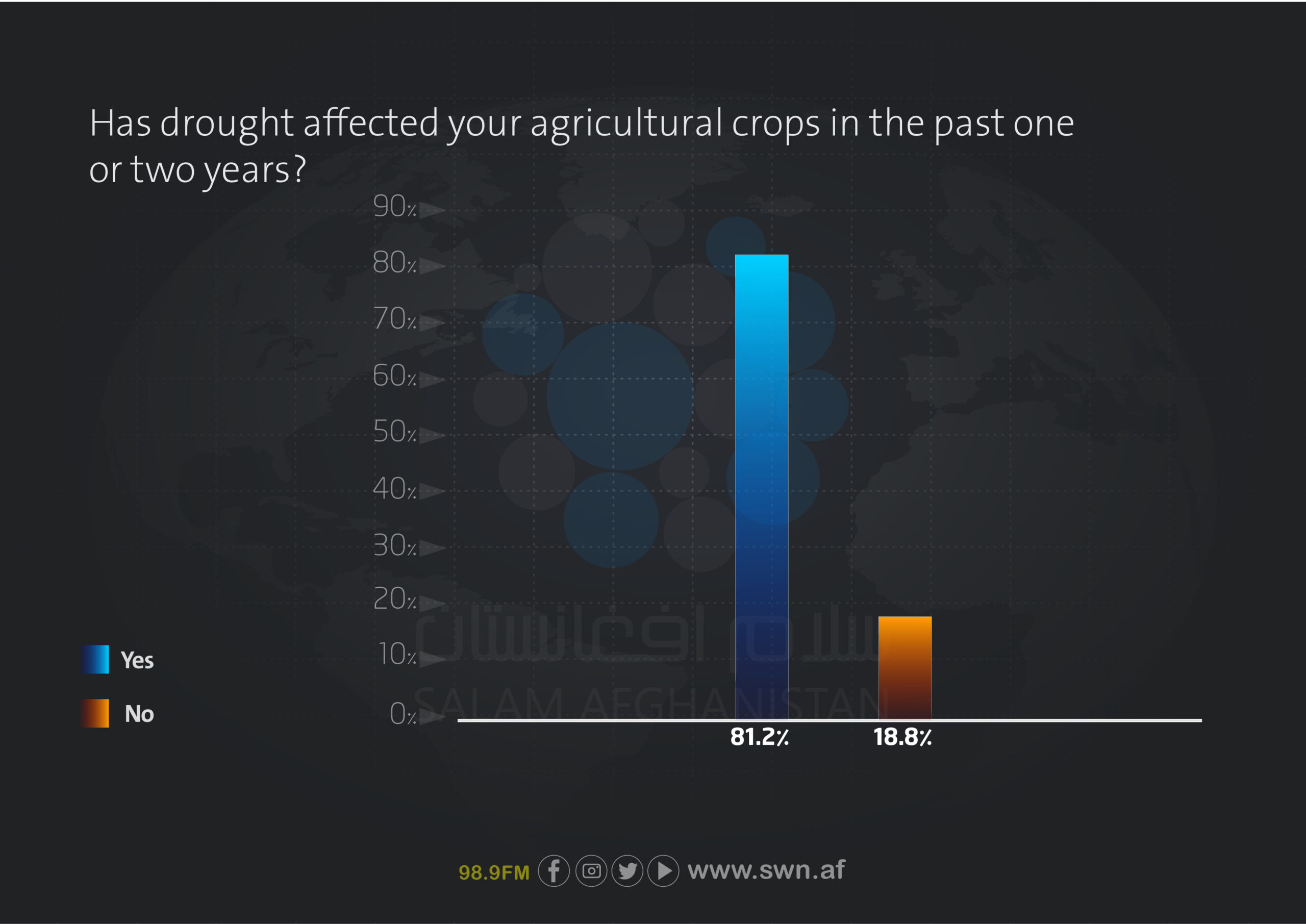
More than 81% of respondents confirmed that drought over the past one to two years has affected their crops. Fewer than 19% reported observing no impact.
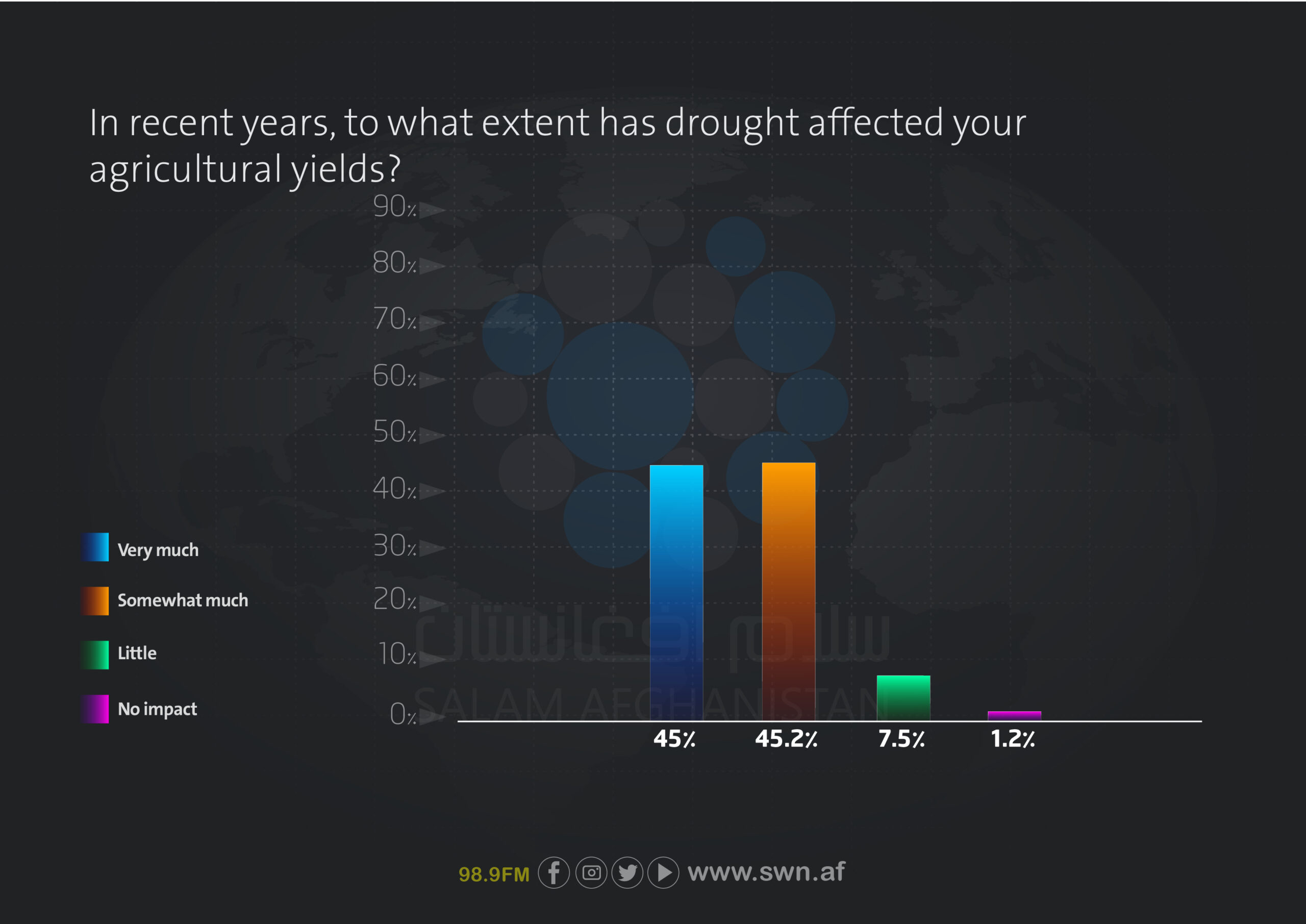
Over 90% of farmers reported that drought has affected their crops severely or to a large extent. Only 1% stated that they did not feel any impact.
Direct consequences of drought
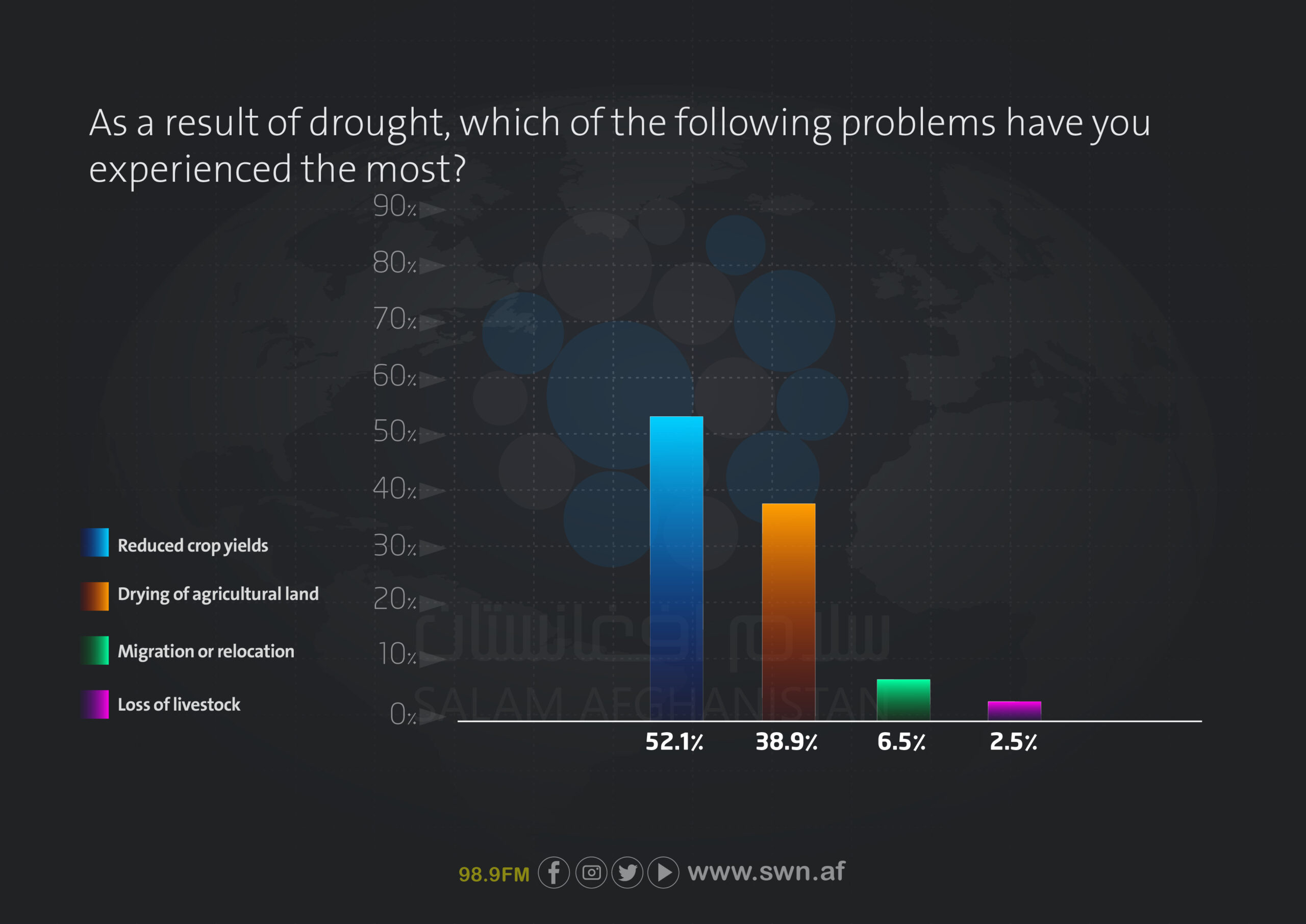
91% of participants reported reduced crop yields or complete drying of their farmland due to drought, while the remaining 9% stated that they lost livestock or were forced to migrate from their areas.
Wheat suffered the most, with a 55.5% loss—a particularly concerning finding, as wheat is Afghanistan’s main staple food. Fruits and vegetables were affected next, ranking after wheat in terms of damage.
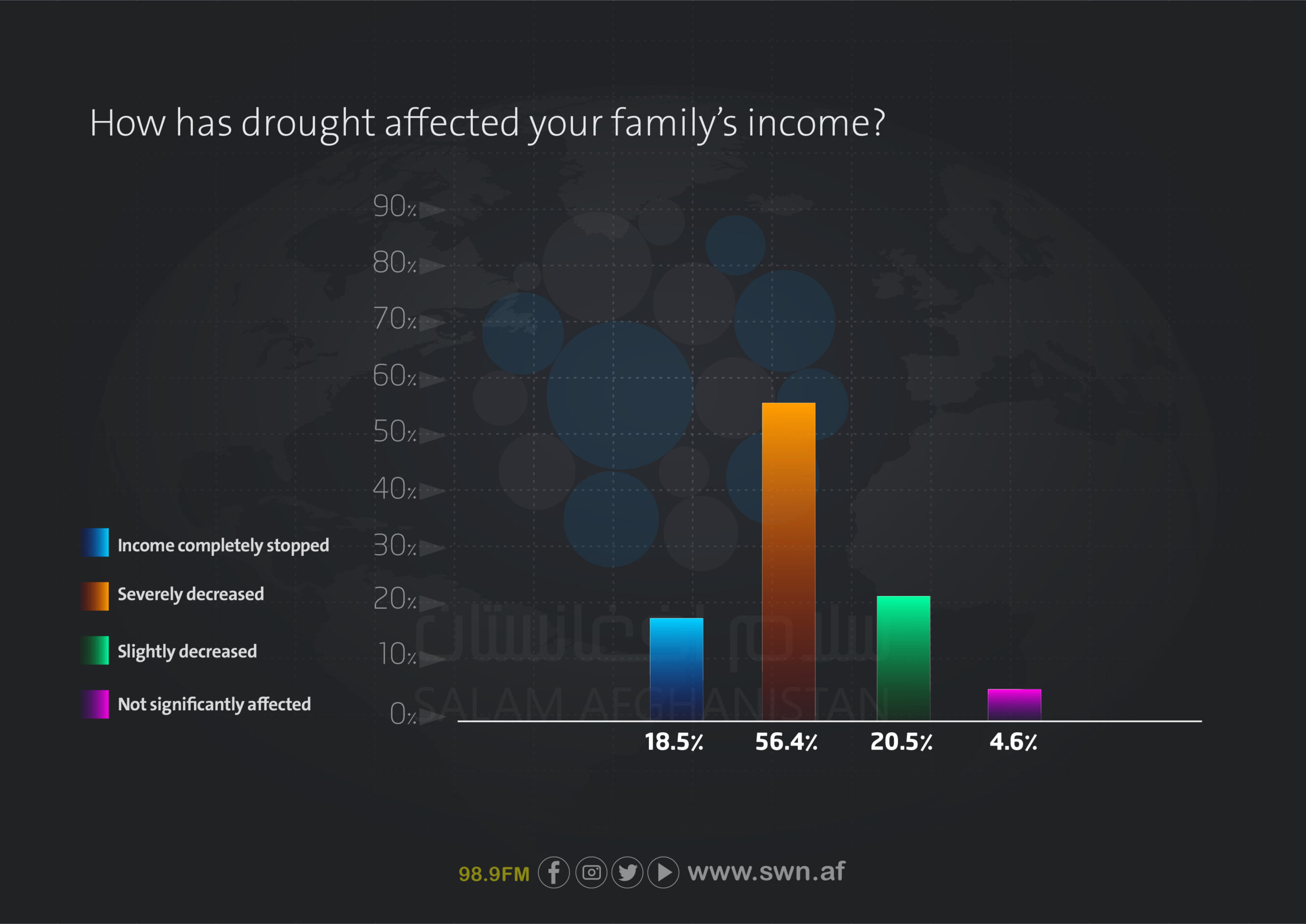
Drought has severely affected household economies. Income for 56.4% of families has sharply declined, while 18.5% have experienced a complete loss of income. Only 4.6% reported little or no impact. These figures reflect the widespread poverty caused by drought.
Land type and vulnerability
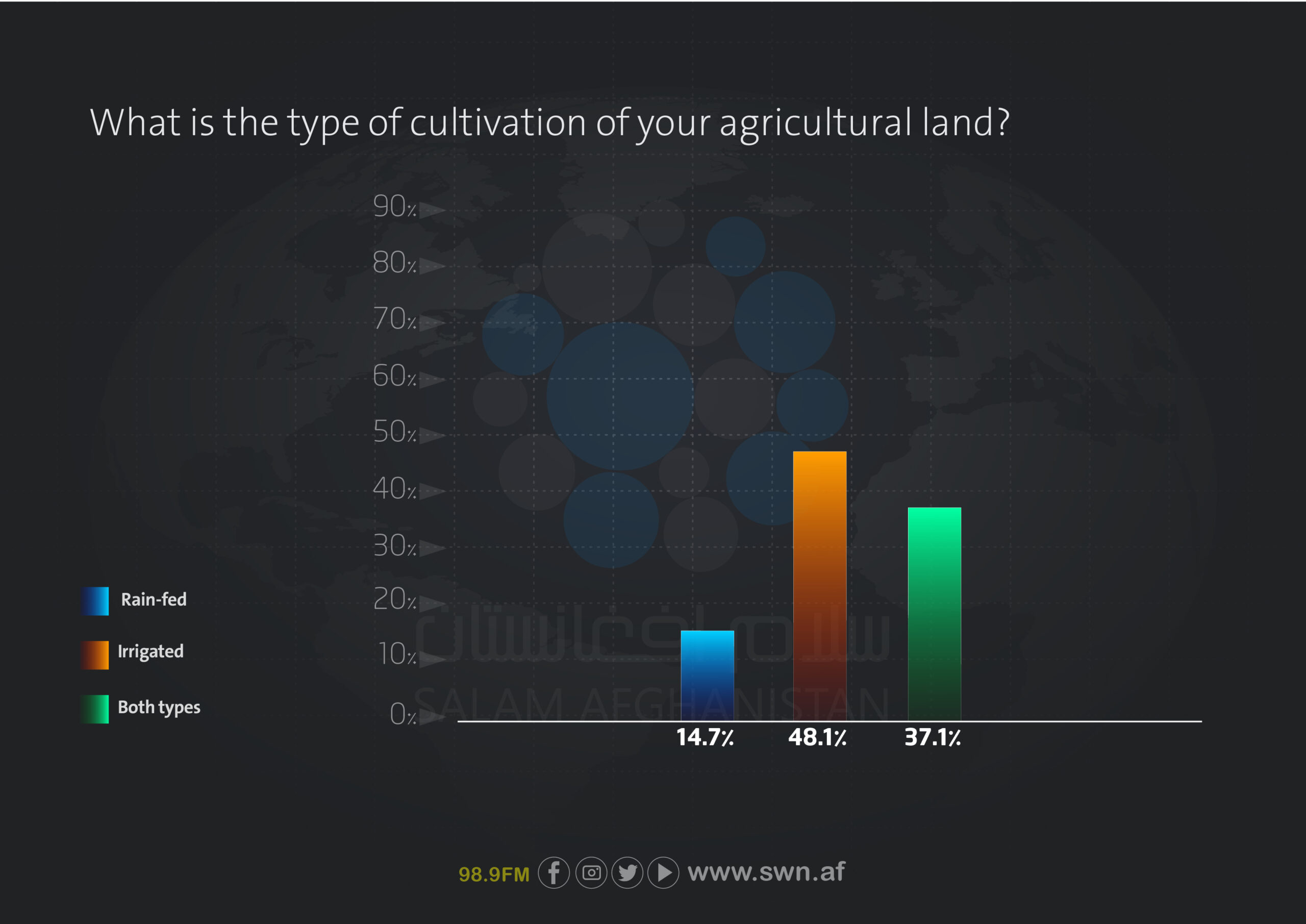
Nearly half of the farmers (48.1%) cultivate irrigated land, while 37.1% have a mix of irrigated and rain fed land. Only 14.7% rely solely on rain fed farming.
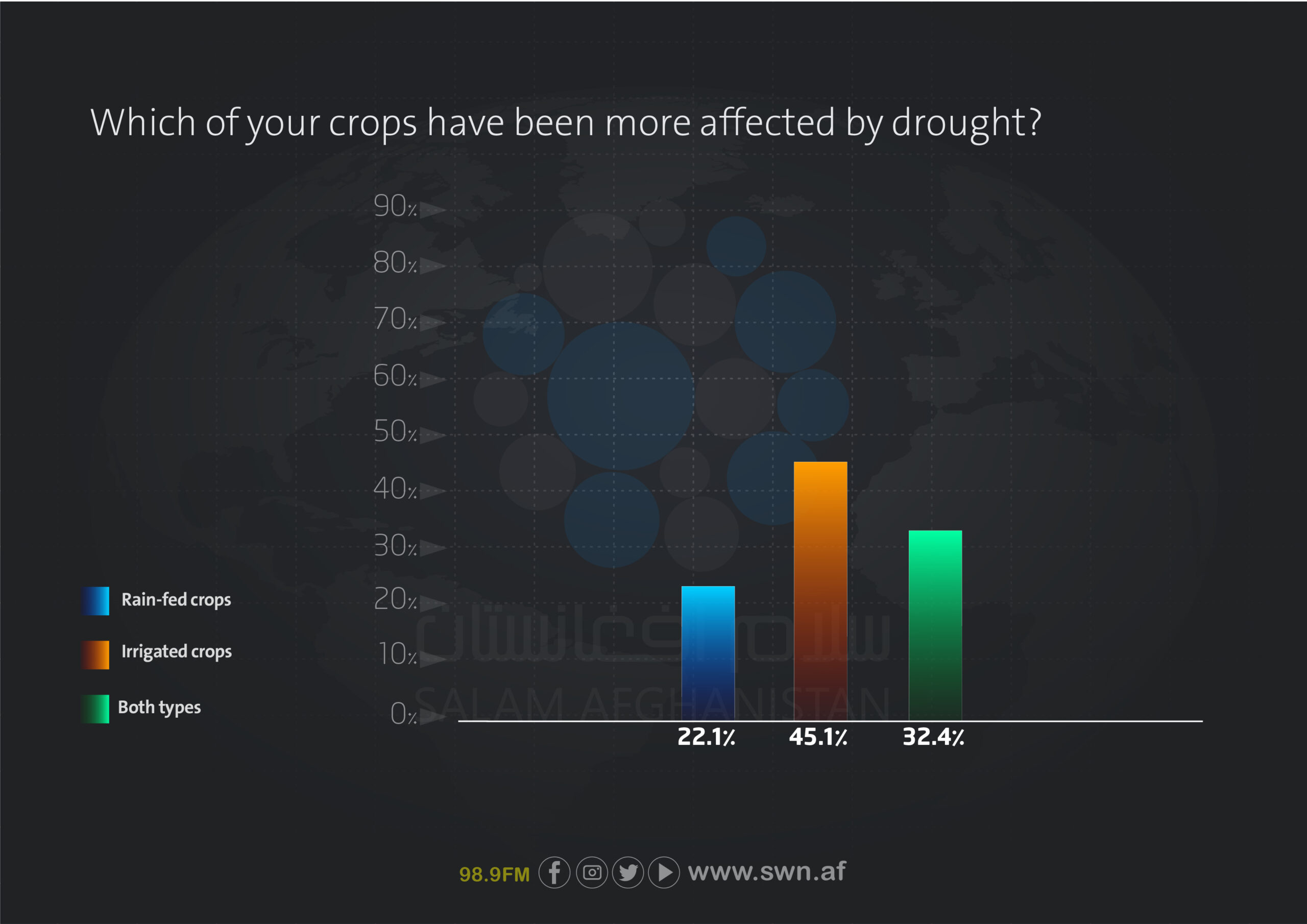
Respondents reported the highest crop damage on irrigated lands (45.5%). However, about one-third (32.4%) stated that both their irrigated and rain fed lands were affected.
Water sources and irrigation changes
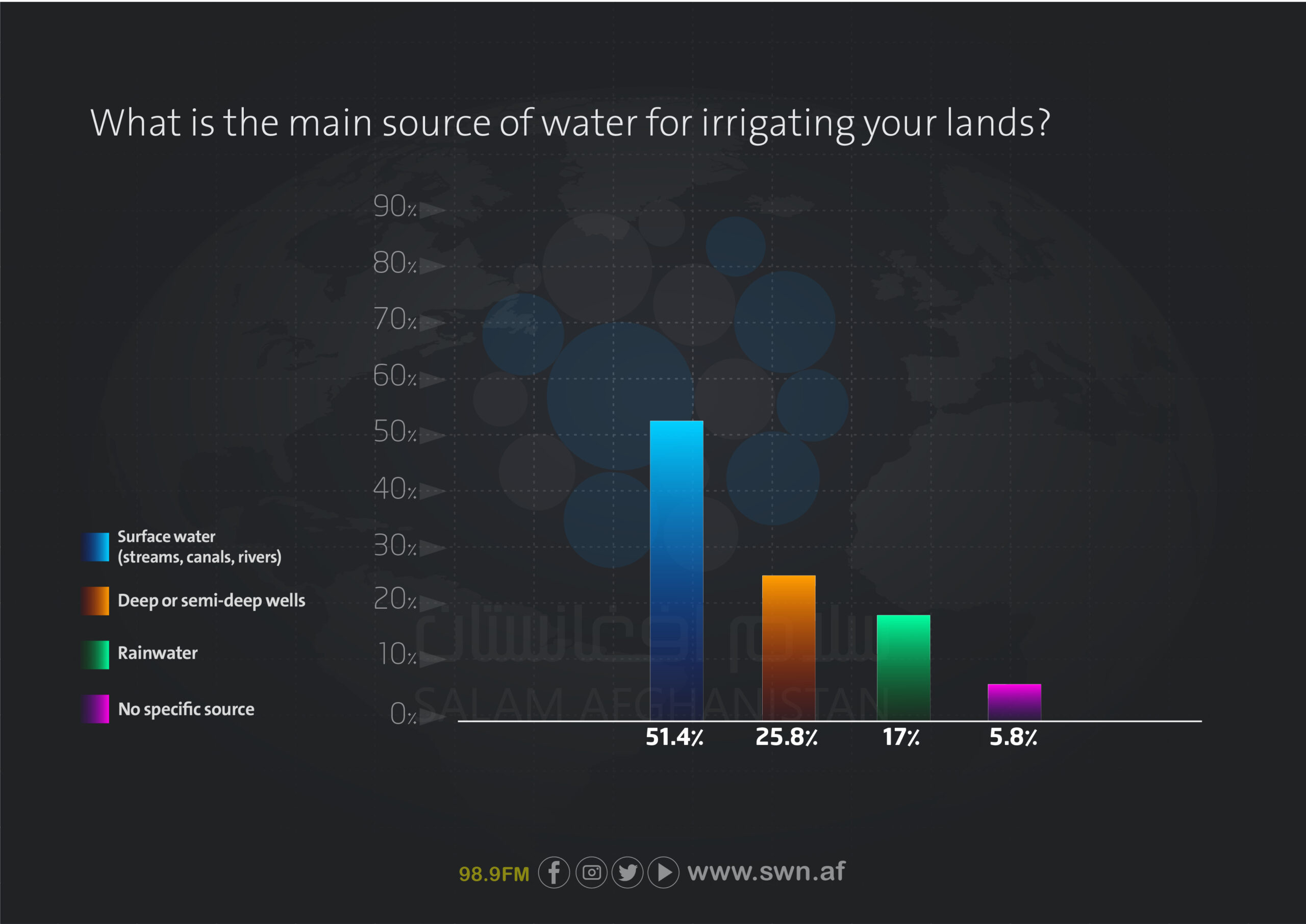
Over half of the participants (51.4%) rely on surface water, while 25.8% use deep or semi-deep wells. Only 17% depend on rainwater for irrigation.
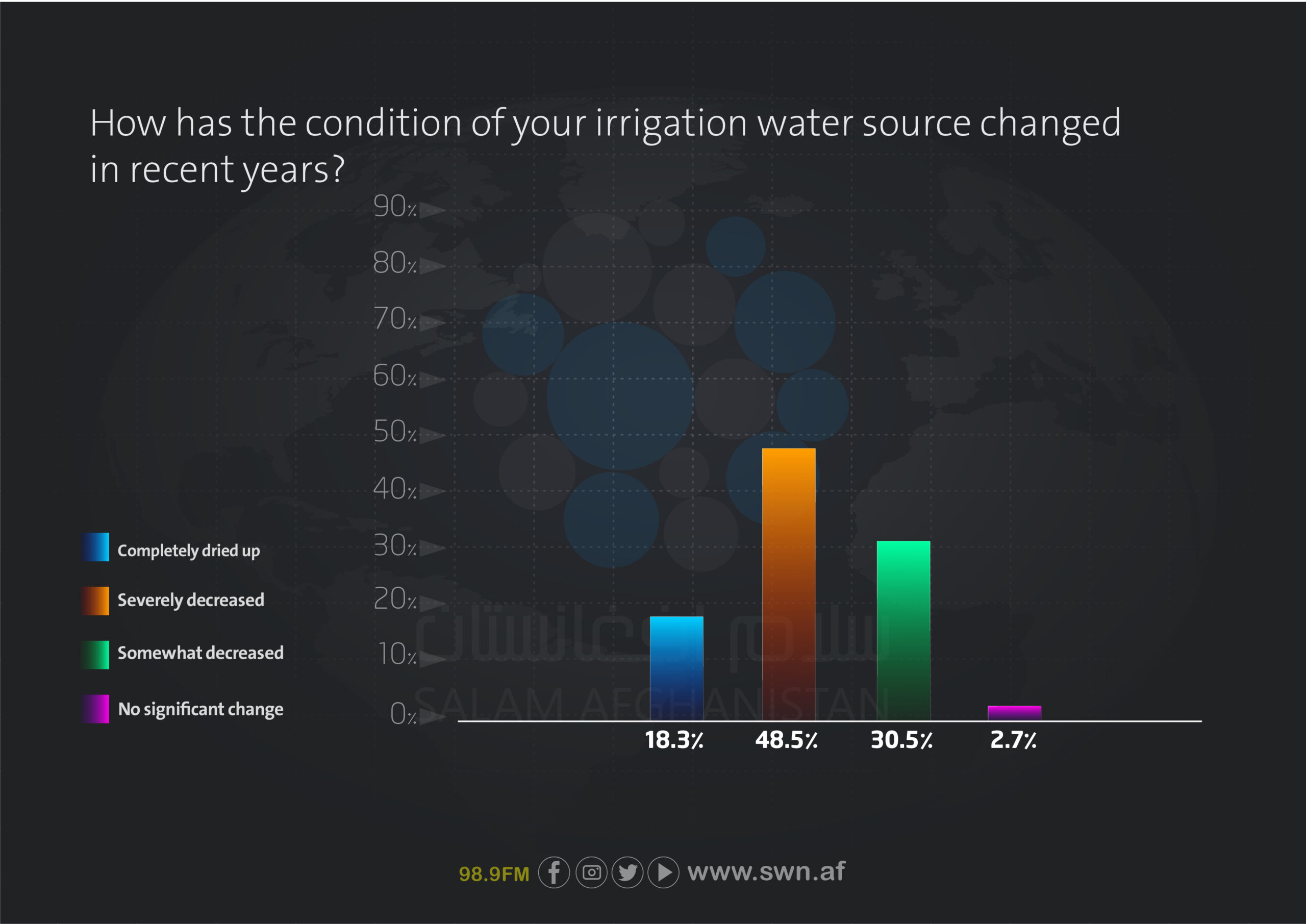
Nearly 70% of respondents reported that their irrigation water sources have either significantly decreased or completely dried up.
Respondents’ reactions and actions
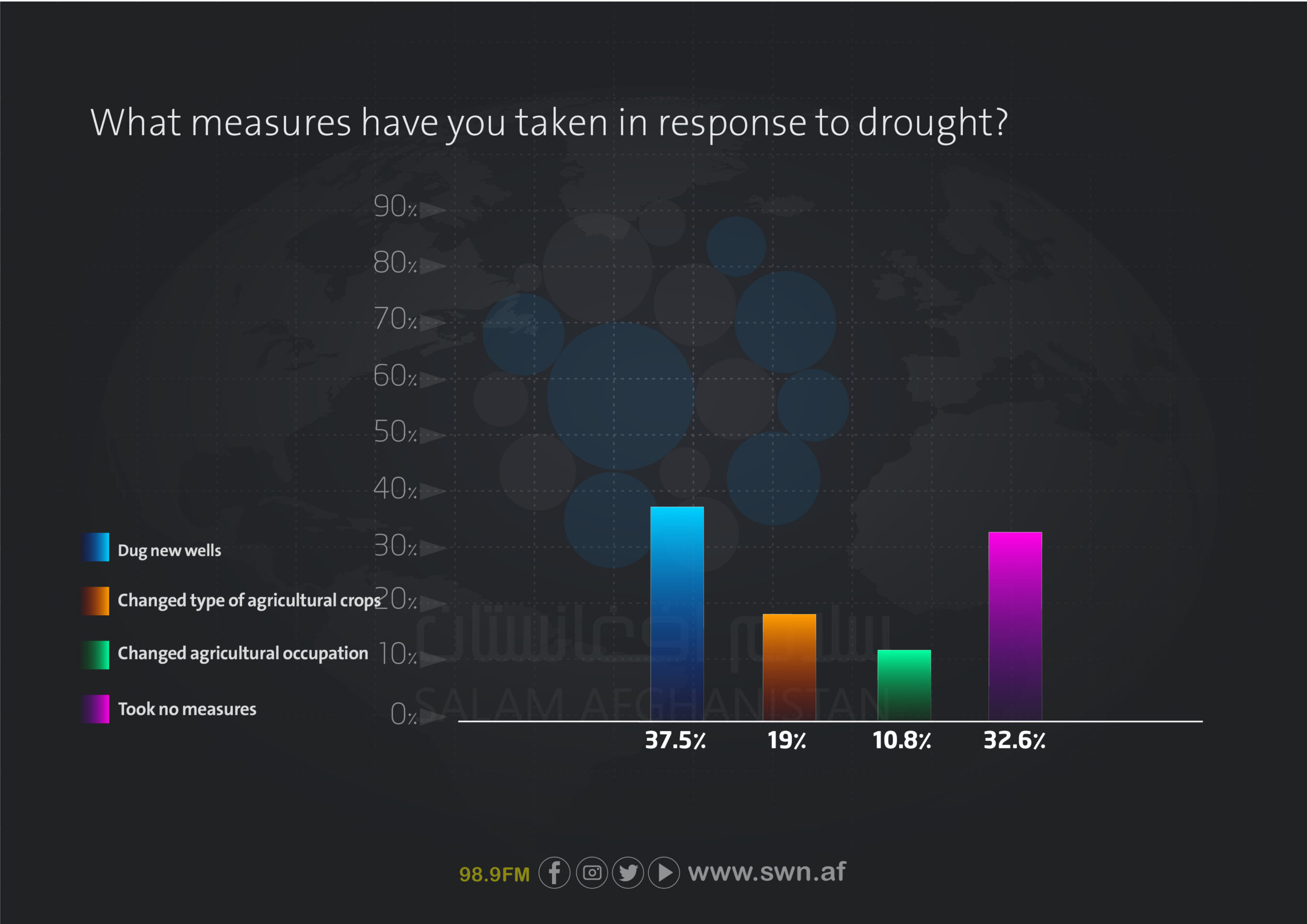
37.5% of respondents have dug wells as a response to drought. Another one-third took no measures, likely due to lack of financial capacity or awareness. Changing crop types and switching occupations were among other coping strategies employed.
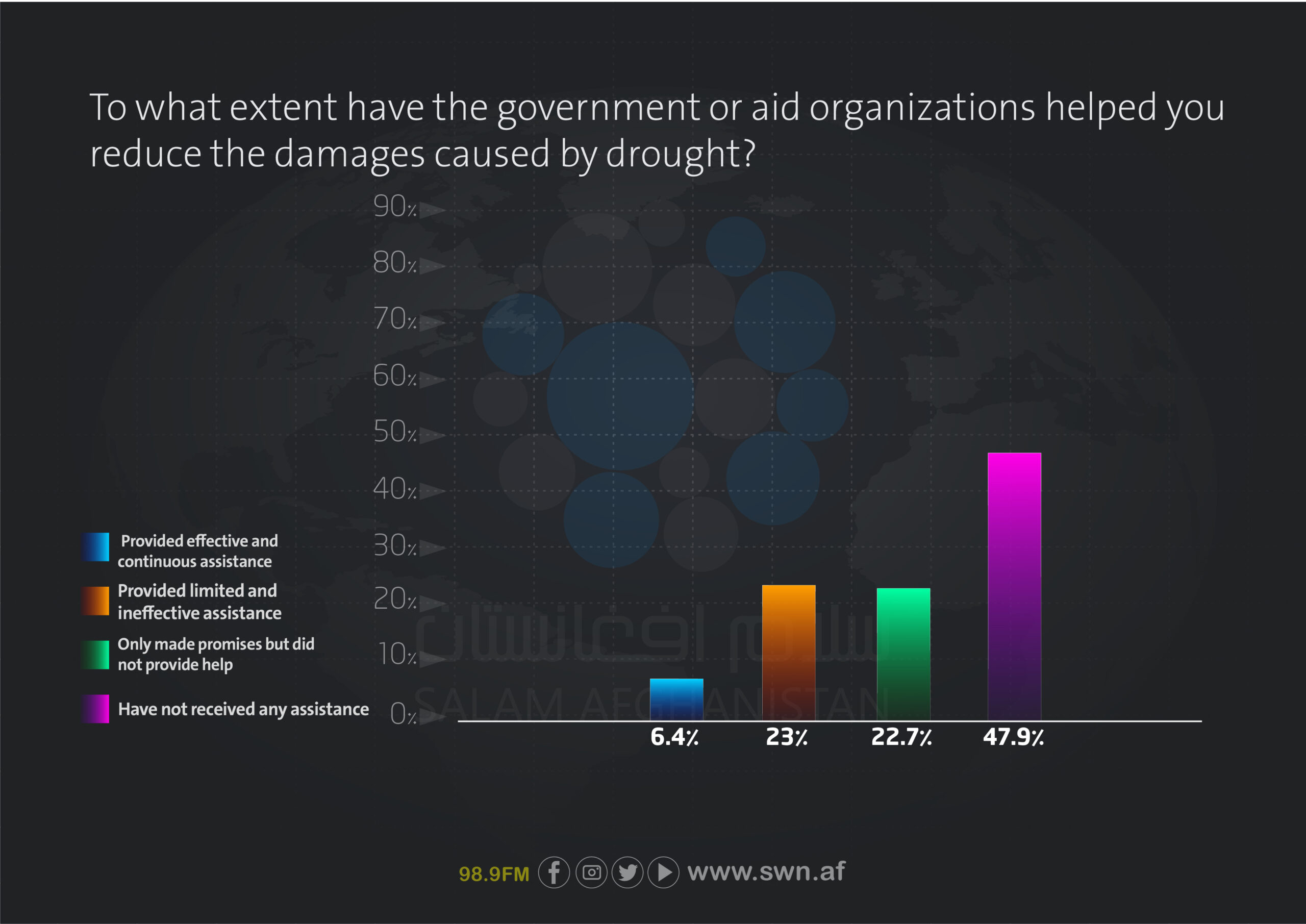
Nearly half of the respondents received no assistance. 22.7% reported receiving only empty promises, while just 6.4% benefited from effective support. This situation highlights a significant gap between farmers’ needs and the responses of responsible institutions.
Over 48% of respondents reported receiving no training on drought management. Only 7.3% had formal training, while about 44% gained partial awareness or learned through media sources. This underscores the urgent need for comprehensive educational programs.
Proposed solutions to mitigate the impacts of drought
Over half of the participants (58%) emphasized the need to implement all proposed measures—modern irrigation systems, training programs, and financial support. This response reflects the community’s clear understanding of the crisis’s complexity and the necessity for multi-layered solutions.
Provincial comparison and priority identification
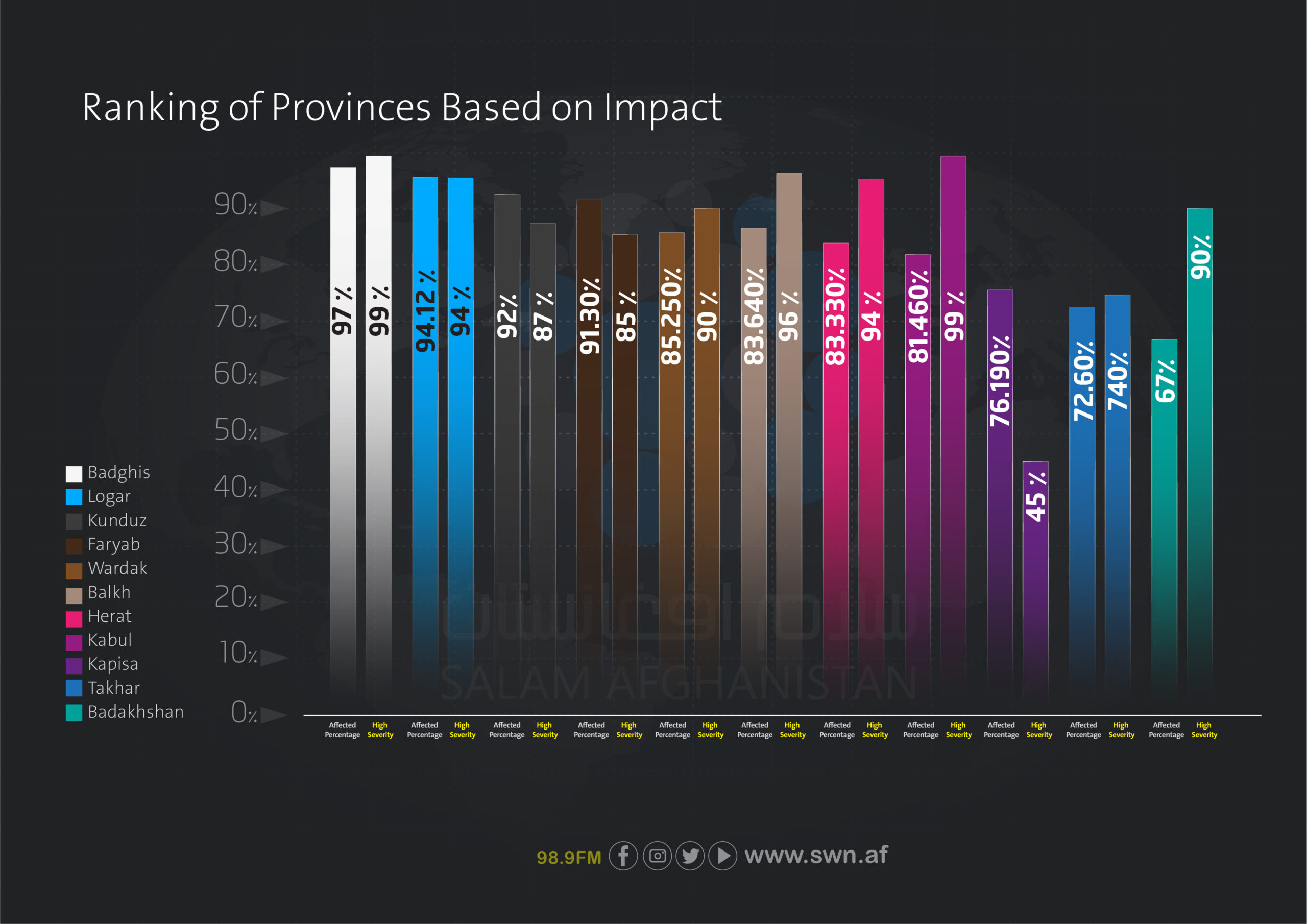
This survey conducted a comparative review of 11 provinces, each with 45 to 200 participants, representing different regions of the country. These provinces include Badghis, Logar, Kunduz, Faryab, Maidan Wardak, Balkh, Herat, Kabul, Kapisa, Takhar, and Badakhshan. Badghis experienced the highest impact, with 97% of respondents affected and 99% reporting severe effects. While Badakhshan faced the lowest impact, with 67% of respondents affected.
Key highlights from the comparison:
- Badghis is identified as the most critical province.
- Kabul shows the highest adaptation capacity.
- Takhar has the highest rate of inaction among farmers.
Severity and extent of drought
According to the survey findings, Badghis ranks as the most affected province, with 97% of respondents impacted and classified as being in a critical condition. Logar (94.12%) and Kunduz (92%) follow closely, facing high-intensity drought. In contrast, Badakhshan reported the lowest impact at 67%. Overall, the average drought impact across these provinces is 83.99%, highlighting the widespread nature of the crisis nationwide. The 30% gap between the highest and lowest impact levels underscores the uneven distribution of drought across the country.
Regarding drought severity, the highest reported levels were in Badghis and Kabul at 99%, while Kapisa recorded the lowest severity at 45%. In eight out of the 11 surveyed provinces, more than 85% of farmers reported high severity, indicating that even in areas with relatively lower overall impact, drought still leaves deep and serious effects.
Economic and Agricultural Consequences
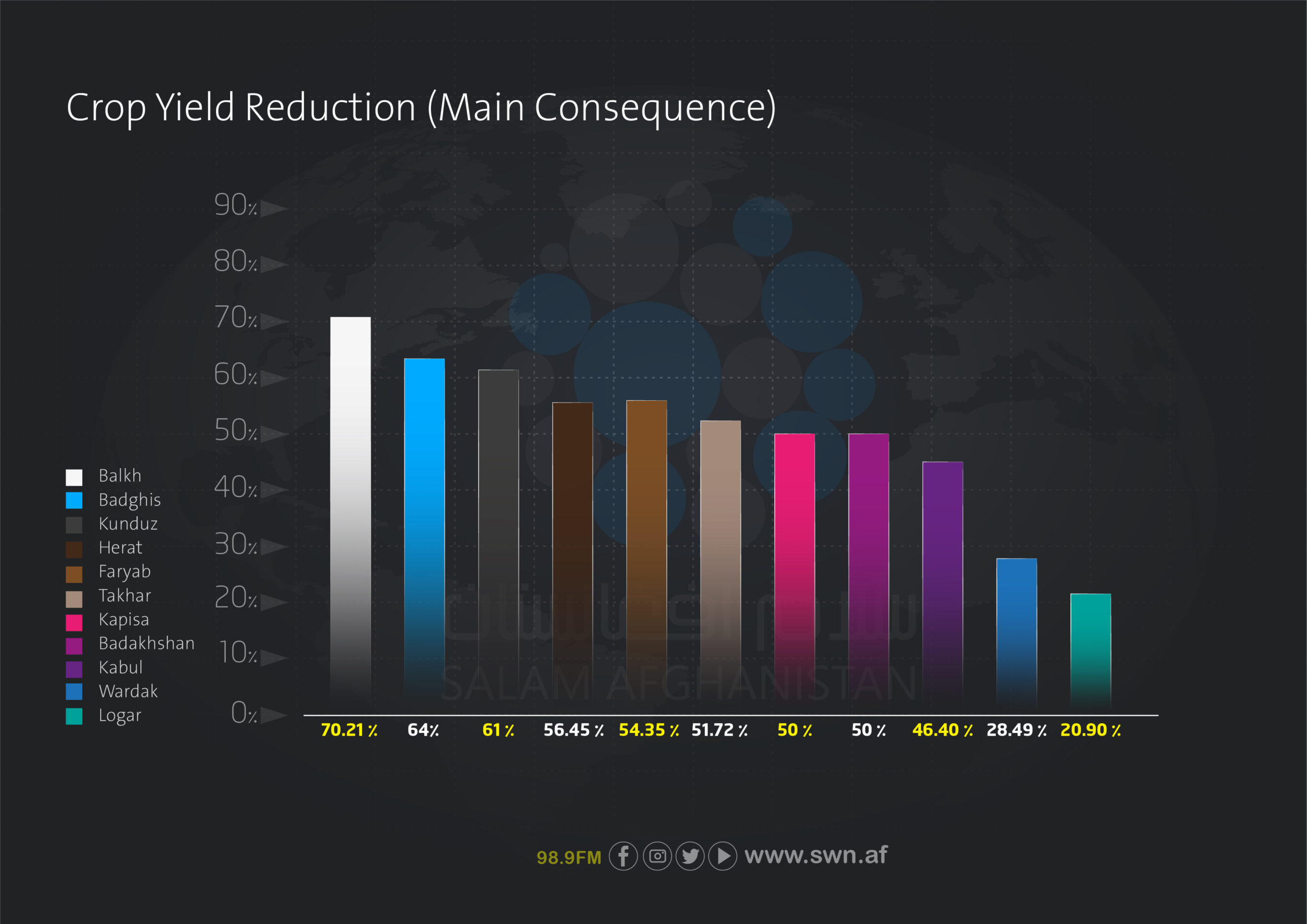
One of the main impacts of drought has been the reduction in crop yields. Balkh reported the highest decrease at 70.21%, even though its overall drought impact was lower. Badghis follows with a 64% reduction, while Logar experienced the least decrease at 20.9%. These findings indicate that yield reductions are not solely determined by overall drought exposure; local factors and crop types play a decisive role.
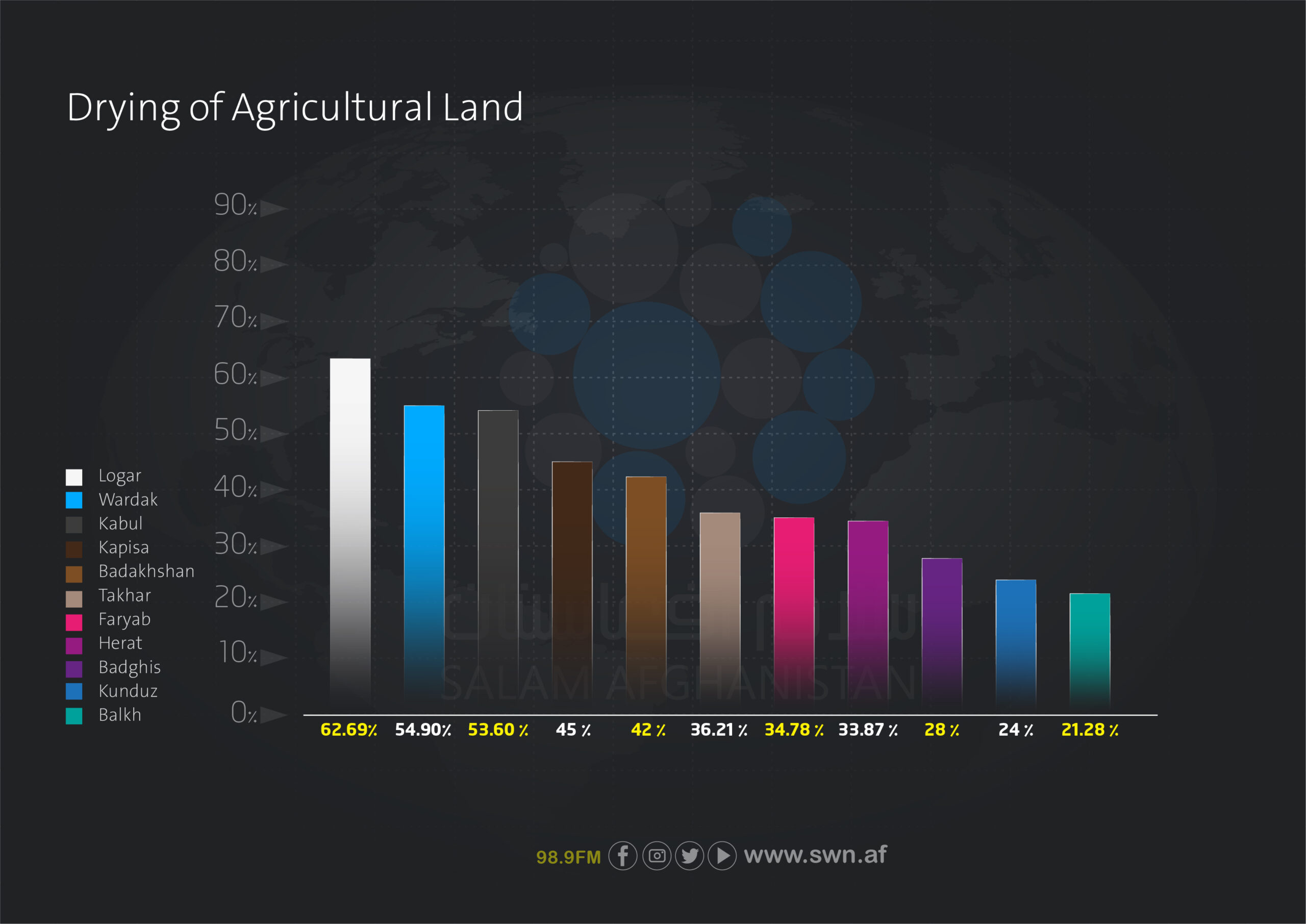
In terms of farmland drying, Logar leads with 62.69% of agricultural land affected. Maidan Wardak (54.9%) and Kabul (53.6%) also reported more than half of their farmland drying up. In contrast, Balkh recorded the lowest level of land drying at 21.28%. These data suggest that in central provinces, land drying is the main challenge, while in northern regions, reduced crop yields are the dominant issue.
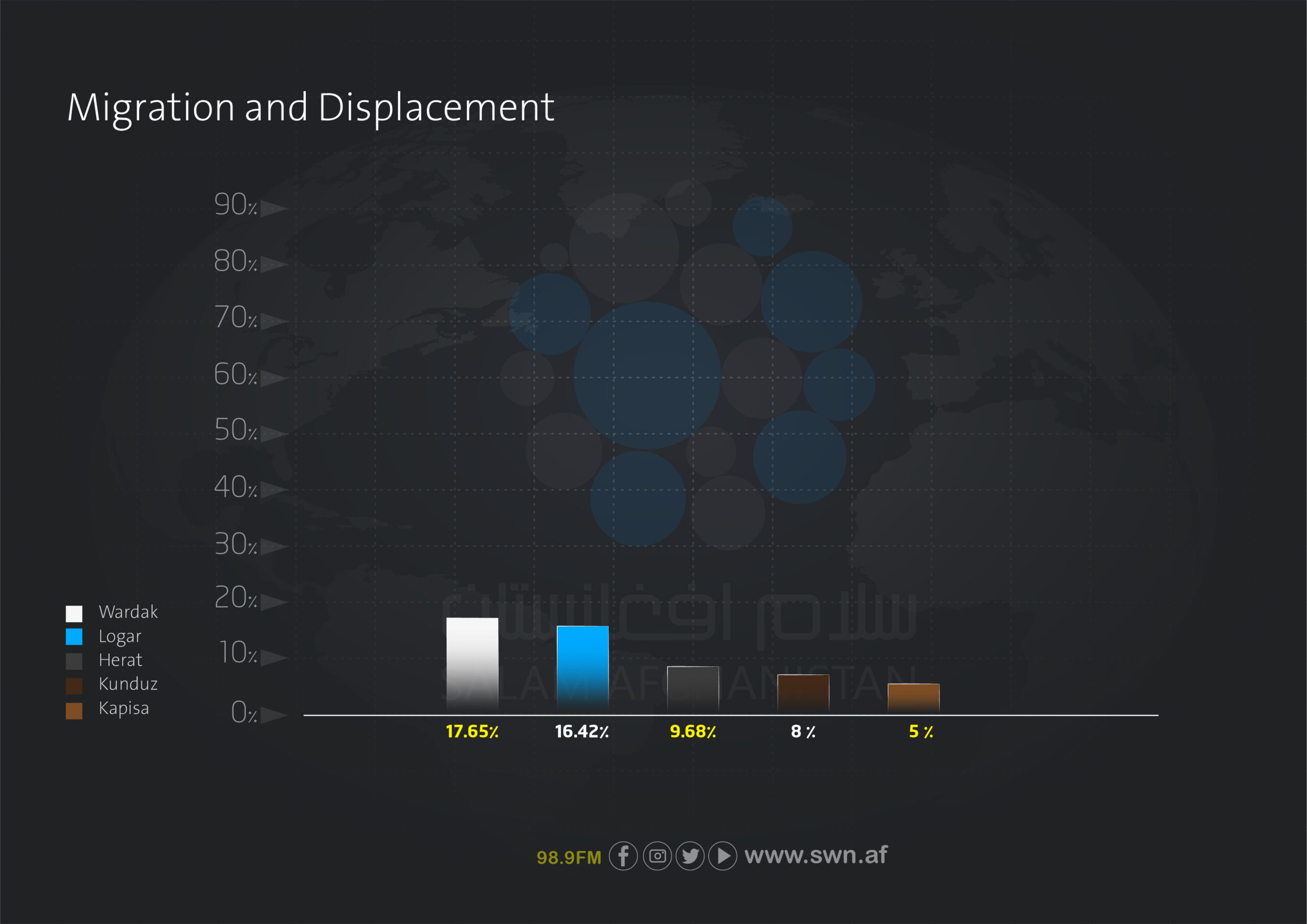
Drought has also led to increased migration in certain provinces. Maidan Wardak (17.65%) and Logar (16.42%) recorded the highest rates of drought-related migration. Herat (9.68%) and Kunduz (8%) reported moderate levels of migration. Most migrations occurred in central provinces, likely due to their proximity to urban centers and better access to transportation and relocation opportunities.
Crop type and vulnerability
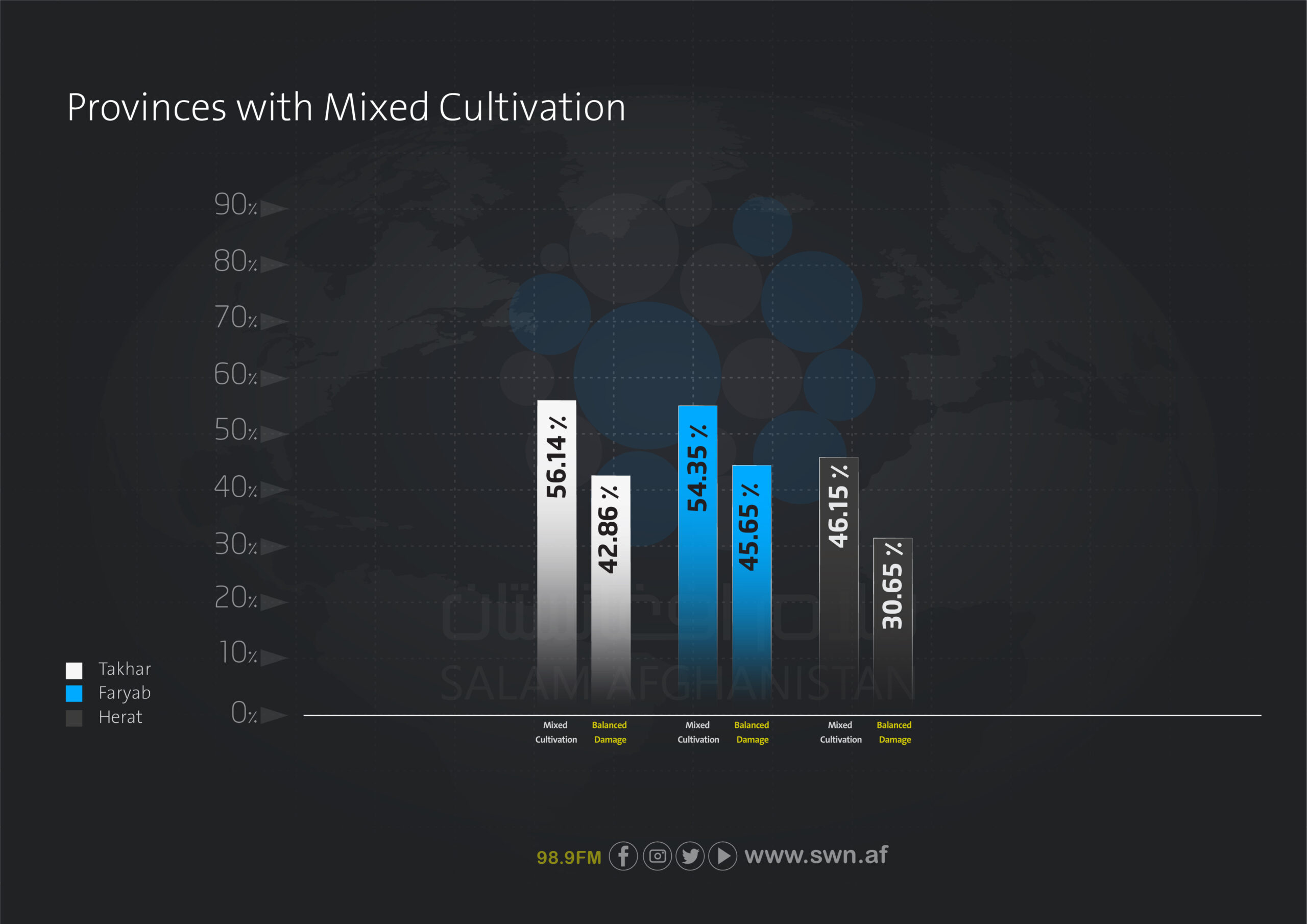
Analysis of farmland types shows that Kabul has the highest dependence on irrigated land at 83.46%. Badakhshan is the only province where rain fed farming predominates, at 39%. In provinces such as Takhar and Faryab, a balanced mix of irrigated and rain fed cultivation is observed.
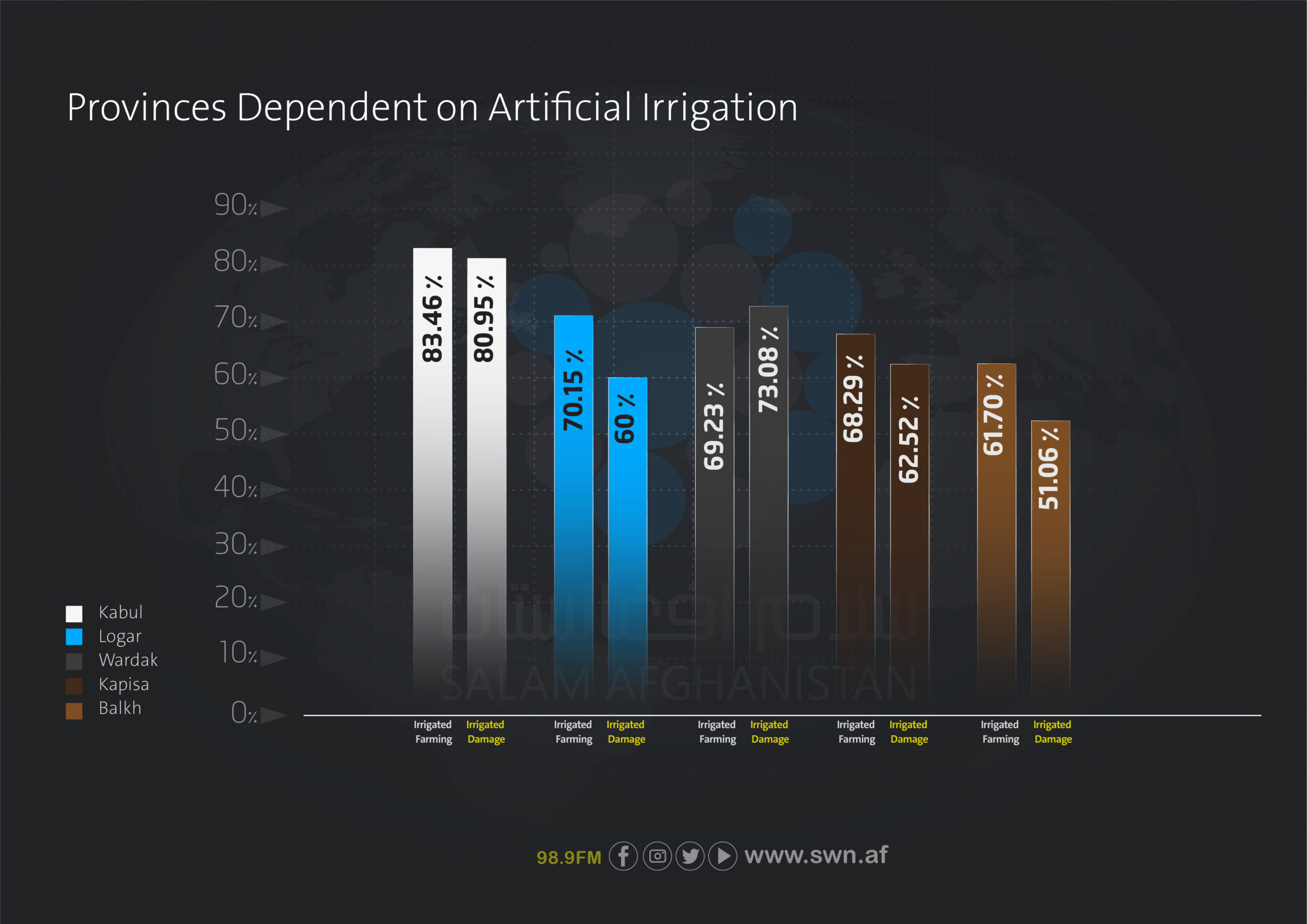
Findings show that irrigated lands are more vulnerable across all provinces. In Kabul, 80.95% of irrigated land has been affected. Even in Badakhshan, where rain fed farming predominates, 57% of land has suffered damage. This highlights the severity of the situation across all types of cultivation.
Water sources and changes
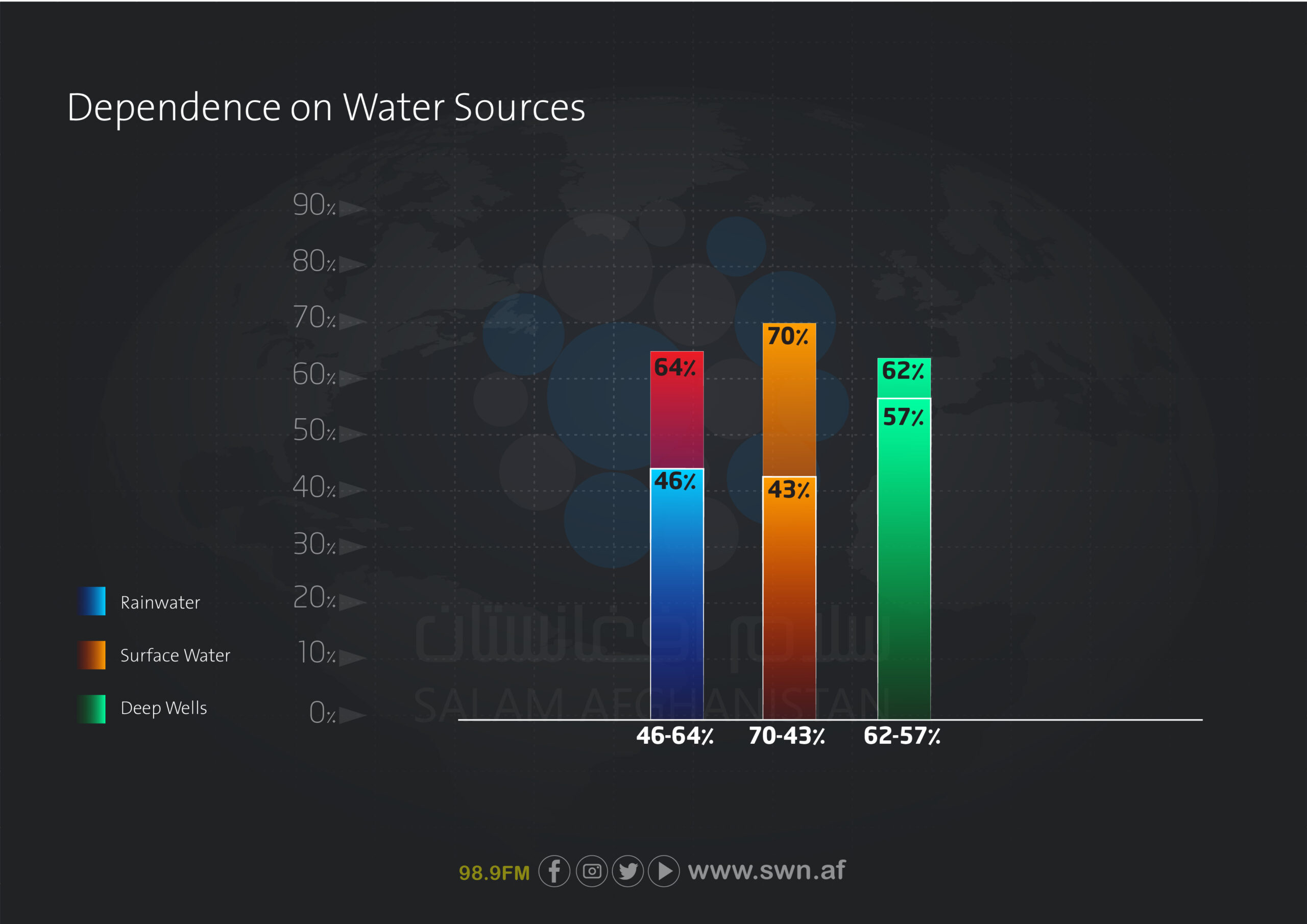
Regarding dependence on water sources, Badghis and Faryab rely most heavily on rainwater, while Takhar and Kapisa primarily use surface water. Logar and Herat have turned to deep wells for irrigation.
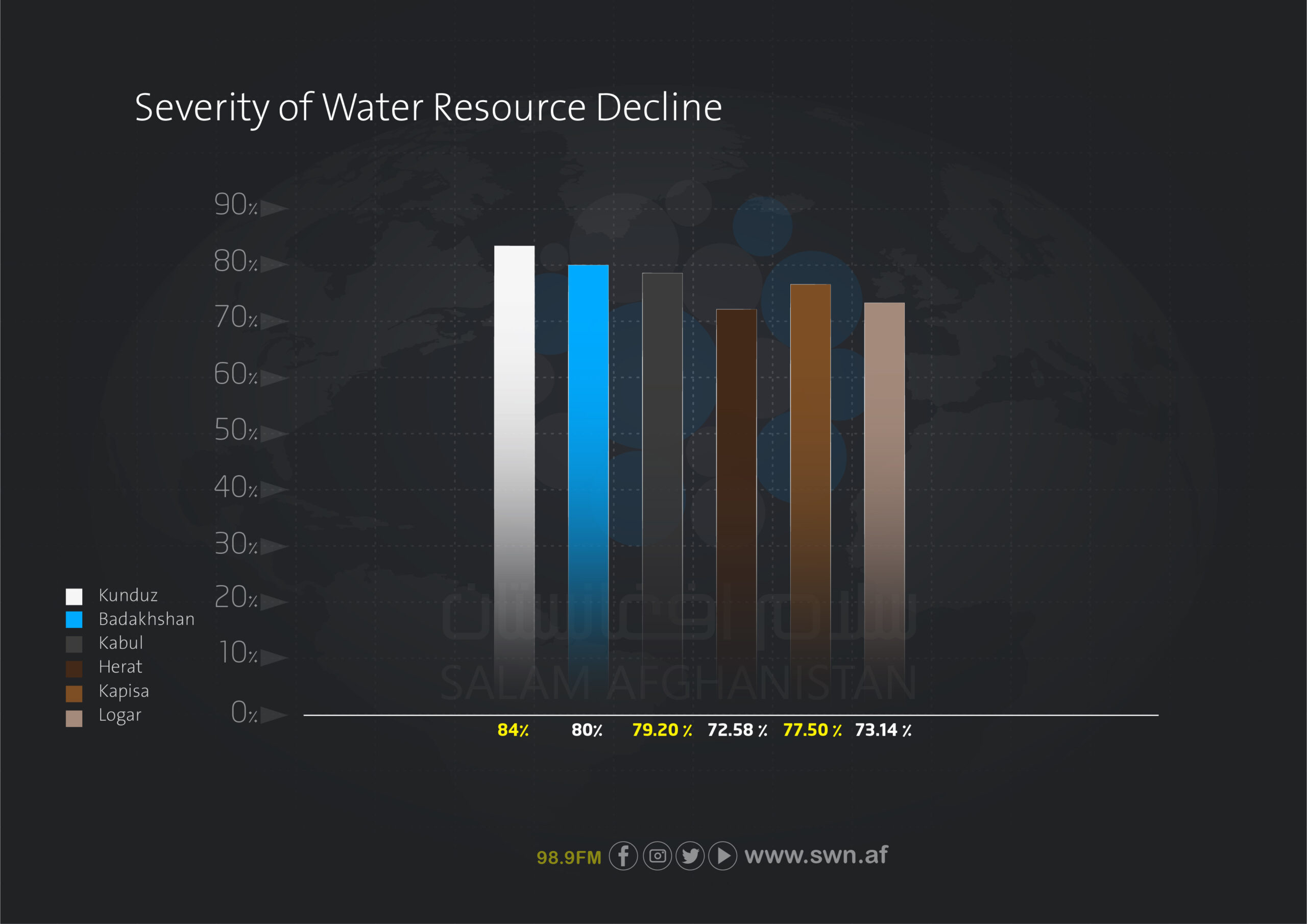
The highest reductions in water sources were reported in Kunduz and Badakhshan (over 80%). Kabul also faces a concerning situation with a 79.2% decrease. Only Logar reported water reductions below 75%. These figures indicate that water scarcity is a nationwide challenge, though its intensity varies across provinces.
Coping and adaptation actions
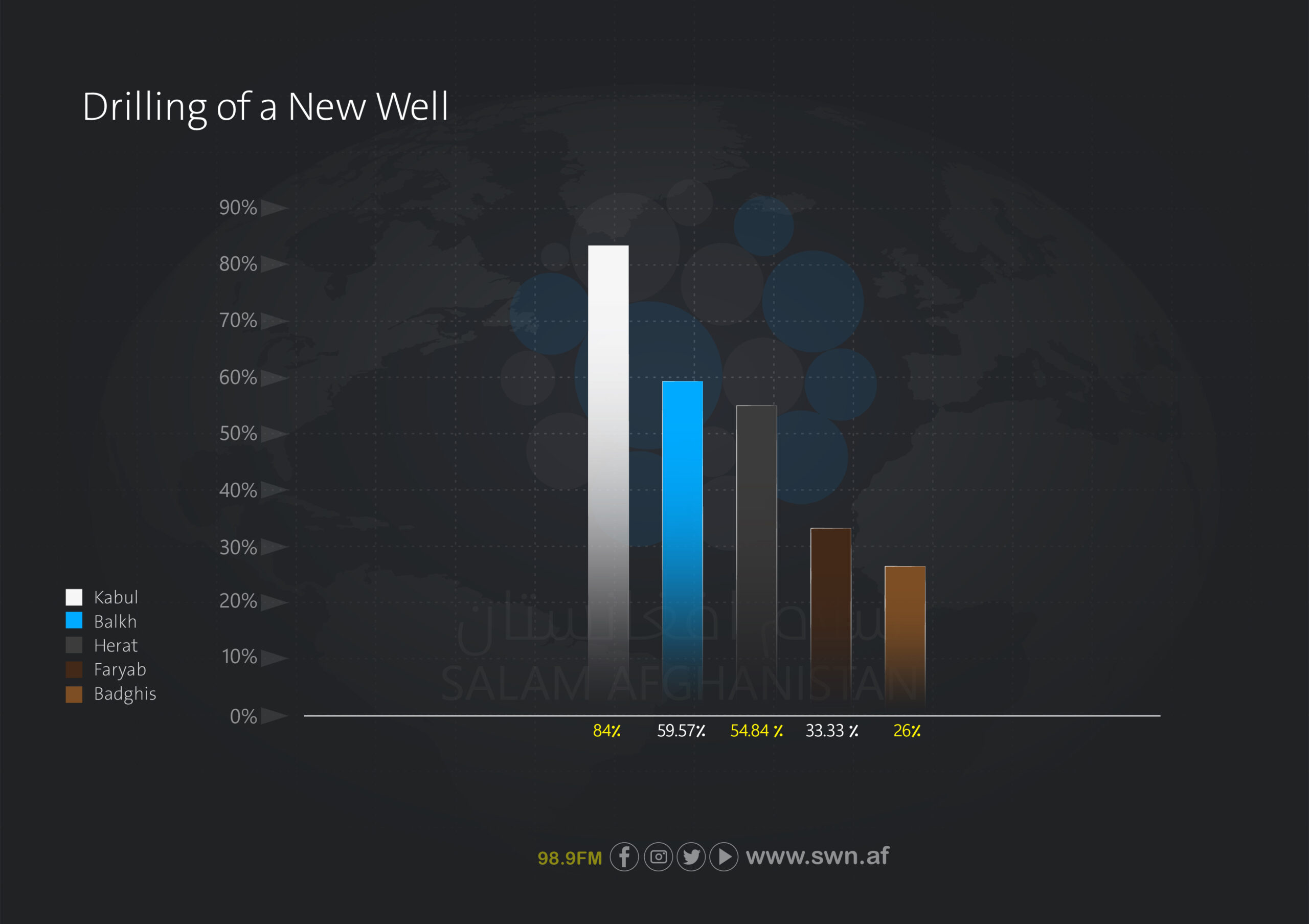
To address drought, some provinces have taken actions such as digging new wells. Kabul leads with 84% of farmers taking action, while Balkh (59.57%) and Herat (54.84%) are at moderate levels. Badghis shows the lowest level of action, with only 26% of farmers implementing measures.
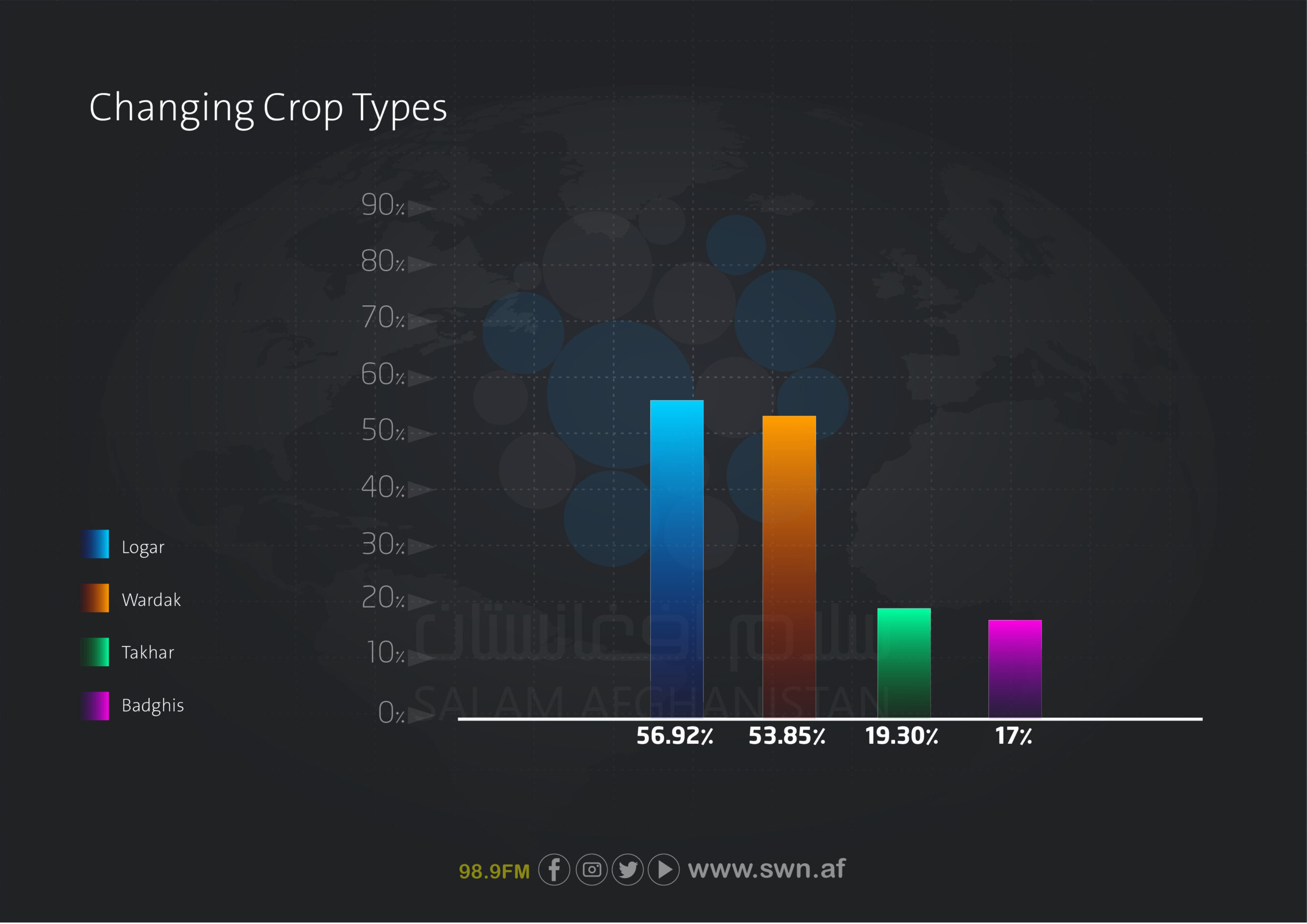
Regarding adjustments in crop types, Logar (56.92%) and Maidan Wardak (53.85%) showed the highest levels of adaptation to new conditions. In contrast, Takhar (19.30%) and Badghis (17%) reported the lowest levels of crop changes.
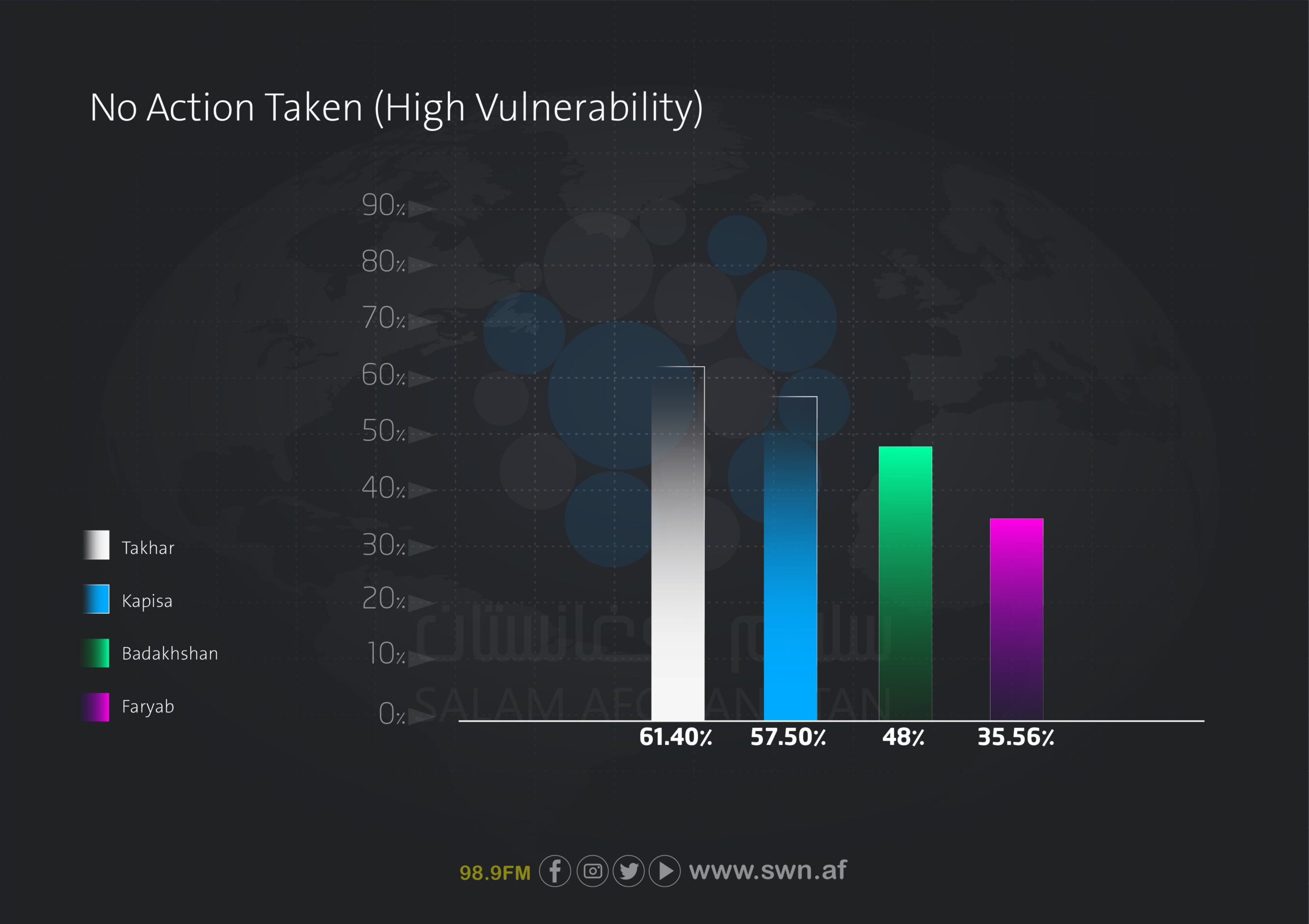
A concerning aspect is the high rate of inaction in certain provinces. Takhar (61.40%), Kapisa (57.50%), and Badakhshan (48%) top the list of provinces where farmers have taken no adaptive measures. This highlights the urgent need for support in the eastern regions of the country.
A closer look at leading provinces in survey participation
Badghis
- Drought Impact: The majority of respondents (97%) confirmed that drought has affected their crops.
- Crop Type: 93% of farmers cultivate rain fed or mixed (irrigated + rain fed) land, while only 7% rely solely on irrigated land.
- Crop Damage: 43% reported that both types of land were affected, and 50% specifically mentioned damage to rain fed land.
- Impact Severity: 99% stated that drought had a “very high or high” impact, with only one respondent reporting a “low” impact.
- Drought-Related Problems: 64% complained of reduced yields, while around 28% reported drying of their land.
- Irrigation Source: Half of the farmers rely on rainwater, 36% on surface water, and wells play a much smaller role.
- Changes in Water Availability: 64% reported a severe decrease in water sources, and 20% said their sources had completely dried up.
- Drought Coping Measures: Only about 26% dug wells, and 17% changed their crop types in response to drought.
Badakhshan
- Drought Impact: About 67% of farmers in Badakhshan reported being affected by drought, a lower percentage compared to Badghis.
- Crop Type: 44% cultivate both irrigated and rain fed land, while 17% rely solely on irrigated land.
- Crop Damage: 57% reported that rain fed crops were more severely affected, and 21% said both types of land were damaged.
- Impact Severity: Around 55% considered the impact “very high,” but about 10% reported little or no effect.
- Drought-Related Problems: Approximately 50% experienced reduced yields, 42% reported land drying, and migration was also noted.
- Irrigation Sources: Surface water and rainwater are the primary sources; wells play a minor role at 8%.
- Changes in Water Availability: Over 80% reported that their water sources had decreased or dried up.
- Drought Coping Measures: Nearly half of farmers (48%) took no adaptive action, 23% dug new wells, and some changed crops or occupations.
Balkh
- Drought Impact on Crops:64% of farmers reported that drought affected their crops in the past one to two years, while only 16.36% felt no impact.
- Crop Type: Most farmland in Balkh is irrigated (61.70%), 10.64% is rain fed, and 27.66% is a mix of both.
- Most Affected Crops:06% of farmers said irrigated crops suffered the most damage, while 25.53% reported damage to both irrigated and rain fed lands.
- Impact Severity: Over half of respondents (51.06%) rated drought impact as “very high,” and 44.68% as “moderately high.”
- Drought Consequences: Reduced yields were the main problem (70.21%), followed by land drying (21.28%) and loss of livestock (8.51%).
- Irrigation Sources: The main sources for most farmers are surface water (44.68%) and deep or semi-deep wells (36.17%).
- Changes in Water Availability: Over 61% reported a severe reduction in water sources, and 29.79% noted a moderate decrease.
- Drought Coping Measures:57% dug new wells to counter drought, while 23.40% took no action.
Takhar
- Drought Impact on Crops: 60% of farmers confirmed that drought affected their crops, while 27.40% reported no impact.
- Crop Type: Most farmers in Takhar (56.14%) cultivate a mix of irrigated and rain fed land, while 26.32% rely solely on irrigated land.
- Most Affected Crops: 86% reported damage to both irrigated and rainfed crops, while 33.93% mentioned only rain fed crops.
- Impact Severity: 59% rated drought impact as “very high,” 46.55% as “moderately high,” and 8.62% reported no impact.
- Drought Consequences: Reduced yields (51.72%) and drying of farmland (36.21%) were the main problems, with some reporting migration or livestock loss.
- Irrigation Sources: 18% of farmers rely on surface water (streams and rivers), while only 1.75% use deep wells.
- Changes in Water Availability: 86% reported a moderate reduction in water sources, 36.84% noted severe decreases, and 10.53% said their sources had completely dried.
- Drought Coping Measures: Over half of the farmers (61.40%) took no adaptive action; only 19.30% changed crop types, and 10.53% dug wells.
Faryab
- Drought Impact on Crops:3% of farmers in Faryab reported that drought affected their crops in the past one to two years, while only 8.7% saw no impact.
- Crop Type:35% cultivate a mix of irrigated and rain fed land, 26.09% rely solely on rain fed land, and 19.57% on irrigated land only.
- Most Affected Crops:65% reported damage to both types of land, 34.78% to rain fed crops, and 19.57% to irrigated crops.
- Impact Severity:48% rated drought impact as “very high,” 41.30% as “moderately high,” and 15.22% considered the impact low.
- Drought Consequences: Reduced yields (54.35%) were the primary issue, followed by farmland drying (34.78%). Some farmers also reported migration or livestock loss.
- Irrigation Sources: Rainwater and surface water are the main sources for 37.78% of farmers each, while 17.78% use wells and 6.67% have unspecified sources.
- Changes in Water Availability: Nearly half (46.67%) reported severe water shortages, and 31.11% said their sources had completely dried up.
- Drought Coping Measures:56% of farmers took no adaptive action; 33.33% dug new wells, and some changed crop types or livelihoods.
Kabul
- Drought Impact on Crops:46% of farmers in Kabul confirmed that drought affected their crops, while 18.54% reported no significant impact.
- Crop Type: The majority of farmland (83.46%) is irrigated; only 2.36% is rain fed, and 14.17% is a mix of both.
- Most Affected Crops: Irrigated lands were most affected (80.95%), rain fed lands saw minimal damage (2.38%), and 16.67% reported both types were affected.
- Impact Severity:40% rated the drought impact as “very high,” 24.80% as “moderately high,” and only 0.80% considered it low.
- Drought Consequences: Drying of farmland (53.6%) and reduced yields (46.4%) were the main consequences reported.
- Irrigation Sources: Surface water is the primary source for 60% of farmers, wells for 36%, and rainwater only 4%.
- Changes in Water Availability: The situation is severe: 50.4% reported their water sources completely dried up, and 28.8% experienced significant reduction.
- Drought Coping Measures: 84% dug new wells to cope with drought. Few changed crops or livelihoods, while 10.4% took no action.
Logar
- Drought Impact on Crops:12% of farmers in Logar reported that drought affected their crops; only 5.88% reported no effect.
- Crop Type: The majority of land is irrigated (70.15%), 26.87% is mixed (irrigated + rain fed), and only 2.99% is fully rain fed.
- Most Affected Crops: 60% said irrigated crops were most affected, while 29.23% reported damage to both types of crops.
- Impact Severity:15% considered the drought impact “moderately high,” 23.87% “very high,” and only 2.99% rated it low.
- Drought Consequences: Drying of farmland (62.69%) was the main consequence, followed by reduced yields (20.9%) and migration or relocation (16.42%).
- Irrigation Sources: Deep or semi-deep wells serve 54.24% of farmers, surface water 37.31%, and rainwater only 2.99%.
- Changes in Water Availability:69% reported severe reduction in water resources, and 10.45% said their sources had completely dried up.
- Drought Coping Measures:92% adapted by changing crop types, 23.08% changed livelihoods, and 15.38% dug new wells.
Herat
- Drought Impact on Crops:33% of farmers reported drought affecting their crops, while 16.67% saw no effect.
- Crop Type: Mixed farming (irrigated + rain fed) dominates at 46.15%; fully irrigated land is 43.55%, and fully rain fed 15.38%.
- Most Affected Crops: Irrigated crops suffered the most (41.94%), while 30.65% reported damage to both types of crops.
- Impact Severity:29% rated the drought impact as “moderately high,” and 32.26% as “very high.”
- Drought Consequences: The primary problem was reduced yields (56.45%), followed by drying of farmland (33.87%) and migration (9.68%).
- Irrigation Sources: Majority rely on deep or semi-deep wells (53.23%), with surface water (32.26%) and rainwater (12.90%) as secondary sources.
- Changes in Water Availability:06% reported severe reduction in water resources, and 14.52% said their sources completely dried up.
- Drought Coping Measures: Over half (54.84%) dug new wells, a small percentage changed crops or livelihoods, and 20.97% took no measures.
Maidan Wardak
- Drought Impact on Crops:25% of farmers reported drought affecting their crops, while 14.75% experienced no impact.
- Crop Type:23% of farmland is irrigated, and 30.77% is mixed farming. No data was recorded for fully rain fed land.
- Most Affected Crops: Irrigated lands suffered the most (73.08%), while 26.92% reported damage to both types of crops.
- Impact Severity: Most farmers (74%) described the drought impact as “moderately high,” 16% as “very high,” and 10% as “low.”
- Drought Consequences: Drying of farmland was the main issue (54.90%), followed by reduced yields (28.49%) and migration or relocation (17.65%).
- Irrigation Sources: Majority rely on deep or semi-deep wells (54.90%), surface water is used by 41.18%, and only 1.96% depend on rain or unspecified sources.
- Changes in Water Availability:69% reported severe reduction, 28.83% moderate reduction, and 13.46% complete drying of water sources.
- Drought Coping Measures: Over half (53.85%) adapted by changing crop types, 21.15% dug new wells, and only 7.69% took no measures.
Kapisa
- Drought Impact on Crops:19% of farmers reported that drought affected their crops, while 23.81% did not feel any impact.
- Crop Type: Most farmland is irrigated (68.29%), 12.20% is rain fed, and 19.51% is mixed.
- Most Affected Crops:52% said irrigated crops suffered the most, while 22.50% reported damage to both types.
- Impact Severity:48% described the drought impact as “moderately high,” 4.76% as “very high,” and 11.90% as “low.”
- Drought Consequences: Main issues were reduced yields (50%) and drying of farmland (45%). Only 5% mentioned migration.
- Irrigation Sources: Most farmers rely on surface water (72.50%), while only 15% use deep or semi-deep wells.
- Changes in Water Availability: 70% reported severe reduction in water sources, and 7.50% said their sources completely dried up.
- Drought Coping Measures:50% took no measures. Only a small proportion changed crop types, occupations, or dug new wells.
Kunduz
- Drought Impact on Agriculture: 92% of farmers reported that drought affected their crops.
- Type of Farmland: 51% of lands are mixed (irrigated and rain fed), 40% fully irrigated, and 10% rain fed only.
- Crops Affected: 43% said both types of crops were damaged, 36% only irrigated, and 20% only rain fed.
- Drought Severity: 55% described the impact as “moderately high,” and 32% as “very high.”
- Consequences of Drought: 61% experienced reduced yields, 24% reported drying of farmland, and 8% faced migration.
- Irrigation Sources: 74% rely on surface water, 8% on wells, and 5% have no defined source.
- Changes in Water Availability: 84% reported that water sources have reduced or completely dried.
- Drought Coping Measures: 36% took no action, 36% dug new wells, and 21% changed their crop types.
Final Conclusion
The national drought survey, conducted with 1,020 farmers across 30 provinces, reveals a comprehensive and concerning picture of drought’s far-reaching impacts on agriculture, livelihoods, and social stability. The findings indicate that drought has transcended a purely climatic event, becoming a national crisis with profound economic, social, and human consequences.
Widespread Impact: Over 80% of farmers reported direct effects of drought, and more than 90% described its intensity as high. Wheat, Afghanistan’s staple crop, has suffered severe damage, leading to food insecurity, structural poverty, drastic income reductions, farmland degradation, and widespread migration.
Insufficient Support and Adaptation: Despite these impacts, responses and assistance remain inadequate. More than half of farmers received no aid, and nearly half had no access to training on drought management. Adaptive measures are limited, and regional disparities in coping capacity are evident.
Need for a Comprehensive Response: Addressing drought in Afghanistan requires a comprehensive, multi-sectoral, and participatory approach. Priority actions should include:
- Rehabilitating irrigation systems
- Providing financial support to farmers
- Developing sustainable water resources
- Expanding agricultural education and training
- Strengthening national coordination with the participation of domestic and international agencies
Without immediate, structured, and targeted intervention, drought could escalate into an uncontrollable crisis for agriculture and food security in Afghanistan.
Researcher and Author: Muzhda Haidari, Salam Watandar’s reporter
Translated by: Friba Qaderi