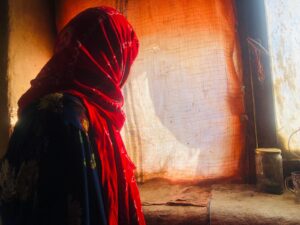
KABUL (SW) – A modest space in a residential basement in Kabul city is serving as a beacon of hope for dozens of women and girls where they are engaged in beadwork and sewing for a newly launched indigenous clothing brand.
This workshop is production space for “Poshak Banowan Kabul” (Kabul Women’s Dress) launched by Saleha Muslemi with an investment of nearly 10,000 afghanis, and it now provides job opportunities for more than 50 women and girls.
In this workshop, women and girls learn sewing and beadwork and earn money from working here.
Saleha says that after completing a six-month learning course, the women and girls can work from home and earn personal income. According to her, those who complete the training with high marks can work as instructors in this workshop.
Most of the women working in this workshop are students who have dropped out of further education due to restrictions by the Islamic Emirate.
Zahra Faizi, a student at the Faculty of Administration and Public Policy at Kabul University, who came to this workshop for sewing after universities were closed to girls, says that now she teaches other girls how to measure, cut, and sew clothes after finishing her training and now works as an instructor at the workshop.
Despite the educational and work limitations, women and girls do not give up and continue to strive for self-sufficiency and progress. This workshop has provided an opportunity for many of them to work together or professionally learn a skill.
Nazanin, one of the students at this workshop, who strives to remain active in society despite the ban on girls’ education, says: “When the school gates were closed, and I couldn’t complete my final year of school, I became hopeless; but now I am learning the art of sewing in this workshop and want to earn an income through this skill.”
This workshop, with the goal of empowering women, is creating job and economic opportunities for many women and girls in Kabul.
Nagina Islam, another employee at the workshop, says that in such conditions, where job opportunities for women are limited, some women and girls have been able to alleviate their economic problems by working in this workshop. Nagina has also contributed to improving her family’s economic situation.
Saleha Muslemi, who walks among the trainees and sewing machines every day, emphasizes that handicrafts and art cannot replace formal education for girls and women.
After the ban on education, many women and girls in various provinces have tried to create small workshops for sewing and handicrafts to provide job opportunities for themselves and other women and girls. The Kabul Women’s Dress workshop is an example of such an effort.