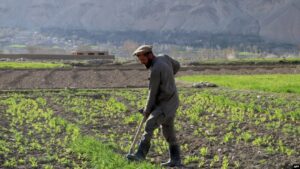
After several consecutive years of drought, this year’s widespread rainfall in Herat—particularly in the northern districts of the province—has brought renewed hope for increased harvests of grains and legumes. Officials from the Herat Directorate of Agriculture say that the condition of rainfed crops is relatively good, and that this year’s rainfall could mark a different season for agriculture and farmers.
Bashir Ahmad Ahmadi, Head of Agricultural Affairs at the Herat Directorate of Agriculture, said, “More than 150,000 hectares of land are under rainfed cultivation, most of it located in districts such as Kushk-e-Kohna, Kushk Rabat-e-Sangi, Gulran, and Kohsan. More than 247 millimeters of rainfall have been recorded in the center of the province, and over 370 millimeters in the northern districts.
According to him, the rainfall this year has been widespread and timely, and it is hoped that it can partly compensate for the droughts of previous years.
Meanwhile, farmers have also expressed relative satisfaction with the improved situation, but they still remain concerned about the consequences of past droughts.
Mohammad Aref Firozi, a 58-year-old farmer with years of experience in agriculture, says the past years have been very difficult due to drought.
“I live in an area where about 80% of the land is rainfed. We also have irrigated land, but it is limited. In previous years, we had good harvests, but in recent years we have faced drought and pests,” he said.
Bashir Ahmad, another farmer from Kushk-e-Kohna, referring to this year’s rainfall, said, “Last year, due to drought, we had up to 70% decrease in harvests. This year’s rainfall has been good, but we still need more rain, especially if the heat increases.”
He also emphasized that farmers do not have the financial capacity to buy improved seeds and need government support in the mechanization of agriculture and the management of water resources.

On the other hand, Turyalai Noori, an agricultural expert, emphasizing the increase in rainfall and its impact on the quality and quantity of agricultural products, said,
“Farmers can turn to crops that require less water and, for water management, use modern irrigation methods such as drip irrigation, sprinkler irrigation, and other systems. In recent times, most use has been made of drip irrigation.”
At the same time, a number of residents of Herat also consider these changes promising and believe that increased harvests this year can reduce part of the economic problems of farmers. Abdul Muttalib Honaryar, one of the residents of the Herat, said,
“In previous years, we faced difficulties in purchasing food items such as lentils, chickpeas, wheat, and corn. This year, there is hope that farmers’ harvests will increase so that they can solve part of their economic problems, because unfortunately the government does not have the capacity to support farmers. Thanks to God that this year there has been special attention for farmers, and it has rained. God willing, farmers will benefit from this year’s rainfall.”
Sayed Abdullahi, another resident of the Herat, said, “There have been several consecutive years of drought. We hope that this year’s rainfall will be up to 70% beneficial for farmers. Currently, the agricultural sector has developed and farmers themselves can properly use underground water resources, which is promising. But if we think that one or two rounds of rains this year will remove the drought of past years, that is a mistake, because there has been ten years of drought.”
Although this year’s rainfall, compared to the consecutive droughts of previous years, has brought a sense of renewed hope among farmers in Herat and has partly reduced the pressure of drought, the sustainability of this situation depends on scientific and effective management of water resources, as well as practical and targeted support for farmers. These factors can direct agriculture in this province toward stability and long-term improvement.