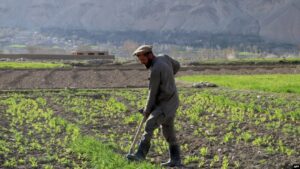
A number of farmers in Pul-e-Alam, the capital of Logar province, as well as in several districts, told Salam Watandar that both surface and groundwater levels have declined significantly compared to previous years.
According to them, they used to irrigate their farmlands and orchards through qanats and canals. However, many of these water sources have now dried up, forcing farmers to dig deep wells to irrigate their land.
They are calling on the government and international institutions to expand drip irrigation systems for farms and orchards across Afghanistan.
Sayedullah, a farmer in Logar, said, “Our wells have dried up. Previously, water could be found at depths of 10 to 12 meters, but now there is no water even at 100 meters. if this water shortage continues, it could lead to a humanitarian crisis.”
Bahram Khan, another farmer, said, “Due to the lack of water, we are facing many problems. In the past, we cultivated three jeribs of vegetables, but now we cannot irrigate even one jerib. All hand-dug wells have dried up, and the qanats are also dry. This means the water is getting deeper day by day.”
Mohammad Idris, another farmer, said that groundwater levels have nearly halved over the past five years, resulting in reduced agricultural yields. He added that due to drought and water shortages, some farmers have abandoned their farmlands. He said,
“Water levels have dropped significantly over the past five years. Floods, qanats, and wells have dried up. Many farmers now grow only essential crops and irrigate just those, which is a major problem for them.”
Meanwhile, Abdul Hamid, a water expert, said that water scarcity is not only a problem for farmers in Logar but also a national challenge. He added that in many areas, farmers are overusing groundwater without proper management, leading to the reduction of water reserves.
“Water scarcity is a serious challenge for farmers. Many people use water without proper planning and do not consider its consumption and value. That is why many canals and rivers have also dried up,” he said.
On the other hand, Mohammad Ismaeil, head of Logar’s Department of Water and Energy, said that in recent years, drought has caused a decline in both surface and groundwater levels in many areas. He added that, to protect water resources, the drilling of deep wells has been halted in the province, and the illegal use of groundwater will be subject to legal action.
“Water scarcity exists across the country and is largely caused by drought. Our department has limited the drilling of deep wells to prevent further reduction in water resources. Anyone who needs to drill a deep well must obtain permission from our department and also construct a recharge well alongside it,” he added.
Officials from the Logar Department of Agriculture, Irrigation, and Livestock also said that a special plan has been developed to address farmers’ problems and promote water conservation.
Nasruddin Bahij, head of forests and natural resources in the department, said that under this plan, farmers are encouraged to grow crops that require less water. He added that terraces, canals, and small dams have been constructed in mountainous areas to improve water management, and awareness campaigns on the benefits of drip irrigation are ongoing.
“Our department has developed a plan that includes alternative solutions to water shortages. Farmers are encouraged to grow low-water crops, and in mountainous areas, terraces, canals, and small dams have been built. Awareness campaigns about drip irrigation are also ongoing,” he said.
Logar is one of the provinces near Kabul, where most residents are busy with agriculture and livestock farming. According to local residents, if water shortages continue, the province will face serious challenges in these sectors in the future. Although recent rainfall has helped recharge some water sources and raised farmers’ hopes, experts emphasize that this improvement is temporary and that without proper water management, the risk of the crisis returning remains high.
Reporter: Khan Wali Ahmadzai