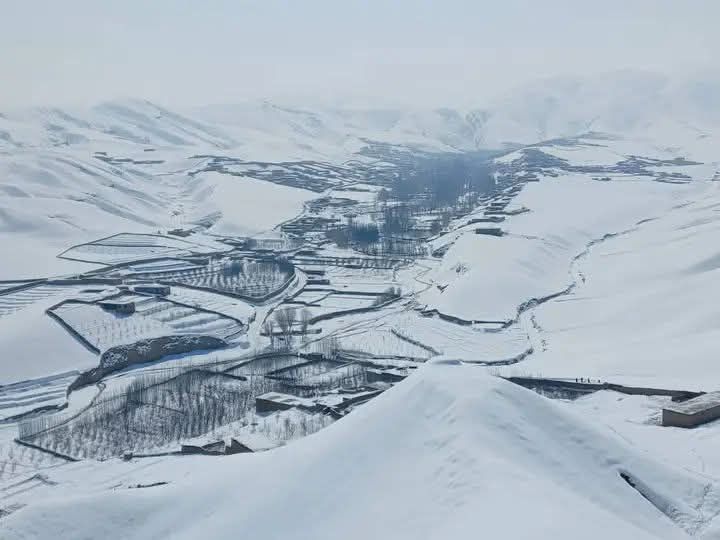
Winter precipitation in Faryab, although short-term, has created a valuable opportunity to strengthen water resources and improve agriculture. Officials from the Departments of Agriculture, Irrigation and Livestock, and Water and Energy in Faryab emphasize that winter rainfall plays a key role in providing groundwater and surface water resources, and that proper use of these resources can reduce the effects of past droughts.
Abdul Quddus Aziz, head of the Groundwater Department of the Faryab Water and Energy Department, says that the province is vulnerable due to reduced rainfall and consecutive droughts. He told Salam Watandar that Faryab province is vulnerable due to reduced rainfall and successive droughts, emphasizing that sustained rainfall and proper water resource management are essential to address the chronic water shortage.
“Winter precipitation is particularly important for replenishing both groundwater and surface water resources.” He said.
He also noted that the construction of small and large dams, check dams, rainwater harvesting systems, and the preservation of vegetation is key to effectively utilizing these resources.
Najibullah Mirzaei, General Director of Agricultural Extension and Development at the Faryab Department of Agriculture, also says that most of the province’s farmland is rain-fed and that drought has severely affected farmers in recent years.
He says: “The majority of land in Faryab province is rain-fed. Unfortunately, previous droughts have had a significant impact on agriculture and on the livelihoods of farmers in the province. Recent snowfall and rainfall can have various positive effects on agricultural land. These benefits depend on the amount and type of precipitation, soil conditions, and the types of crops grown. Such precipitation helps recharge groundwater, increase soil moisture, promote plant growth, and reduce pests and crop diseases.”
Meanwhile, residents of Faryab and farmers across the province have expressed their happiness over the recent rainfall and hope that this positive trend will help protect them from the ongoing challenges of drought.
Jalaluddin, a resident of ‘Khwaja Sabz Posh’ district in Faryab who migrated to Maimana, the provincial capital, due to drought, said:
“Several years of drought forced us to leave our land and move to the city. Now I earn a living by driving a rickshaw, and I have four children to support. There is no other work available.”
Abdul Hakim, a farmer from ‘Shirin Tagab’ district of Faryab, shares a similar story. He says:
“I own land, but because of the drought I cannot cultivate it. I am unemployed, and my sons are also unemployed. We harvested no crops last year, and the situation remains the same this year. I used to be a farmer, but due to successive droughts, we left everything behind and moved to the city. In my family of three or four members, all of us are unemployed.”
On the other hand, Khal Mohammad, a resident of Maimana, while expressing happiness about the recent snowfall, also points to the difficulties it has caused. He says:
“The snowfall was good, and it also rained; but hunger and hardship have increased as well. What can people do? I am unemployed myself and have four children. The snowfall and rain over the past few weeks have added to the problems faced by poor and vulnerable families. Mud houses are collapsing, and roofs are leaking — all of this brings losses. Even so, snowfall has its own benefits.”
It is worth noting that in recent days, snowfall in Faryab has reached approximately 30 centimeters. These winter precipitations have created a valuable opportunity to replenish water resources and improve agricultural conditions. However, without proper resource management and attention to people’s economic challenges, this opportunity may have only a temporary impact.