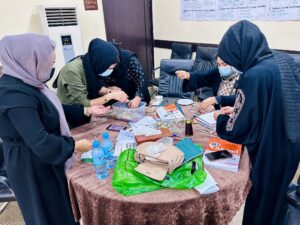
Despite widespread limitations imposed on women in Afghanistan, many have managed to continue their work across various sectors, even creating job opportunities for other women.
In this report, Salam Watandar interviewed 26 active women in business, industry, healthcare, media, and agriculture. The report reveals that some women have been able to seize limited opportunities and continue their work under difficult circumstances.
Among the women interviewed, nine are involved in business and industry, seven in healthcare, six in agriculture, and four in media.
Karima Rahimyar, head of the “Afghan Women’s Vocational Education Services Institute” and director of the “Pioneering Board of Afghan Women,” says that since the collapse of the republic system, she has continuously worked to create job opportunities and provide advisory services to women.
She does not view the imposed restrictions as an obstacle to the overall growth of women and believes that even within limitations and challenges, opportunities for women exist. She said: “I have expanded my work and we help women whose daughters have been banned from education, those struggling financially, or even those who sell their children. We employ women whose mental and physical well-being has been affected, offering them work and providing free consultations.”
Shukriya Shams, a businesswoman in the clothing production sector, shares the same belief that women should not succumb to their circumstances. “After the collapse of the regime, I decided to expand my business, and now 30 women work in our workshop. I believe women will have better days and they must not give up.”
In other sectors, women have also found ways to continue their work. Breshna Nikzad and Mahboba, both teachers, share that they pursued alternative career paths when their original jobs were affected by restrictions.
Breshna explains, “I used to work in an institute, but after women were banned from work, I didn’t give up. Now I work at a health center. If you want to succeed, you can. One must believe in their own capabilities and have hope.”
Mahboba adds, “Despite the restrictions, I’ve tried to make the most of the available opportunities. Additionally, I offer other women the chance to learn and work in my workshop so that they can become financially independent.”
However, some women, although still able to work, express concern about their professional futures given the current climate in Afghanistan.
Shamayel Mosawi, a journalist currently working in a media outlet, states, “I am worried that we may be banned from working, as this is a real possibility. If these restrictions continue, it will be detrimental to women and force them to stay home. I have no hope for my professional future.”
Halima Sediqi, another journalist working in media, says, “Journalism is about providing accurate information, but with these restrictions, we can’t do our jobs properly. If these limitations persist, they could erase women from society and their work. Given the current situation, I have little hope of continuing in the media field.”
Despite these challenges, women are still allowed to work in a few areas. However, experts in legal and social issues emphasize the significant social and economic role women play in society. They argue that women make up about half of the society, and denying them the right to work has severe consequences for society as a whole. They also stress the importance of creating alternative opportunities for women and encouraging them to seize these.
Ahmad Rashed Sediqi, a sociologist, says, “Women, as a large part of society, play a vital role in the development of all aspects of society. Women who work hard in these difficult circumstances create hope for society, and we should encourage them to contribute to the growth of our community and economy.”
Noor Aqa Shoaib, a legal expert, adds, “According to the Universal Declaration of Human Rights, the UN Charter requires states to ensure the rights of their citizens. The right to work is a fundamental human right, and governments should work to facilitate the fulfillment of this right.”
However, Zabihullah Mujahid, spokesperson for the Islamic Emirate, claims that work opportunities in necessary sectors are provided to women while adhering to Islamic law. He further highlighted that currently, 150,000 women are working in business and industry, with 5,000 women registered in the Chamber of Commerce and Industry.