KABUL (SW) – The World Food Programme (WFP) has stated that “in Afghanistan, many children go to school hungry.”
On Wednesday, January 24, on the occasion of World Education Day, WFP wrote on social media platform X that having meals is necessary for children to learn.
“On the International Day of Education, we remind the world that school meals are essential for learning.”
WFP added that it distributes nutritious biscuits to 700,000 male and female students every morning.
Widespread poverty in Afghanistan leaves most children Without food security and adequate living conditions.
UNAMA: Continued exclusion of girls from education risks isolation for Afghanistan,
On the other hand, The United Nations Assistance Mission in Afghanistan (UNAMA) has underscored the importance of equal education for all Afghan citizens by releasing a video tape in commemoration of World Education Day.
Roza Otunbayeva, the United Nations Secretary-General’s representative for Afghanistan and head of UNAMA, emphasized in the video that the ongoing exclusion of girls from education in Afghanistan will isolate the country globally and within Islamic nations. Mrs. Otunbayeva highlighted that the education of girls is not solely the desire of Western countries but is also a shared aspiration among Islamic nations.
She added: “In Afghanistan, education is considered more important than a right; this is as a basis for the future of Afghanistan. Education in Afghanistan is necessary to deal with today and tomorrow’s challenges. The ruling authorities in Afghanistan must support these rights for everyone.”
After the return of the Islamic Emirate to power, female students above the sixth grade were prohibited from attending school. However, Zabihullah Mujahid, the spokesperson of the Islamic Emirate, assures that work on the plan to reopen girls’ schools is ongoing, and there is hope for a resolution to this issue.
According to the statistics of the Ministry of Education, in the current solar year, more than 11.500 million students have been engaged in education throughout Afghanistan, with 4.24 million and 574 of them being girls.
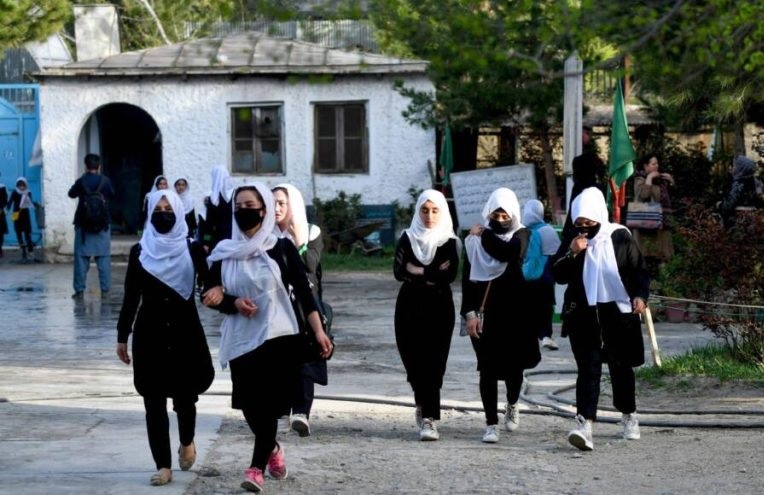
On World Education Day, the United Nations Children’s Fund (UNICEF) has also highlighted the serious challenges on the road to education in Afghanistan by publishing a report. According to the UNICEF report, only 13% of children in grades two and three have reading skills, despite 200,000 new students expected to enroll in primary schools this year.
In its report, UNICEF said that in more than half of the schools in Afghanistan, students do not have access to sanitary drinking water and toilets.
The de-facto government, however, assures efforts to standardize education, solve the challenges facing education in Afghanistan, and work on the plan to reopen girls’ schools.
“The Islamic Emirate has tried to develop the madrasas and schools, to build high schools in the districts and villages throughout Afghanistan, and there have been positive changes in the field of education. Efforts have been made to ensure that education, both in terms of quality and innovation should be positively changed as the international standards, and deficiencies should be eliminated,” said Mujahid.
Officials from the Ministry of Education also say that in order to expand education throughout Afghanistan in the last two years, 972 new schools and 200 local schools have been established in different provinces.