KABUL (SW) – A number of women who previously worked in various institutions, including the Ministry of Education, women’s rights organizations, non-governmental institutions, universities, media, telecommunication companies and other institutions, say that they are faced with extreme economic hardships.
The first institutions that were closed by the government of the Islamic Emirate after the recent political developments were the institutions defending women’s rights. Zahra used to work at the Afghan Women’s Network before the regime change. She said that with the salary she received, she could cover all the living expenses of her family, but now poverty has not only made life difficult for her, but has also made her entire family face many challenges.
Zahra added: “After the arrival of the Islamic Emirate, I lost my job and the place where I worked was closed by the Islamic Emirate and women were not allowed to work again. With the loss of my job, the economic situation of my family has become very grim. I earned enough to support my family, I was the breadwinner of my entire family.”
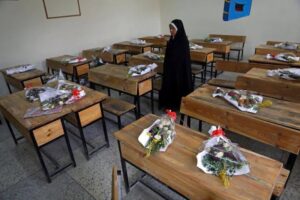
Educational institutions, including the ban on female students above the sixth grade, followed by the ban on girls’ education in universities, have also caused the unemployment of teachers and professors in schools and universities.
Shiba, who was a teacher in one of the private schools in Kabul, lost her job due to the ban on the education of girls above the sixth grade. She said that unemployment has put her in a bad economic situation and she is now unable to pay for her children’s education. Shiba added: “In general, once you earn a living and suddenly you become unemployed, the economic situation gets worse so the life is over.”
Marwa, a teacher who was able to pay the living expenses of all her family members with a salary of eight thousand afghanis, said that after the ban on the education of middle and high school girls, she became unemployed and in debt and her life became bitter. “I was the only person in the house working and now I have no income as I lost my job.”
Nastern (pseudonym) is another teacher who became unemployed after the political changes in the country. She also takes care of her younger siblings. “I am facing problems because I am the guardian of my brothers and sisters and our financial situation is really bad. Our life is going very badly.”
Khatire and Sima (pseudonyms) are two other ladies, one of whom worked as a teacher and the other in the gender department of a private university. They say that they have become unemployed due to the work and educational restrictions on women. They consider themselves like birds without food and water, imprisoned in a cage.
In continuation of the increasing restrictions on women, the Ministry of Economy of the Islamic Emirate banned the activity of women in non-governmental institutions last year. As a result, many women who worked in these institutions became unemployed.
Sabra Sidi, who was an employee of a non-governmental organization, said that now she is unemployed and is always at home, and she is not even able to meet her living expenses. She added: “Not only can we not help the family, even the necessities that we ourselves have are not provided, and this situation is very worrying. Not only to us, but to all the women who have lost their jobs.”
Rukhsar is another lady who used to work in one of the telecommunication firms and now she is unemployed due to the ban on women’s work. She says that life in suffering and poverty has become difficult and exhausting for her and has robbed her of the ability to stand. Rukhsar said that Afghan women have been forgotten and have no support.
She said: “I lost my job with the recent developments in the country. The job was in one of the telecommunication companies. The economic situation is much worse than before. I earned 12,000 afghanis a month and was the breadwinner of my family.”
Unemployment and poverty have not only affected women teachers or employees of institutions, but a number of female journalists have also become unemployed after the recent developments and are in a dire livelihood situation.
Two female journalists in Balkh and Badakhshan, who did not want their names written in the report, said that they have become unemployed due to the restrictions imposed on female journalists and the closure of a number of media outlets.
Sepna Sahar, a reporter at one media House in Kabul, who has lost her job said: “Currently, we do not earn even 10 afghani because we are at home and we are facing many problems. Our life has become more difficult.”
The industry and trade sector is one of the sectors where a number of women still work. However, these women also complain about the deterioration of their business and income.
Nafisa Danesh, a ruby and saffron trader, said: “Unfortunately, if the situation continues in the same way, in the next three to four months, everything that women have in the bazaar, have shops, have production, or have offices, they will be forced to close altogether because the lack of market and lack of customers causes people to fail.”
Sania Mohammadi, one of the industrialists, said that in the past, she used to export her products to Russia and Germany, but now her business has failed.
Meanwhile, Pashtun Amiri, a board member of Afghanistan Women’s Chamber of Commerce and Industry, expressing concern about the current situation, said that the restrictions imposed on women and their lack of support have caused the stagnation of industry and business among women.
She added: “The sales markets that we had in Bagh Zanana and Bagh Babar, women do not come there anymore. Therefore, we don’t have any sales, we don’t have any work.”
Although most of the big institutions that support women have been closed, but the Network for Women, which is still active, expresses concern about the unfortunate economic situation of women.
Fariduddin Nouri, the head of this institution, said that they do not have a detailed study of the economic situation and the number of unemployed women, but 80% of the women who worked in this institution are now unemployed.
He added: “Of the 500 people who were employees of this institution, now that number has decreased to 110 people. A large number of women Re getting unemployed every day for about two years.”
Analysts consider the overwhelming unemployment of women as a big warning for the country’s economy.
Jabar Safi, one of the experts on economic issues, told Salam Watandar that women worked in the civil, military, institutions, trades, handicrafts and various other sectors and had a positive role in the economy of their families. “With the new government, the ban on women has had a negative impact on trade and production.”
Mohammad Shabir Bashiri, another expert on economic issues, told Salam Watandar that a huge number of women have lost their jobs. “This issue caused poverty in families, and they fell into the circle of poverty as singles who lost their jobs in Afghanistan, and in the same way, the number of beggars in the country increased, and the level of poverty and unemployment rate increased.”
The government of the Islamic Emirate has not announced any plans for women to return to work.
Abdulrahman Habib, the spokesman of the Ministry of Economy, said that they do not have accurate statistics on the number of women who have become unemployed, and that the suspension of women’s work will continue until further notice. He added: “In this case, so far the previous letter issued by the Ministry of Economy can be applied and implemented. The exact statistics in this case are not available at the moment.”
ENDS